

Christianity has been a formative and continuously changing influence on what became the United States, present from Spanish Catholic missions in the 1500s through today’s immigrant-driven pluralism. Scholars like Mark Noll and archival collections at the National Archives and Library of Congress document a history that shaped laws, reform movements, and culture, but never as one unified church. What follows traces that arc from colonial missions to modern debates over faith and public life.
TL;DR:
- Religious identity in America was shaped early on by Spanish missions in Florida and the Southwest before English colonization began.
- The founding era reflected a complex religious landscape without a national church, and the Constitution explicitly protected religious freedom and barred religious tests.
- The Great Awakenings democratized Christianity and spurred social reforms, leading to the growth of evangelicals and the expansion of denominations like Baptists and Methodists.
- Immigration, slavery, and the Black church decentralized and diversified American Christianity, establishing institutions like Catholic parishes and Black religious networks with civic influence.
- By the late 19th and 20th centuries, institutionalization, suburban growth, and immigration further transformed American faith, now characterized by pluralism, local innovation, and shifting denominational lines.
Table of Contents
- Where Did Christian History in America Begin?
- What Role Did Faith Play in the Revolutionary Era and the Founding?
- How Did the Great Awakenings Reshape American Christianity?
- How Did Immigration, Slavery, and the Black Church Reshape 19th-Century Christianity?
- How Did American Christianity Build Its Institutions?
- What Changed for Christianity in 20th-Century America?
- What Does American Christianity Look Like Today?
- Was America Founded as a Christian Nation?
- What This History Means for Christian Witness Today
- Sources
Where Did Christian History in America Begin?
Christian history in America did not start at Plymouth Rock. Spanish Franciscan and Jesuit missionaries planted the faith in Florida and the Southwest decades before English Protestants ever saw the Atlantic coast, and their mission networks left behind some of the earliest printed religious material in the region.
St. Augustine, founded in 1565, anchored a chain of Spanish missions across Florida that predates Jamestown by more than forty years. Catholic liturgical printing tied to these mission networks, including material connected to Mexico City presses as early as 1556, came well before the Puritans ever sang a psalm on New England soil, according to Library of Congress records on missionary activity in the American West. French Jesuits pushed into the Great Lakes and Mississippi Valley around the same era, building their own network of missions among Native communities.
English settlement brought a different pattern entirely. Jamestown (1607) carried the Church of England into Virginia as an established colonial church, while the Massachusetts Bay Colony (1630) built a Puritan commonwealth that fused civil law with congregational theology. Quakers took root in Pennsylvania under different assumptions about liberty of conscience, and Swedish Lutherans settled pockets of the Delaware Valley. Each region built religion into its charter and economy differently:
- Florida and the Southwest: Spanish Franciscans and Jesuits built mission compounds tied to colonial administration and Native evangelization.
- New France territories: French Jesuits established missions along the Great Lakes and Mississippi corridors, often working alongside fur trade networks.
- Virginia: The Church of England became the established, tax-supported faith, closely tied to colonial governance.
- Massachusetts Bay: Puritan congregationalism shaped both civil law and church membership, blending governance and doctrine.
- Pennsylvania: Quaker settlers built a colony explicitly organized around religious toleration, an outlier for its time.
- Delaware Valley: Swedish and Dutch Lutheran and Reformed communities added further denominational variety early on.
These weren’t footnotes. They were the blueprint. Colonial charters wrote religious identity into their founding documents, and the regional patterns set in the 1500s and 1600s echoed for centuries in how different parts of the country related to faith, government, and each other.
What Role Did Faith Play in the Revolutionary Era and the Founding?
The founders did not write a Christian nation into the Constitution, but they didn’t write a secular one either. Public documents from the Revolutionary era carry religious language, Providence, Creator, and divine judgment, that reflected a culture where faith and civic virtue were assumed to be connected, even as the men writing those documents held wildly different personal beliefs.
Records held by the National Archives on religion and the Founding Fathers show founders who ranged from devout Christians to theistic rationalists who doubted core Christian doctrines while still affirming a providential God active in human affairs. That range matters because it explains the settlement they built:
- No national church. Unlike England, the new republic refused to establish a single, government-funded denomination.
- First Amendment protections. Congress was barred from either establishing a religion or prohibiting its free exercise.
- No religious tests for office. Article VI barred the federal government from requiring religious qualifications for public service, a sharp break from colonial precedent in places like Virginia and Massachusetts.
- State-level variation persisted. Some states kept religious establishments or tests for years after ratification, showing the national settlement didn’t erase local practice overnight.
The founding wasn’t one moment. Understanding it requires attention to three separate origins, the colonial charters, the Revolution, and the constitutional order, because religious meaning shifts depending on which moment you’re examining, according to The Heritage Foundation’s analysis.
The Heritage Foundation’s report lands on a balanced conclusion: Christian ideas clearly shaped many founders’ moral vocabulary and assumptions about virtue, but the founders stopped well short of building a theocracy. That’s the tension worth holding onto. Religion mattered enormously to the founding generation’s worldview without ever being formally established as the law of the land.
How Did the Great Awakenings Reshape American Christianity?
Revivalism did more to democratize American religion than any single doctrine or denomination could have on its own. The Great Awakenings pulled faith out of established churches and put it into fields, tents, and frontier camps, and the results reshaped everything from denominational size to social reform.
Here’s how the sequence unfolded:
- The First Great Awakening (1730s–1740s) swept through the colonies with preachers like Jonathan Edwards and George Whitefield emphasizing personal conversion over inherited church membership.
- That emphasis on individual conversion undercut the authority of established colonial churches, since a person’s standing before God no longer depended on baptism records or parish rolls.
- The Second Great Awakening (roughly 1790s–1840s) followed with camp meetings on the frontier, drawing thousands to outdoor revivals in places like Cane Ridge, Kentucky.
- Baptists and Methodists expanded fastest during this period because their circuit-rider model and lay leadership fit frontier conditions better than churches requiring seminary-trained clergy.
- That expansion fed directly into reform movements, with converted believers organizing against slavery, alcohol abuse, and other social ills they saw as moral failures needing correction.
- Educational institutions followed the revivals, as denominations built colleges and seminaries to train the next generation of preachers and reformers.
The awakenings helped expand evangelical denominations and catalyzed reform movements throughout the 18th and early 19th centuries, according to Yale University’s guide to American Christian history. What started as an emotional appeal for personal salvation ended up restructuring which denominations dominated American religious life for the next century.
How Did Immigration, Slavery, and the Black Church Reshape 19th-Century Christianity?
The 19th century broke American Christianity apart in ways the founding generation never anticipated. Catholic immigration, sectional conflict over slavery, and the rise of the independent Black church each pulled the religious landscape in different directions at once.
Irish, German, and latter Italian and Eastern European immigration tripled Catholic populations between 1850 and 1890, according to the Smithsonian’s National Museum of American History. That growth forced rapid institution building. Catholic dioceses built parish schools, hospitals, and mutual aid societies largely because Protestant-dominated public institutions weren’t designed to serve Catholic immigrant communities. Nativist backlash followed almost immediately. The Know-Nothing movement of the 1850s organized explicitly around anti-Catholic and anti-immigrant sentiment, winning local and state offices on platforms that treated Catholic immigration as a threat to Protestant American identity.
Slavery split denominations along sectional lines well before the country itself split. Southern Baptists and Southern Methodists broke from their national bodies in the 1840s over whether slaveholders could serve as missionaries and ministers, a theological rupture that mirrored the political one coming a generation later. Some Southern clergy built elaborate biblical defenses of slavery, while abolitionist Christians, many rooted in Quaker, Congregationalist, and revivalist traditions, framed emancipation as a gospel imperative.
Out of that same era came the independent Black church, arguably the most consequential religious institution the country produced. Denied real authority in white-led congregations, Black Christians built their own denominational structures, the African Methodist Episcopal Church chief among them, that functioned as spiritual sanctuaries and centers of political organizing at once.
The Black church became something white denominations never quite replicated: a single institution serving as worship space, mutual aid network, school, and political headquarters, all under one roof, often the only roof a community fully controlled.
A few threads from this period carried forward for generations:
- Catholic parish and school systems became permanent fixtures of American urban life, not temporary immigrant accommodations.
- Political nativism against Catholics recurred in later decades, echoing the Know-Nothing pattern well into the 20th century.
- Denominational splits over slavery in the 1840s often outlasted the war itself, with some regional divisions persisting for over a century.
- The Black church model of combined spiritual and civic leadership directly shaped 20th-century civil rights organizing.
How Did American Christianity Build Its Institutions?
By the late 19th century, American Christianity stopped being primarily a movement of revivals and started becoming a network of institutions. Seminaries multiplied, denominational bureaucracies formed mission boards and publishing houses, and churches began organizing formal responses to industrial poverty rather than relying solely on individual conversion to fix social ills.
The Social Gospel movement captured this shift best. Preachers and theologians argued that saving souls wasn’t enough if cities were producing child labor, slum housing, and unsafe factories. Churches responded by building settlement houses, urban missions, and charitable organizations aimed at systemic conditions rather than individual sin alone. This period also saw the first serious ecumenical cooperation, with national councils bringing together denominations that had spent decades competing for converts on the frontier.
Several institutional patterns emerged that still shape American church life:
- Seminary education professionalized, moving clergy training away from apprenticeship models toward formal theological degrees.
- Denominational mission boards coordinated both domestic frontier evangelism and overseas missionary work under centralized administration.
- Publishing houses and Sunday school curricula standardized religious education across thousands of congregations at once.
- Faith-based social services, orphanages, hospitals, and settlement houses, became a primary channel through which churches engaged public problems.
- Early ecumenical councils brought competing denominations into shared advocacy on issues like temperance and labor conditions.
Institutionalization changed who held religious authority. Where 18th-century revivalists answered mainly to their own sense of calling, 20th-century clergy increasingly answered to denominational hierarchies, seminary credentials, and national boards. That trade-off brought consistency and resources, but it also distanced everyday believers from some of the spontaneous, lay-driven energy that had powered the Great Awakenings.
What Changed for Christianity in 20th-Century America?
Postwar America saw a religious boom that reshaped where and how people practiced faith. Suburban expansion after World War II filled new subdivisions with new congregations, and church membership climbed through the 1950s in a pattern that planted the seeds for what would eventually become the megachurch model.
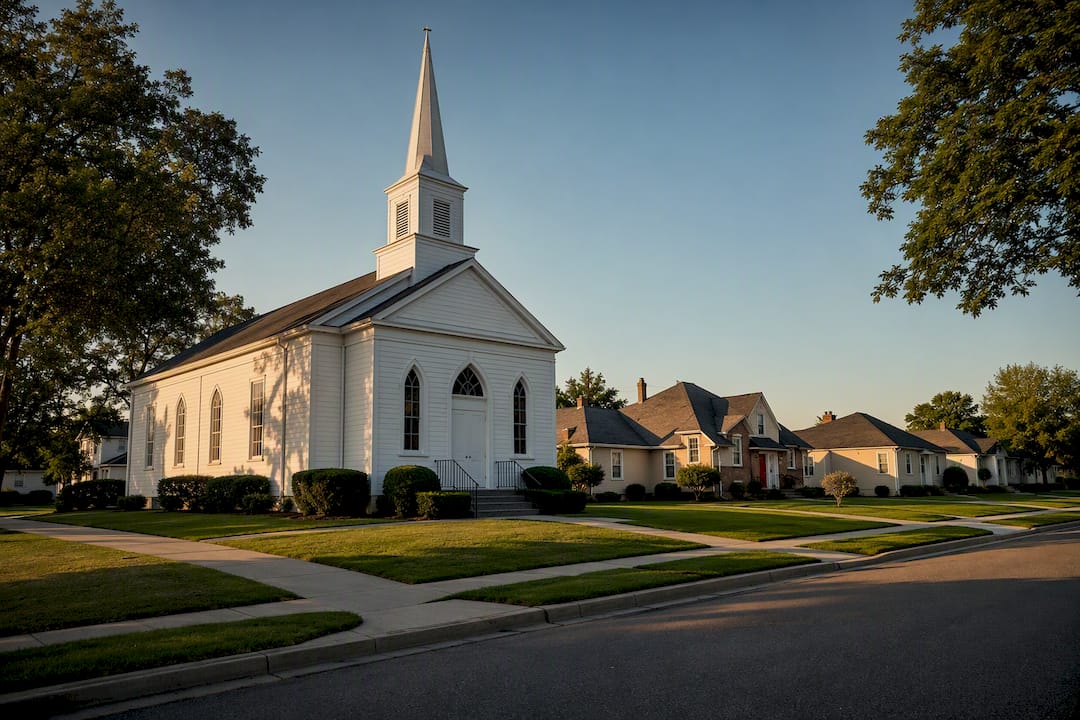
That boom masked a deeper shift already underway. Mainline Protestant denominations, Methodists, Presbyterians, Episcopalians, began a numerical decline that accelerated through the second half of the century, even as evangelical and Pentecostal churches grew. The reasons weren’t simple. Mainline theological liberalism, changing generational attitudes, and denominational structures that struggled to adapt to suburban and later exurban growth all played a part.
Statistic snapshot: The postwar decades produced two contradictory trends at once, overall church attendance climbing through the 1950s while mainline denominations began the slow membership decline that continues into the present, a pattern Yale’s American Christianity resources trace across the century’s institutional records.
Two other developments defined the era just as much as suburban growth:
- The Black church anchored the civil rights movement. Leaders like Martin Luther King Jr. drew directly on Black church traditions of preaching, organizing, and moral witness built over the previous century.
- Organized evangelical political activity emerged from the 1970s onward, as evangelical leaders built national coalitions that shifted how Christian identity intersected with party politics for the first time at this scale.
- Pentecostal and charismatic movements grew rapidly, spreading emotional, Spirit-centered worship styles well beyond their early 20th-century origins into mainstream evangelical and even some Catholic circles.
- Megachurches began forming in the later decades, consolidating suburban growth into large, multi-service congregations that operated more like institutions than traditional parishes.
The century that started with revival tents ended with satellite campuses and cable television ministries. The forms changed. The underlying pattern of American Christianity constantly reinventing its outward expression did not.
What Does American Christianity Look Like Today?
Religious pluralism defines 21st-century American Christianity more than any single denomination or movement. Immigration has reshaped congregational life again, this time bringing Christian traditions from Latin America, Africa, and Asia into direct contact with older American denominational structures.
Immigrant Christianity’s growth reflects broader ties to majority-world Christian movements, reshaping worship styles, languages, and congregational life across the country, according to the Smithsonian’s resources on early American religion. Immigration has also shifted the religious marketplace itself, with new arrivals often bringing more theologically conservative and charismatic worship styles than the American congregations receiving them, according to Yale’s Reflections project on immigration.
The much-discussed rise of religious “nones,” those who claim no religious affiliation, tells a more complicated story than headlines suggest. Surveys consistently show a gap between declining formal affiliation and persistent private belief or practice, particularly among younger adults who distrust institutions more than they reject faith outright. Historians note that Christianity has unified and divided American life in equal measure. It provided shared moral language while also provoking sectarian conflict and reform impulses, a pattern documented in Baylor University Press’s histories of American Christianity.
A few trends worth watching heading further into this decade:
- Immigrant-led congregations are growing even as older, historically white denominations shrink.
- Denominational realignment continues, with congregations splitting or merging over theology, worship style, or social issues rather than staying locked into inherited labels.
- Local innovation is outpacing national structures, as individual congregations experiment with formats denominational headquarters never anticipated.
- Practice and belief are diverging for many younger adults, complicating any simple story about American secularization.
Was America Founded as a Christian Nation?
Both sides of this debate have real evidence, and both miss something if taken alone. The “Christian founding” position points to the moral vocabulary of founding documents, widespread religious practice among the colonial population, and the founders’ assumption that virtue required some religious grounding.
The “plural founding” position points to the First Amendment’s establishment clause, the deliberate absence of religious tests for federal office, and the genuine theological diversity among founders, from orthodox Christians to deists skeptical of the Bible’s supernatural claims. Both readings draw on real historical evidence. Neither one, alone, captures the full picture.
- Founders overwhelmingly assumed some connection between religion and public virtue, even when they disagreed on doctrine.
- The Constitution deliberately avoided establishing any single church, a structural choice distinct from personal religious sentiment.
- State-level religious establishments persisted for years after the federal Constitution, showing the “founding” wasn’t one clean moment.
- Christian ideas influenced many founders’ moral reasoning without producing anything resembling a theocracy.
Pro Tip: When this debate comes up in conversation, resist picking a side immediately. Ask which “founding” the other person means, the colonial charters, the Revolution, or the Constitution, since each moment tells a different part of the story.
What This History Means for Christian Witness Today
Studying this history humbles me. Every generation of American Christians has claimed to represent the “true” faith while contradicting the generation before it. Puritans who fled persecution built colonies that persecuted others. Abolitionist Christians and pro-slavery Christians both quoted the same Bible. That should make anyone pause before assuming today’s cultural moment is uniquely dangerous for people of faith.
What history teaches is that Christian witness has always been public, visible, and occasionally uncomfortable, from mission bells in Spanish Florida to camp meeting revivals to Black church pulpits during the civil rights movement. Boldfaithapparel exists in that same tradition of visible testimony, built on the conviction that faith is not just believed, it’s lived, and lived faith tends to show up in public, not just in private devotion.
Practically, that means showing up. Volunteer at a local shelter. Wear your faith where people can see it, whether that’s a shirt reading “Faith Over Fear” or a quiet act of service nobody photographs. History shows that Christianity’s deepest influence in America rarely came from political power alone. It came from ordinary believers willing to be visibly, sometimes awkwardly, faithful in public. That’s still the assignment.
— Larry
Sources
Mark Noll’s A History of Christianity in the United States and Canada remains the standard academic synthesis. Pair it with the National Archives on the Founders, Library of Congress mission records, and The Heritage Foundation’s founding report for primary and scholarly context.
Faith has always looked for ways to be seen, and that hasn’t changed. Boldfaithapparel carries that same conviction into everyday life through apparel built for bold, visible testimony: T-shirts and hoodies carrying messages like “Faith Can Move Mountains,” “Jesus Saves,” “Not My Strength but His,” and “Jesus the Way, the Truth, and the Life, John 14:6,” alongside patriotic faith designs that echo the same civic religious spirit found throughout this country’s history. Explore the full collection at Boldfaithapparel and pair it with pieces from partners like Gulf of America’s patriotic apparel line if you want your wardrobe to say something true about both your faith and your country. FREE DELIVERY applies storewide, no complicated fine print required.


