

The clearest examples of repentance in the Bible are David, Jonah and the people of Nineveh, the Prodigal Son, the tax collector in Luke 18, Peter, Zacchaeus, Saul of Tarsus, Manasseh, and Ahab, each showing a heart that turns from sin toward God and proves it through changed action. Scripture treats repentance as more than regret. It is a decisive redirection of a life, and every one of these stories shows what that redirection actually looks like on the ground, whether in a king’s ashes, a fisherman’s tears, or a tax collector’s sudden generosity.
Here are the examples worth knowing first:
- David confesses adultery and murder after Nathan’s confrontation (Psalm 51; 2 Samuel 12).
- Jonah and Nineveh turn from judgment through prayer and citywide fasting (Jonah 2–3).
- The Prodigal Son returns home after squandering his inheritance (Luke 15:11–32).
- The tax collector beats his chest and asks for mercy instead of boasting (Luke 18:9–14).
- Peter weeps after denying Christ, then is restored at the shore (Luke 22:61–62; John 21:15–17).
- Zacchaeus repays what he stole, making restitution well beyond the original amount (Luke 19:1–10).
- Saul of Tarsus is knocked to the ground on the Damascus road and becomes Paul (Acts 9:1–19).
- Manasseh is humbled in Babylonian chains before restoring worship in Jerusalem (2 Chronicles 33:10–20).
- Ahab tears his clothes and puts on sackcloth after Elijah’s rebuke (1 Kings 21:27–29).
One name belongs on this list for a different reason. Judas Iscariot felt crushing remorse and returned his silver, but Matthew 27:3–5 records despair, not repentance. His story stands as a warning about what turning to God is not.
Table of Contents
- What Are the Clearest Examples of Repentance in the Bible?
- Six Close Readings of Repentance in Action
- What Does Biblical Repentance Actually Mean?
- What Are the Signs of Genuine Repentance?
- What Repentance Is Not
- How Can You Practice Repentance Today?
- Repentance Lessons Worth Remembering
- Frequently Asked Questions
- Sources
What Are the Clearest Examples of Repentance in the Bible?
Scripture does not treat repentance as a single formula. It shows up as a private confession scrawled in a psalm, a national fast declared by royal decree, a runaway son’s rehearsed apology, and a criminal’s dying request. What ties these examples together is not the emotion attached to them but the direction of the turn: away from self-rule, toward God, and into a changed pattern of living.
The table below gathers the individual and corporate examples readers most often search for, with their primary references, so you can go straight to the text.
| Example | Reference | Type |
|---|---|---|
| David | Psalm 51; 2 Samuel 12 | Individual |
| Jonah and Nineveh | Jonah 2–3 | Corporate/national |
| The Prodigal Son | Luke 15:11–32 | Individual (parable) |
| The tax collector | Luke 18:9–14 | Individual (parable) |
| Peter | Luke 22:61–62; John 21:15–17 | Individual |
| Zacchaeus | Luke 19:1–10 | Individual |
| Saul of Tarsus (Paul) | Acts 9:1–19 | Individual |
| Manasseh | 2 Chronicles 33:10–20 | Individual (royal) |
| Ahab | 1 Kings 21:27–29 | Individual (royal) |
| Judas Iscariot | Matthew 27:3–5 | Contrast (remorse, not repentance) |
| Israel (recurring cycle) | Judges 2:11–19; Nehemiah 9 | Corporate/national |
Notice how many of these involve someone in a position of power. Kings, apostles, and a tax collector who worked for Rome all appear here, which tells you something important: repentance is not reserved for people with obviously broken lives. It reaches into palaces and pulpits just as often as it reaches the desperate.
Six Close Readings of Repentance in Action
Lists tell you where to look. These six readings show you what happened when Scripture’s most cited repentance stories actually unfolded.
David’s confession after Nathan’s confrontation
David had a year to hide his affair with Bathsheba and the murder of her husband before the prophet Nathan confronted him with a parable about a stolen lamb. David’s response, once he understood the parable was about him, was immediate: “I have sinned against the LORD” (2 Samuel 12:13). Psalm 51, traditionally linked to this event, goes far beyond that single line.
Have mercy on me, O God, according to your steadfast love; according to your abundant mercy blot out my transgressions. Wash me thoroughly from my iniquity, and cleanse me from my sin.
David does not minimize what he did, negotiate with God, or point to his crown as an excuse. He asks for a clean heart, not just a clean record, which is the marker Bible study resources point to as the model of real repentance. The takeaway: genuine repentance names the sin specifically and asks God to change the person, not just erase the consequence.
Jonah and Nineveh’s citywide turning
Jonah’s own repentance inside the fish (Jonah 2) is often overshadowed by what happens next: an entire pagan city changes course. When Jonah finally preaches judgment in Nineveh’s streets, the king removes his robe, sits in ashes, and issues a decree that everyone, human and animal, fast and wear sackcloth. Jonah 3:8 records the king’s own instruction: “let everyone turn from his evil way and from the violence that is in his hands.”
God saw what they did, how they turned from their evil way. And God relented of the disaster that he had said he would do to them, and he did not do it.
This is corporate repentance on a national scale, and Nineveh’s fasting and sackcloth illustrate that a whole community, not just an individual heart, can turn. The application: repentance is not only a private transaction. It can move through a household, a church, or a nation when leaders model it first.
The Prodigal Son’s rehearsed return
Jesus tells the story of a son who demands his inheritance early, wastes it in reckless living, and ends up feeding pigs, a job about as low as a Jewish listener could imagine. Luke 15:17 says he “came to himself,” a phrase that captures repentance as waking up to reality rather than simply feeling bad about consequences.
I will arise and go to my father, and I will say to him, Father, I have sinned against heaven and before you. I am no longer worthy to be called your son.
He rehearses a speech, expecting to be hired as a servant. His father runs to meet him before he finishes talking. The application here: repentance does not have to be eloquent or complete before God responds. The turn itself, however clumsy, is what matters.
Peter’s collapse and restoration
Peter swore he would die before denying Jesus, then denied him three times in one night. Luke 22:61 records the moment it broke him: Jesus “turned and looked at Peter,” and Peter “went out and wept bitterly.” That was not the end of his story. After the resurrection, Jesus asks Peter three times, once for each denial, “do you love me?” and each time commissions him again: “feed my sheep” (John 21:15–17).
Peter’s repentance is defined by what happens after the tears. He does not disappear from ministry. He becomes the lead voice at Pentecost weeks later, preaching to the same crowd that watched Jesus die. The application: godly sorrow does not end in shame. It ends in restored purpose.
Zacchaeus and immediate restitution
A wealthy chief tax collector, despised for extorting his own people on Rome’s behalf, climbs a tree just to see Jesus over a crowd. Jesus invites himself to dinner at Zacchaeus’s house, a scandal by itself, and Zacchaeus responds before Jesus even asks anything of him.
Behold, Lord, the half of my goods I give to the poor. And if I have defrauded anyone of anything, I restore it fourfold.
That is repentance measured in dollars, not just words. Luke 19:9 has Jesus declare, “today salvation has come to this house.” The application: real repentance often costs something concrete, and it moves fast once conviction lands.
Saul’s conversion on the Damascus road
Saul was not a wavering skeptic. He was actively hunting Christians for arrest and execution when a light from heaven knocked him to the ground and a voice asked, “Saul, Saul, why are you persecuting me?” (Acts 9:4). He was blind for three days before Ananias restored his sight, and from that point his entire trajectory reversed. The man who once dragged believers to prison became the New Testament’s most prolific missionary and letter writer. The application: repentance can arrive as a sudden interruption, not just a slow conviction, and it can redirect a life aimed in the exact opposite direction.
What Does Biblical Repentance Actually Mean?
The Old Testament often uses the Hebrew words shubh (to turn or return) and nacham (to be sorry or console oneself), pointing to both an emotional grief over sin and a physical reorientation back toward God. The New Testament sharpens this with Greek vocabulary that distinguishes feeling from turning.
Strong’s Greek entry 3340 defines metanoeó (metanoia) as a decisive change of mind and direction that produces conduct worthy of repentance. It is not the same word as metamelomai, which describes regret or a change of feeling without necessarily a change of direction, the word used of Judas in Matthew 27:3. Scripture also uses epistrephó, meaning to turn or return, often paired with metanoeó to describe the full motion: an inward change of mind followed by an outward turn of life.
Reading across the case studies above, four elements consistently mark genuine repentance:
- Awareness of guilt: David does not deflect Nathan’s accusation; he owns it outright (2 Samuel 12:13).
- A grasp of God’s mercy: Psalm 51:1 appeals directly to God’s “steadfast love” as the basis for forgiveness, not David’s own effort.
- Turning from sin: Nineveh’s king commands the city to “turn from his evil way” (Jonah 3:8), a physical and behavioral shift, not a private feeling.
- Persistent pursuit of holiness: Zacchaeus’s fourfold restitution and Paul’s decades of ministry both show repentance sustaining itself over years, not hours.
GotQuestions’ study on repentance frames this as a complete change of orientation, one that produces visible fruit such as changed behavior, restitution, and renewed obedience, not merely an altered mood. That distinction runs through every example in this article and separates a genuine biblical turning from a passing wave of guilt.
What Are the Signs of Genuine Repentance?
Scripture rarely leaves repentance as an invisible, internal event. It expects evidence, what John the Baptist called “fruit in keeping with repentance” (Luke 3:8) and what Paul described to King Agrippa as deeds “in keeping with their repentance” (Acts 26:20).
- Confession: David’s unqualified admission in Psalm 51 sets the standard; he never blames Bathsheba or circumstances.
- Restitution where possible: Zacchaeus repays four times what he took (Luke 19:8), turning sorrow into concrete correction.
- Changed behavior over time: Paul’s decades of missionary work, recorded across Acts, demonstrate repentance that outlasts the initial crisis.
- Symbolic public acts: Ahab tearing his clothes and Nineveh’s citywide sackcloth and fasting mark a visible break from the old direction (1 Kings 21:27; Jonah 3:5).
- Leadership in turning: Manasseh does not just repent privately. After his release from Babylon, he removes foreign altars, restores the temple, and commands Judah to serve the Lord (2 Chronicles 33:15–16), a king modeling repentance for an entire nation.
- Fruit that lasts: pseudo-repentance tends to repeat the same sin, while genuine repentance produces measurable, enduring behavioral change.
Pro Tip: Watch what a person does three months after the crisis, not three days after. Ahab’s sorrow in 1 Kings 21 bought him a delayed judgment, but nothing in the following chapters shows lasting reform, while Manasseh’s turning reshaped the rest of his reign. Time is the test emotion cannot fake.
What Repentance Is Not
Confusing remorse with repentance is one of the oldest misreadings of Scripture, and it shows up constantly in how people talk about “feeling sorry” versus actually changing course.
- Remorse is not repentance. Judas felt such crushing guilt over betraying Jesus that he returned the silver and, in despair, took his own life (Matthew 27:3–5). He never turned to God; he turned further inward, into hopelessness.
- Ritual alone is not turning. Fasting or sackcloth without a changed heart is theater. Nineveh’s fasting mattered because it was paired with the king’s explicit command to abandon violence and evil (Jonah 3:8), not because ashes have spiritual power on their own.
- Confession without change is incomplete. Pharaoh repeatedly told Moses “I have sinned” during the plagues (Exodus 9:27), then hardened his heart again once the pressure lifted. Saying the words is not the same as sustaining the turn.
- Momentary sorrow is not life reorientation. King Saul confessed to Samuel that he had sinned (1 Samuel 15:24), yet his pattern of disobedience continued, and his kingship was still torn from him. Compare that to David, whose confession in Psalm 51 marked a genuine, lasting reorientation even though he still suffered real consequences.
How Can You Practice Repentance Today?
Scripture’s examples are not just history. They form a practical pattern for anyone who wants to turn from sin toward God right now.
- Recognize and name the sin specifically. David did not generalize; he confessed exact wrongs before God (Psalm 51:3–4). Vague guilt rarely leads anywhere; specific confession does.
- Confess directly to God. Acts 2:38 ties repentance to a clear response: “Repent and be baptized every one of you.” Confession is the starting move, not an afterthought.
- Make restitution where it is possible. Zacchaeus’s fourfold repayment (Luke 19:8) shows that repentance sometimes has a price tag, and paying it is part of the turn, not separate from it.
- Seek accountability and pastoral help. Nathan confronted David face to face rather than letting him work it out alone (2 Samuel 12:1–7). If the harm involves ongoing addiction, abuse, or serious injury to others, professional counseling or pastoral guidance should be part of this step, not a substitute for it.
- Demonstrate new fruit through changed habits. James 2:17 puts it plainly: faith without works is dead. Luke 3:8 calls for “fruit in keeping with repentance,” meaning the change has to show up in ordinary, daily choices over time.
Whatever brought you to this point, Mark 1:15 and Psalm 51 both point to the same reality: God does not turn away from a broken and contrite heart. He runs to meet it, the same way the prodigal’s father did.
Why These Examples and Sources Were Chosen
These stories were selected because they appear across the canon (Old and New Testament, gospel narrative and parable, individual and national), because the text explicitly marks a turning point rather than leaving it implied, and because each one teaches something distinct about how repentance functions, whether privately, publicly, suddenly, or over years.
- Topical Bible references — , used to cross-check which examples appear most consistently across study resources.
Every claim in this article traces back to a specific verse or a linked source below, so you can verify it yourself rather than taking a summary at face value.
A Perspective on Living These Stories Out
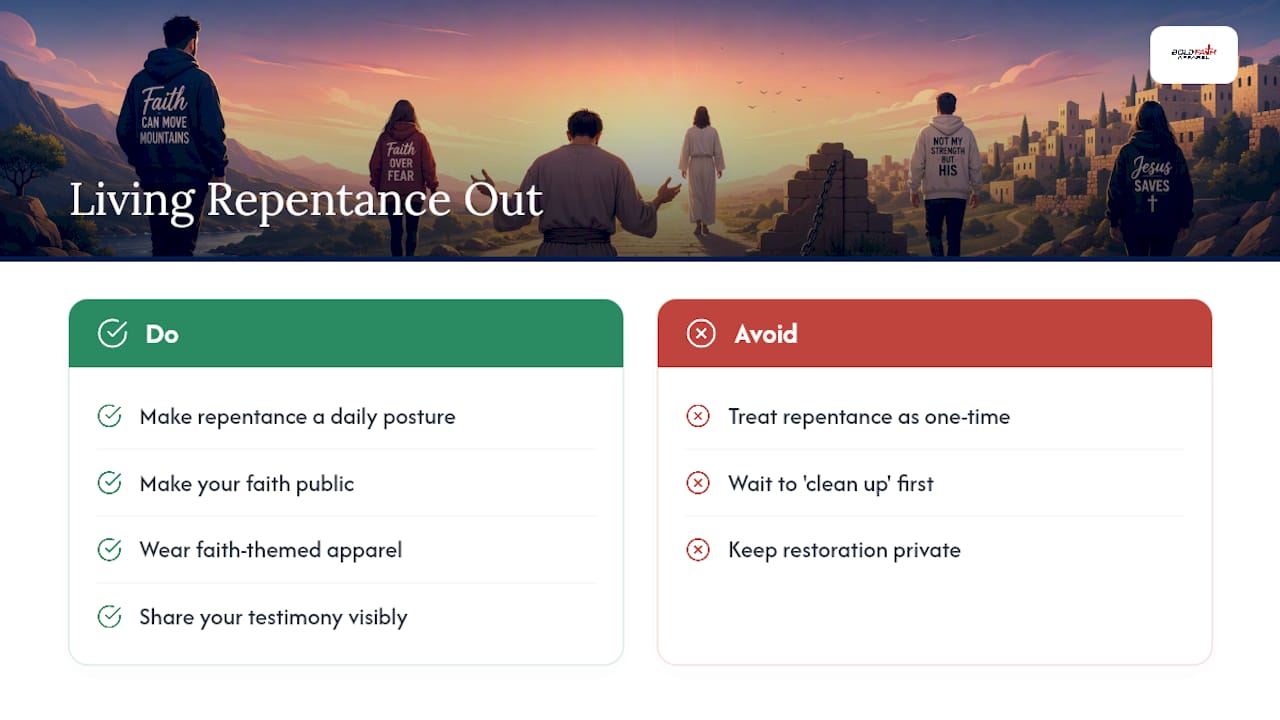
These stories stay with me because none of them describe people who cleaned themselves up first. David was already king when he fell hardest. Peter was already an apostle when he denied Christ three times in one night. What changes the story is not the size of the failure but the direction of the turn afterward, and that is the part modern readers tend to skip past, assuming repentance is a one-time transaction instead of a daily posture.
I think that is why public, visible faith matters more than people give it credit for, and wearing faith-themed hockey apparel can be a meaningful way to share that testimony. Peter’s restoration did not stay private between him and Jesus on a beach. It became public ministry within weeks. If your life has been turned around, there is something to be said for wearing that testimony where people can see it. Boldfaithapparel makes scripture shirts and hoodies precisely for that reason: a shirt that says “Jesus Saved My Life” or “Faith Over Fear” is a small, daily reminder to yourself and a quiet witness to everyone around you that the turning was real and it stuck.
Repentance Lessons Worth Remembering
Biblical repentance is a decisive change of mind that produces visible, lasting changes in behavior, not a passing wave of guilt or a private feeling that never leaves the heart.
| Point | Details |
|---|---|
| Repentance means turning, not just feeling | Metanoeó (Strong’s 3340) describes a change of mind that redirects action, distinct from mere regret. |
| David sets the pattern | Psalm 51 models specific confession, appeal to mercy, and lasting life change after Nathan’s rebuke. |
| Corporate repentance is biblical too | Nineveh’s citywide fasting in Jonah 3 shows a whole nation turning under a king’s leadership. |
| Fruit distinguishes genuine repentance | Zacchaeus’s fourfold restitution and Paul’s decades of ministry prove the turn outlasted the crisis. |
| Judas is the warning example | Remorse without turning to God, as in Matthew 27:3–5, ends in despair rather than restoration. |
| Restoration follows sincere repentance | Peter’s restoration in John 21 and God’s relenting toward Nineveh in Jonah 3:10 show mercy meeting genuine turning. |
Frequently Asked Questions
What is the clearest example of repentance in the Bible? David’s response to Nathan’s rebuke in 2 Samuel 12 and his prayer in Psalm 51 are widely treated as the clearest model, since the text records specific confession, appeal to God’s mercy, and lasting change rather than a vague statement of regret.
What is the difference between repentance and remorse in Scripture? Remorse is sorrow over consequences, as seen in Judas returning the silver in Matthew 27:3–5. Repentance, from the Greek metanoeó, involves a change of mind that redirects a person’s life toward God and produces changed behavior over time.
Does the Old Testament have examples of repentance, or is it mostly a New Testament concept? Both testaments contain clear examples. Ahab (1 Kings 21:27–29), Manasseh (2 Chronicles 33:10–20), and Nineveh (Jonah 3) all show Old Testament repentance, often marked by sackcloth, fasting, and reversed royal policy.
How does repentance relate to salvation? Acts 2:38 links repentance directly with baptism and receiving the Holy Spirit, while Mark 1:15 pairs “repent and believe” as the twin response to the gospel. Scripture treats repentance and faith as connected, not separate, steps toward salvation.
Is Judas Iscariot an example of repentance? No. Judas displays remorse, not repentance. Matthew 27:3–5 uses different Greek vocabulary than the word for genuine repentance, and his response ends in despair rather than a turn toward God’s mercy.
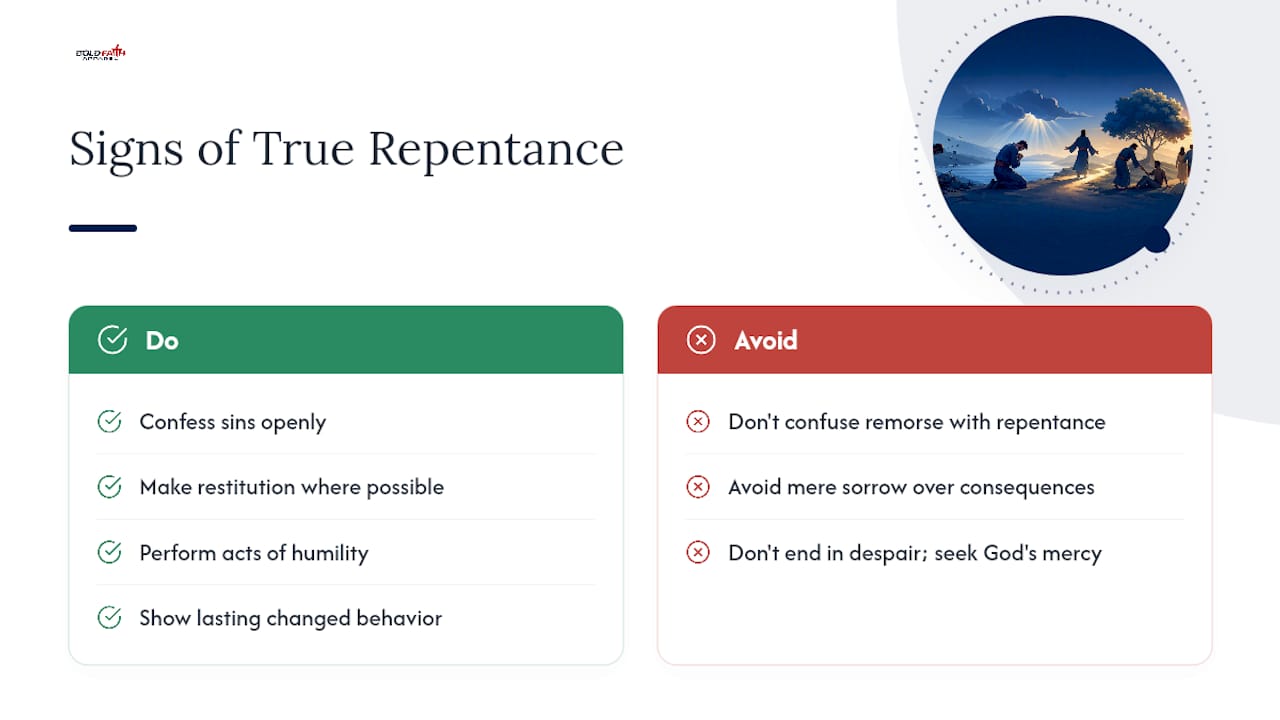
What are practical signs that someone has truly repented? Scripture points to confession, restitution where possible, symbolic acts of humility, and most importantly, “fruit in keeping with repentance” (Luke 3:8), meaning changed behavior that persists well beyond the initial moment of conviction.
Sources
- Strong’s Greek: 3340. μετανοέω (metanoeó) – Repent
- Gotquestions
- Jonah: Two stories of miraculous repentance | Grace to You (GTY)


