

Faith and patriotism are compatible when patriotism stays subordinate to God. That is the ordered love, or ordo amoris, that Christian theology has taught for centuries: love your country, but never let that love outrank your love of God. Scripture backs this balance through Romans 13 and 1 Peter 2, and the framework holds up whether you’re voting, volunteering, or just deciding what to wear on the Fourth of July.
TL;DR:
- Patriotism must remain subordinate to God’s authority, with love of country rooted in gratitude and expressed through service and prayer, not idolatry.
- Christian thinkers from Augustine to contemporary voices emphasize loving one’s country in the right order, encouraging reform and service rather than pride or uncritical loyalty.
- The key distinctions between patriotism and nationalism include ultimate authority, openness to critique, neighbor love, and exclusivity, with patriotism remaining rooted in divine hierarchy.
- Daily practices like praying for leaders, volunteering locally, and speaking about political opponents biblically help maintain ordered patriotism in civil life.
Table of Contents
- What Does the Bible Say About Faith and Patriotism?
- How Have Christian Thinkers Shaped Views on Country and Faith?
- Patriotism vs. Nationalism: How Do You Tell the Difference?
- What Does Ordered Patriotism Look Like in Daily Life?
- How Should Churches Handle Patriotic Displays and Civic Life?
- What Do Other Faiths Teach About National Loyalty?
- A Bold Faith Apparel Perspective: Wearing Your Convictions Without Losing Christ
- Wear Your Faith Without Losing Sight of Christ First
- Sources
- FAQ
What Does the Bible Say About Faith and Patriotism?
The concept of ordered love, ordo amoris, gives Christians a working rule: loves exist in a hierarchy, and country belongs below God, but above self-interest. Augustine developed this idea centuries ago, and it still shapes how theologians talk about faith and patriotism today. Love isn’t the problem. Misplaced love is.
Scripture gives specific instruction here, not just a vague principle. Romans 13 tells believers to submit to governing authorities because government exists under God’s authority. First Peter 2:17 puts it even more directly: “Honor all men. Love the brotherhood. Fear God. Honor the Emperor.” That’s a chain of command, and country sits well below “fear God.” First Timothy 2 adds a practical habit: pray for leaders, “that we may lead a quiet and peaceable life.”
The Catechism of the Catholic Church states this plainly in paragraph 2239: love and service of one’s country “follow from the duty of gratitude and belong to the order of charity.” That’s a strong claim. Patriotism isn’t a cultural preference or a political stance. It’s a moral duty rooted in gratitude, the same family of virtue as honoring your parents.
Thomas Aquinas placed patriotism within the virtue of piety, itself a branch of justice. You owe your country something, the way you owe your parents something, because you received life, protection, and formation through it. That debt doesn’t erase your higher debt to God. It sits underneath it.
A few anchor points worth remembering:
- Romans 13: government carries God-given authority; honoring it is not optional.
- 1 Peter 2:17: honor civil authority, but fear God first. The order matters.
- 1 Timothy 2:1-2: pray for leaders as a concrete act of ordered patriotism.
- CCC #2239: love of country is a duty of gratitude, part of the order of charity, not separate from it.
Pro Tip: If you’re ever unsure whether your patriotism has drifted toward idolatry, ask a simple question: would I still worship, obey, and trust God if my country failed me tomorrow? If the honest answer is no, something has slipped out of order.
How Have Christian Thinkers Shaped Views on Country and Faith?
Christian reflection on faith and patriotism didn’t start with a modern culture war. It runs through some of the most careful minds in church history, and their nuances still matter.
Augustine’s ordo amoris remains the foundation. He argued that virtue is really just loving things in the right order, and disorder, not the object of love itself, is what corrupts a person. Aquinas built directly on that, teaching that duties to country fall under piety, a species of justice owed to those who gave you life and formation, alongside duties to parents and to God.
C.S. Lewis added a crucial warning in The Four Loves. He didn’t condemn patriotism. He called it a “love of country” worth having. But he warned that this love “becomes a demon when it becomes a god,” turning from a source of service into a justification for cruelty or blind loyalty.
Contemporary voices carry the same tension forward:
- Daniel Darling defines Christian patriotism as love of country “manifested in loyalty, service, and giving honor,” while staying open to reform.
- Cardinal McElroy, speaking at a Mass marking the nation’s 250th anniversary, argued that patriotism should be shaped by the Beatitudes and should lead to reform rather than complacency, in a homily on the meaning of patriotism.
The through line across sixteen centuries, from Augustine to a 2026 anniversary Mass, is remarkably stable: love your country, keep it under God, and let that love push you toward service and correction rather than pride.
Patriotism vs. Nationalism: How Do You Tell the Difference?
Patriotism and nationalism can look identical from the outside. A flag, an anthem, a sense of belonging. The difference shows up in what each one demands of you.
Patriotism loves a country while keeping God as the final authority. It welcomes critique, serves the common good, and treats people outside the nation as neighbors still worthy of love. Nationalism inverts the order. It treats the nation itself as sacred, resists correction, and often narrows neighbor-love down to insiders only. The Gospel Coalition draws exactly this line, warning that Christian nationalism risks making the nation central to redemptive history, a role Scripture reserves for the church and for Christ.
Four practical tests separate the two:
- Ultimate authority. Patriotism submits the nation to God’s judgment. Nationalism submits God’s people to the nation’s judgment.
- Openness to critique. Healthy patriotism invites reform and correction. Nationalism treats criticism of the country as betrayal.
- Neighbor love. Patriotism extends love beyond national borders. Nationalism often narrows love to those who share your identity.
- Exclusivity claims. Patriotism says the nation is worth serving. Nationalism says the nation defines who counts as fully human or fully faithful.
Watch for specific warning signs: leaders treated as untouchable, entire groups of people demonized as enemies of the country, or slogans that quietly equate national loyalty with salvation itself. Any of these signals that patriotism has curdled into something closer to idol worship.
Pro Tip: In church settings, keep political speech in the category of conscience formation, not endorsement. Teach people how to think biblically about civic life; resist telling them exactly who to vote for. The moment a pulpit starts sounding like a campaign podium, patriotism has crowded out the gospel.
What Does Ordered Patriotism Look Like in Daily Life?
Ordered patriotism isn’t abstract. It shows up in specific, repeatable habits that any believer can start this week.
Service is the clearest expression. Volunteering at a local shelter, serving on a school board, showing up for a neighborhood cleanup, these are small acts of gratitude that don’t require a political party. Christian patriotism, according to Darling’s framing, is patriotism expressed through loyalty and service rather than slogans. That kind of service crosses partisan lines almost by definition, because a hungry neighbor doesn’t care how you voted.
Civic habits matter just as much. Study how your local government actually works before you complain about it. Vote with a conscience shaped by Scripture and prayer, not by tribal reflex. And take 1 Timothy 2 seriously: pray for leaders by name, including ones you didn’t vote for. That single habit does more to reorder your heart than any amount of political debate.
A few concrete practices worth building into a normal week:
- Read one local government agenda or school board update per month.
- Pray by name for a specific elected official, especially one you disagree with.
- Volunteer with an organization that serves people regardless of their politics.
- Speak about political disagreements the way you’d want to be spoken about.
Personal witness rounds this out. How you talk about political opponents in casual conversation says more about your theology than any bumper sticker. Visible testimony, whether that’s a conversation, a shared meal, or something as simple as a T-shirt with a faith-affirming message, works best when it points to Christ rather than a party.
Pro Tip: Before you share a political post, ask whether it would embarrass you if a struggling neighbor read it. If the answer is yes, that’s usually a sign to reword it, or skip it entirely.
How Should Churches Handle Patriotic Displays and Civic Life?
Congregations face a real, practical question every summer: how patriotic should a worship service get? The guiding principle is simple even when the application gets messy. Worship stays Christ-centered, and no service should function as an endorsement of a candidate or party.
Practical policy reflections from the Colson Center point toward a few workable habits: keep flag displays modest and separate from the altar or communion table, pray for leaders by office rather than by party, and choose sermon themes that teach civic virtue rather than partisan positions.
A short list of policies that tend to work well:
- Display national symbols in a fellowship hall or entryway, not in the sanctuary’s focal point.
- Include a standing prayer for civic leaders as part of regular intercession, not just around elections.
- Offer civic education resources (voter guides on issues, not candidates) through a church library or newsletter.
- Organize cross-partisan service projects, missions trips, food pantries, tutoring programs, where political identity is irrelevant to the work.
Churches that model this well tend to become known for service rather than politics, which is exactly the reputation Scripture points toward.
What Do Other Faiths Teach About National Loyalty?
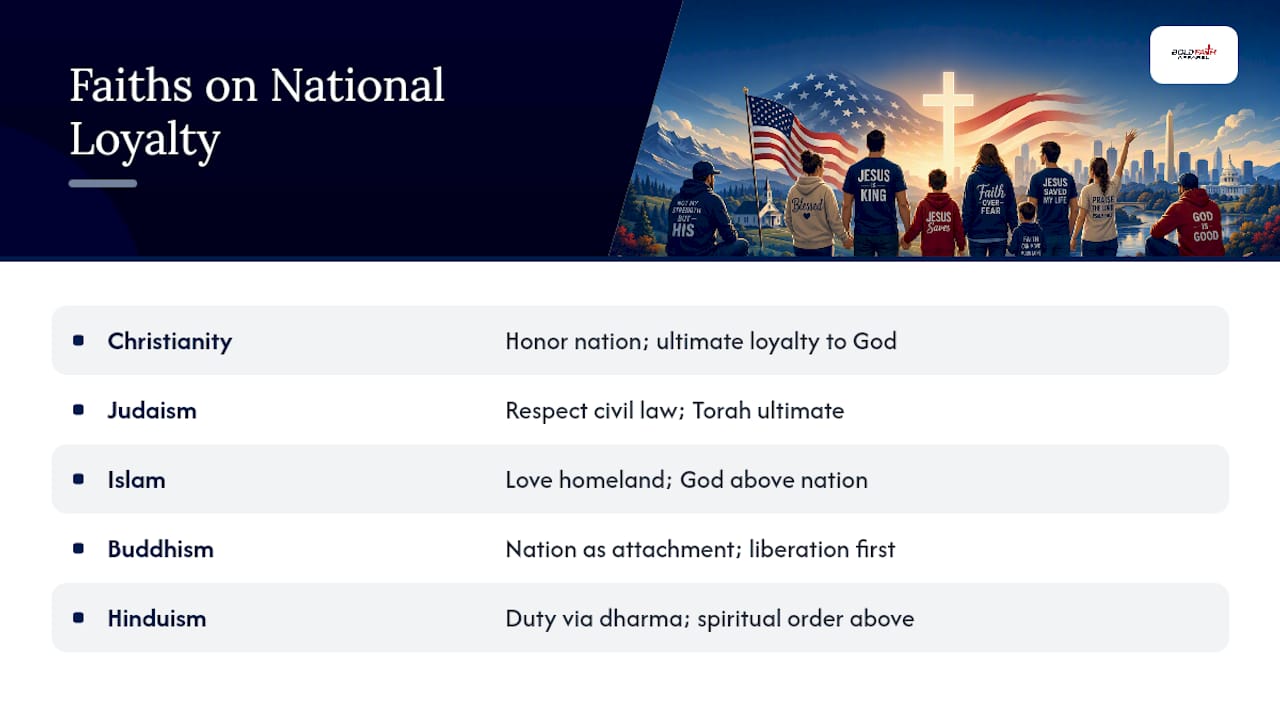
Christianity isn’t alone in wrestling with the tension between religious devotion and national loyalty. Judaism has long framed civic responsibility through the concept of dina d’malchuta dina, “the law of the land is the law,” which obligates religious Jews to respect civil government while maintaining ultimate loyalty to Torah. Islam carries a related idea in the concept of watan, love of homeland, which many Muslim scholars affirm as legitimate so long as it never eclipses submission to God.
Buddhist traditions generally treat national identity as one more attachment to hold loosely, useful for social order but ultimately secondary to the pursuit of liberation from suffering. Hindu thought, particularly through concepts of dharma, ties civic duty to one’s role in society, but subordinates that duty to cosmic and spiritual order rather than the nation itself.
The pattern repeats across traditions: religious communities that survive centuries almost always build in some version of ordered loyalty, honor the nation, serve it faithfully, but reserve ultimate allegiance for God. Christians debating faith and patriotism aren’t facing a uniquely Christian dilemma. They’re facing a version of one of the oldest questions any faith community has had to answer: what do we owe Caesar, and what do we owe God?
A Bold Faith Apparel Perspective: Wearing Your Convictions Without Losing Christ
Gratitude is the right starting point for patriotism, not pride. You didn’t earn the freedoms you have. Someone else paid for them, and ultimately, God ordained the authorities who protect them. That’s the posture Scripture points toward, and it changes how you show up as a citizen.
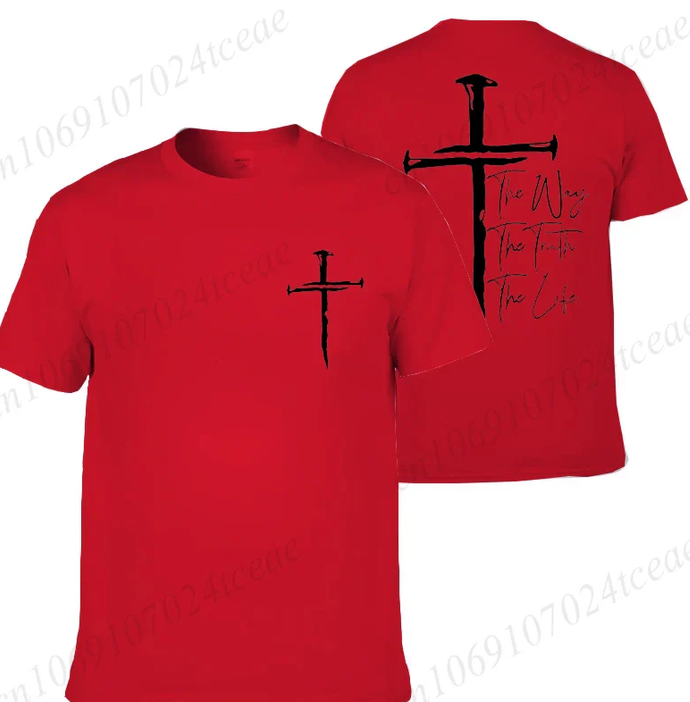
Visible testimony works the same way. Serving your neighbors regardless of their politics, showing up for the people your country sometimes forgets, and yes, even wearing a message that points to Jesus rather than a party, all of that can be ordered patriotism in action. The Bold Faith Movement’s take on Christian patriotism puts it directly: Jesus stays first, country stays grateful and second.
Faith-forward apparel isn’t a substitute for civic engagement or spiritual discipline. It’s one small, visible way to keep declaring where your ultimate loyalty rests, even on a day built around flags and fireworks.
— Larry
Wear Your Faith Without Losing Sight of Christ First
Bold Faith Apparel exists for readers who want to express gratitude for their country without ever confusing it with their faith. The collection features faith-forward apparel including T-shirts, hoodies, and caps that express Christian convictions.

The collection includes designs that combine patriotic themes with scriptural messages such as “Jesus the Way the Truth and the Life John 14:6,” “Faith Over Fear,” and “God is Good.” A collection of patriotic Christian clothing examples shows eight ready looks that keep the order right: country honored, Christ exalted. If you’re weighing a gift with lasting meaning beyond a single holiday, a non-traditional giving option is worth a look too.
Apparel won’t disciple your kids or reform your city government. It’s one visible, honest way to declare where your loyalty ultimately rests. Browse the full collection at Boldfaithapparel and pick a piece that says what your heart already believes.
Sources
- Littleflowermemphis
- In Defense of Christian Patriotism — Daniel Darling
- Christian Nationalism vs. Christian Patriotism — The Gospel Coalition
- A virtuous love of country — Colson Center / Breakpoint
FAQ
What does God say about patriotism?
Scripture doesn’t use the word “patriotism,” but it commands honor for governing authorities in Romans 13 and 1 Peter 2:17, and it commands prayer for leaders in 1 Timothy 2. The Catechism frames love of country as a duty of gratitude within the order of charity, meaning it’s expected, but always ranked below love of God.
Is patriotism biblical?
Yes, when it stays ordered under God rather than becoming an ultimate loyalty. Honoring civil authority and serving your country are treated as expressions of gratitude and justice throughout Scripture and classical theology, not as competing loyalties to faith.
What was Charlie Kirk’s religious affiliation?
Public reporting has identified Charlie Kirk as a professing evangelical Christian who spoke frequently about faith alongside conservative political commentary. This article focuses on the broader theological question of faith and patriotism rather than any individual commentator’s biography.
What did Mark Twain say about patriotism?
Mark Twain is widely associated with skepticism toward blind national loyalty, often paraphrased as support for one’s country, not necessarily its government. That sentiment lines up with the Christian distinction this article draws between healthy patriotism, which tolerates critique, and nationalism, which does not.
What are the four types of patriotism?
Definitions vary across scholars, but a common framework distinguishes constructive patriotism (love of country paired with willingness to critique and reform it), blind or uncritical patriotism, symbolic patriotism (attachment to flags and rituals), and civic patriotism (commitment to democratic institutions and processes). Christian ordered patriotism most closely resembles the constructive type, since it welcomes correction rather than demanding unquestioning loyalty.


