

Yes, Christians can celebrate Halloween in good conscience, but how you do it matters more than whether you do it. Scripture never mentions Halloween by name, which puts it in the category of what Romans 14:5-6 calls a “disputable matter”: one believer treats the day as significant, another does not, and both can honor God. The real question isn’t permission. It’s whether your choice glorifies God and keeps your witness intact, per 1 Corinthians 10:31.
Most Christian families land in one of four places:
- Abstain completely. Skip the night entirely because of its occult associations or personal conviction.
- Participate with limits. Trick-or-treat, but set firm rules on costumes and imagery.
- Reclaim and repurpose. Trade Halloween for a harvest festival, Trunk-or-Treat, or a Reformation Day event.
- Use it for outreach. Stay home, hand out candy, and treat the doorstep as mission territory.
“Do this for the glory of God” isn’t a slogan you post afterward. It’s the test you run before you decide anything, from the costume to the candy bowl.
Pray about it, read the relevant passages together as a family, and give other believers room to land somewhere different than you do. Judging a brother or sister over a costume choice misses the point of Romans 14 entirely.
Key Takeaways
Halloween observance falls under Romans 14 as a disputable matter, so the deciding factor is whether your specific choices glorify God and protect your witness.
| Point | Details |
|---|---|
| Scripture doesn’t name Halloween | Romans 14 and 1 Corinthians 10:31 govern the decision, not a specific verse about the holiday. |
| History is mixed | Samhain and All Hallows’ Eve both shaped the modern holiday, so origin claims alone don’t settle the question. |
| Four common paths | Families typically abstain, participate with limits, repurpose the night, or lean into outreach. |
| Costume choices carry weight | Skip gore and occult imagery; saints, heroes, and scripture-themed apparel work as quiet witness tools. |
| Decide, then communicate | Pray, study Scripture, set a standard, and share it without judging families who chose differently. |
Table of Contents
- Where Halloween Actually Came From
- What Does the Bible Say About Halloween?
- How Christians Commonly Respond to Halloween
- Practical Guidance for Families This Halloween
- How to Decide What’s Right for Your Family
- Simple Outreach Tools for Halloween Night
- A Pastoral Word on Conviction and Unity
- Frequently Asked Questions
- Sources
Where Halloween Actually Came From
The history is messier than either side of the debate usually admits, and that’s worth knowing before you make a family decision. The commonly cited origin is Samhain, a Celtic harvest festival marking the boundary between summer and the dark half of the year. Centuries later, the Christian church established All Hallows’ Eve on October 31 (known as All Hallows’ Eve), the night before All Saints’ Day, as a time to remember the faithful departed. Over generations, the two traditions blended and then secularized into the candy-and-costume holiday recognized today.
Historians actually disagree about how direct the line from Samhain to modern Halloween really is. Some scholars argue the connection is overstated, while others see clear folk-tradition carryover. Even a practice as small as carving a jack-o’-lantern has more than one competing origin story attached to it, which should tell you something about how much weight origin claims alone can bear.
That mixed record cuts against a simple “it’s pagan, avoid it” argument and a simple “it’s basically Christian, no concerns here” argument. Both oversimplify.
Halloween’s DNA carries both pagan and Christian fingerprints. The history doesn’t settle the moral question. Your conscience and God’s Word still have to do that work.
What matters more today is what the holiday has become: heavy on horror marketing, neighborhood ritual, and secular entertainment, with the religious roots on either side mostly forgotten by the culture around you.
What Does the Bible Say About Halloween?
Scripture gives you principles, not a verse-by-verse ruling on trick-or-treating. Three passages do the heavy lifting.
Romans 14 governs disputable matters, things Scripture doesn’t clearly command or forbid. One believer observes a day, another doesn’t, and Paul says both can act “fully convinced in their own mind.” 1 Corinthians 10:31 sets the actual finish line: “whatever you do, do it all for the glory of God.” And a cluster of passages, including Deuteronomy 18:10-12, Acts 19, and 1 Peter 5:8, warn against occult practice and staying alert to the enemy’s schemes. None of them mention costumes or candy corn.
Dr. Jim Denison offers a useful lens here. He sorts every cultural practice into three buckets: biblical (commanded), unbiblical (forbidden), and nonbiblical (neither). Denison places Halloween squarely in the nonbiblical category, which shifts the decision from “is this allowed” to “how do I steward this specific choice.” That framework does more work than most debates on this topic, because it stops people from arguing over permission when the real conversation should be about wisdom.
Apply it to specifics and the picture clarifies fast:
- A superhero, historical figure, or wholesome character costume rarely raises a concern.
- Costumes glorifying gore, demons, or explicit occult imagery cross into territory Scripture actually warns against.
- Decorating your porch with a cross-carved pumpkin or a verse-lit window sends a different message than a display built around horror.
- Handing out candy while wearing something that quietly points to Christ turns a neutral moment into a witness opportunity.
Pro Tip: Run every Halloween decision, costume or otherwise, through one filter: does this point toward God’s glory, or away from it? Denison’s own reframe makes this the real test, not whether the holiday itself is “Christian enough.”
How Christians Commonly Respond to Halloween
Believers who take Scripture seriously still land in different places, and that’s expected under a Romans 14 framework. Here’s what drives each choice.
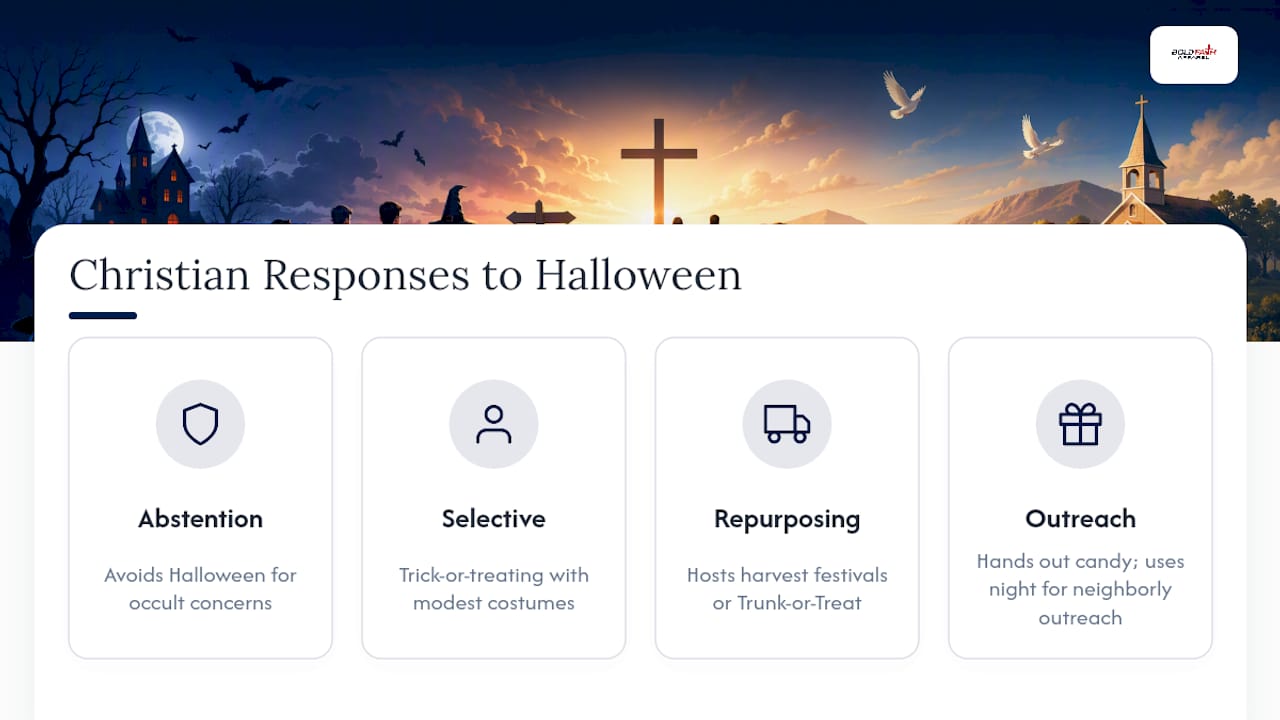
Full abstention usually comes from concern over the holiday’s occult undertones or a family’s personal conviction that the night carries too much spiritual risk to engage with at all. Focus on the Family frames this as a legitimate pastoral concern, not paranoia.
Selective participation looks like trick-or-treating with clear costume boundaries, letting kids dress as firefighters, biblical figures, or favorite heroes while skipping the haunted-house block of the neighborhood entirely.
Repurposing the night means trading the traditional format for a church harvest festival, a Trunk-or-Treat event in a parking lot, or even a Reformation Day gathering that commemorates October 31 (known as All Hallows’ Eve) (commemorating Reformation Day).
Outreach-focused engagement treats the doorbell as an open door. Families stay home, hand out candy, and use the traffic as a built-in opportunity for kindness and conversation.
None of these positions require condemning the others. The believer who skips the night entirely and the one who runs the church harvest booth are both trying to honor God with the choice in front of them.
Practical Guidance for Families This Halloween
Once you’ve settled on a general approach, the details matter more than the label you put on it. Here’s a working framework parents can apply directly.
Costume and decoration checklist:
- Keep costumes modest, age-appropriate, and free of gore or explicit demonic imagery.
- Consider saints, biblical heroes, or historical figures as costume options that double as conversation starters.
- Skip decorations that glamorize death or witchcraft; a carved cross or scripture-lit pumpkin works just as well as a jack-o’-lantern.
- Let older kids weigh in on the family’s standard so the rule feels like a shared decision, not an arbitrary restriction.
Trick-or-treat safety basics:
- Stick to well-lit, familiar streets and go in groups.
- Set a firm end time before you leave the house.
- Carry a flashlight or use reflective gear so drivers see kids clearly.
- Have one adult supervise every small group of children, no exceptions.
If your family leans toward repurposing the night, a harvest festival at church, a Trunk-or-Treat in the parking lot, or a small neighborhood outreach gathering all give kids the candy-and-costume fun without the darker cultural trappings. FamilyLife’s practical list of alternatives is worth reading in full if you’re building this out for the first time.
When kids ask why your family does things differently than the house next door, keep the answer short: “We want to celebrate in a way that points people to Jesus, not away from Him.” That’s a sentence a seven-year-old can repeat to a curious neighbor without feeling awkward.
Pro Tip: If you’re handing out candy at the door, wear clothing that reflects personal principles that opens a door of its own. A hoodie printed with “Faith Over Fear” or “Jesus Saves” gives parents walking their kids around the block something to notice, and sometimes something to ask about. Boldfaithapparel’s Bible verse hoodies are built for exactly that kind of quiet, low-pressure witness.
How to Decide What’s Right for Your Family
A conscience-driven decision beats a rule copied from another family’s convictions. Work through it in this order:
- Pray first. Ask God for wisdom before you settle on a position, not after you’ve already picked one and want confirmation.
- Read the relevant Scripture together. Romans 14, 1 Corinthians 10:31, and the occult warnings in Deuteronomy 18 give you the actual boundaries to work within.
- Name your specific concerns. Is it the imagery, the neighborhood culture, your kids’ ages, or your own past experience with the occult? Vague unease is harder to act on than a named concern.
- Set a clear family standard. Write it down if it helps. Costumes allowed, costumes off-limits, events you’ll attend, events you won’t.
- Communicate it without judgment. Tell your kids, your spouse, and if it comes up, your church community, without implying that families who chose differently got it wrong.
A few conversation starters worth using with a spouse or older kids:
- “What about this night actually worries you?”
- “Does this choice make it easier or harder for us to talk about Jesus with our neighbors?”
- “Are we avoiding this out of wisdom or out of fear?”
If a decision starts to strain relationships at church, that’s the moment to bring it to a pastor rather than debate it further on your own. GotQuestions puts it plainly: the goal is acting from conviction while refusing to let a disputable matter fracture fellowship.
Simple Outreach Tools for Halloween Night
Turning the doorstep into a mission field doesn’t require a speech. It requires a plan.
A one-line gospel card tucked into candy bags can say something as simple as: “Wishing you a night full of light. Jesus is the light of the world (John 8:12). Happy Halloween from your neighbors.” No pressure, no ask, just a seed.
Three short scripts work for almost any door interaction:
- Friendly greeting: “Happy Halloween! Love the costume. Here you go!”
- Gentle bridge: “We’re celebrating tonight because we believe every good thing, even candy, comes from a good God.”
- Event invitation: “If you’re ever looking for a fun, safe fall event, our church runs one every October. Would you like a flyer?”
Pro Tip: A shirt with “God is Good” or “Praise the Lord” printed across it does more evangelistic work at your own front door than most people realize. It’s a silent conversation starter that lets neighbors ask the questions instead of feeling cornered by them.
A Pastoral Word on Conviction and Unity
Scripture gives you real freedom here, and freedom always comes with responsibility attached. Listen closely to what the Spirit is showing you, not just what your neighbor or your pastor decided. Protect your conscience, but don’t weaponize it against a believer who reads Romans 14 and lands somewhere different than you did.
Use the tools above, the costume boundaries, the outreach scripts, the harvest-festival option, instead of a flat “we don’t do that.” A firm conviction and a generous spirit aren’t in tension. They’re supposed to travel together.
Frequently Asked Questions
Is Halloween okay for Christians to celebrate? Yes, under Romans 14’s framework for disputable matters. The Bible neither commands nor forbids Halloween by name, so the deciding factor is whether your specific choices, costumes, activities, and attitude honor God.
What does the Bible say about Halloween specifically? Nothing directly. Scripture does warn against occult practices in passages like Deuteronomy 18:10-12, and it sets the broader standard in 1 Corinthians 10:31: whatever you do, do it for God’s glory.
What are good Christian alternatives to Halloween? Church harvest festivals, Trunk-or-Treat events, Reformation Day gatherings, and saint-costume nights all let kids enjoy the fun elements of the holiday without the darker cultural trappings.
Should Christian kids wear scary or demonic costumes? Most pastoral guidance says no. Gore and demonic imagery cross into territory Scripture warns against, while superhero, historical, or biblical-figure costumes rarely raise a concern.
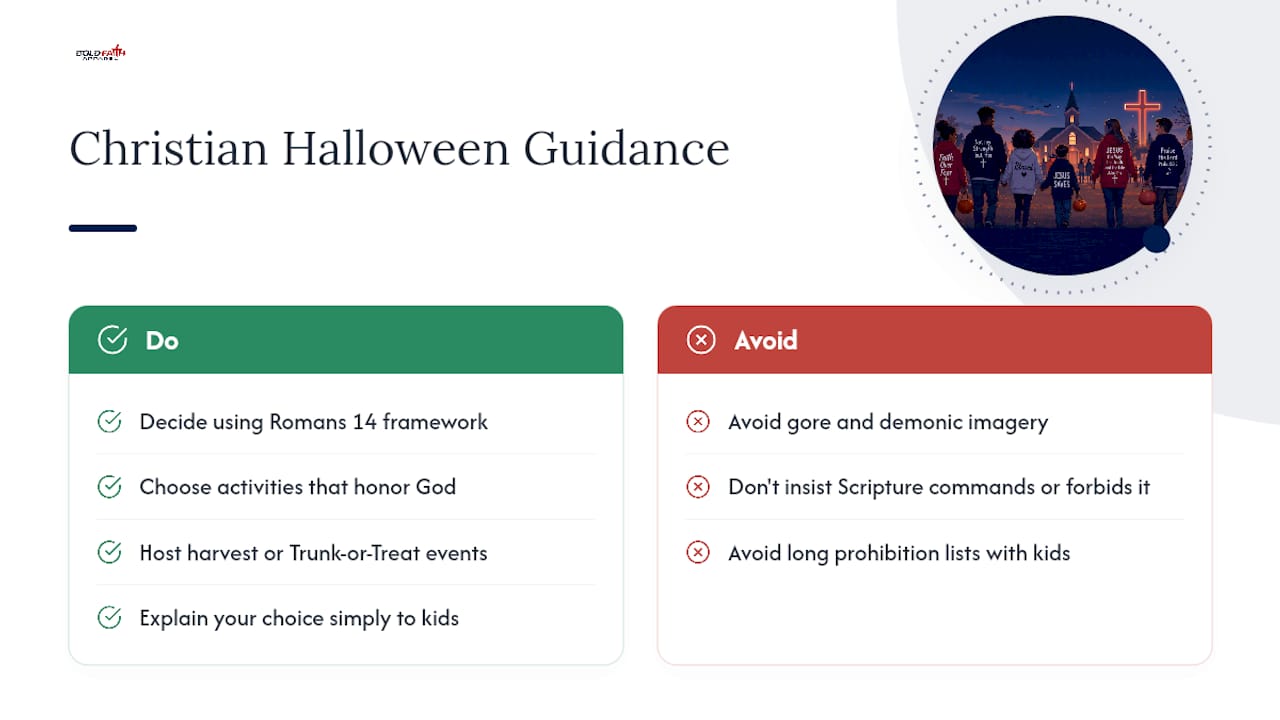
How do I explain my family’s Halloween decision to my kids? Keep it simple and positive: “We want to celebrate in a way that points people to Jesus.” A short, confident answer works better than a long list of prohibitions.
Sources
- What does the Bible say about Halloween? | Denison Forum
- Should Christians Celebrate Halloween? | GotQuestions
- Should Christians Celebrate Halloween? | Focus on the Family
- Christianity


