

Here are ready-to-say prayers and Scripture-backed prompts you can use now to intercede for the United States. This page gives you short prayers for daily use, mid-length prayers for deeper intercession, a corporate prayer for group settings, and 17 Scripture-paired prompts to guide your own words. Every prayer here stays God-centered and nonpartisan, built for private devotion, family time, or a small-group prayer meeting.
TL;DR:
- Prayers for America primarily focus on unity, healing, leadership wisdom, and gospel access, avoiding partisan language and candidate specifics.
- Structured prompts like the 17 themes from Revive Our Hearts help guide focused, nonpartisan intercession on topics such as repentance, justice, and national protection.
- The ACTS model of Adoration, Contrition, Thanksgiving, and Supplication provides a simple framework for organizing group prayer sessions effectively.
- Influential prayers from David Jeremiah and Billy Graham emphasize communal humility, revival, and spiritual renewal over political victories.
- Personal reflection, Bible-based focus, and wearing faith-inspired apparel can reinforce prayer efforts and exemplify public witness for national intercession.
Table of Contents
- Prayers for America You Can Say Right Now
- 17 Scripture-Backed Prayer Prompts for the Nation
- How Do You Lead a Prayer Meeting for the Nation?
- Praying on Memorial Day, Independence Day, and the National Day of Prayer
- Where Does the Practice of Praying for America Come From?
- What Themes Show Up Most in Prayers for America?
- Which National Prayers Have Shaped How Christians Pray for America?
- How Should You Reflect Personally Before You Pray for the Nation?
- Why Bold, Public Faith and Prayer Still Matter
- Wear Your Testimony While You Pray for America
- Sources
- FAQ
Prayers for America You Can Say Right Now
You don’t need a script to intercede for your country, but having one ready helps when your mind goes blank in a prayer circle or during a quiet morning devotion. Below are short prayers for immediate use, followed by longer prayers for deeper moments, and one corporate prayer built for group settings.
Ten short prayers, one line each:
- “Lord, protect our nation’s leaders and give them courage to do what is right.” (Romans 13:1)
- “God, unite the hearts of this divided country under Your truth.” (Psalm 133:1)
- “Father, cover our military and their families with Your peace.” (Psalm 91:11)
- “Jesus, open doors for the Gospel to spread freely across America.” (Colossians 4:3)
- “Lord, heal the wounds of racism, division, and bitterness in this land.” (2 Chronicles 7:14)
- “God, raise up godly leaders who fear You more than they fear public opinion.” (Proverbs 29:2)
- “Father, protect our children and strengthen every family in this nation.” (Joshua 24:15)
- “Lord, give wisdom to judges and lawmakers as they shape our future.” (James 1:5)
- “God, revive Your church in America and awaken hearts to repentance.” (Psalm 85:6)
- “Jesus, be the hope of this nation when fear tries to take hold.” (Isaiah 41:10)
Those ten cover the basics. When you have more time, a mid-length prayer lets you go deeper into a specific concern.
Prayer for leadership wisdom: “Father, You alone set up leaders and remove them. Give our president, our Congress, and our courts a spirit of wisdom that surpasses political strategy. Let them govern with humility, protect the vulnerable, and seek Your face before they seek the polls. Where pride has taken root, bring conviction. Where fear has taken root, bring courage rooted in You.”
David Jeremiah’s national prayer offers a model worth adapting here. His prayer for America asks God to make the country truly “one nation under God,” pushing believers to pray for unity that rises above party lines rather than settling for a slogan.
Lord, help us become one nation under God, not in name only, but in the way we treat one another, forgive one another, and seek You together above every other loyalty.
Prayer for repentance and revival, adapted from themes in Franklin Graham’s national prayer:
Father, forgive us as a nation for turning from You. We have taken Your blessings for granted and chased comfort instead of holiness. Turn our hearts back toward You, and give our leaders humility to seek Your guidance rather than their own understanding.
That posture of repentance and gratitude runs through Franklin Graham’s prayer for America, which pairs thanksgiving for the nation’s blessings with a direct call to national humility.
Prayer for healing and unity: “God, where there is division, plant seeds of understanding. Where there is anger, bring patience. Heal the parts of this nation that feel broken beyond repair, and remind us that You are still able to mend what politics cannot.”
A corporate prayer to open or close a prayer meeting:
Almighty God, we come before You as citizens of heaven first, and citizens of this nation second. We thank You for the freedom to gather and pray. We ask You to bless this land with justice, to protect it from evil, and to fill it with people who love You and love their neighbor. Give wisdom to those in authority, comfort to those who grieve, and courage to those who stand for truth. May Your name be lifted high across every state, every city, and every home. In Jesus’ name, amen.
Collections from Billy and Franklin Graham lean on this same rhythm of humility and revival rather than political outcomes, a pattern worth noticing when you write your own prayers for America.
17 Scripture-Backed Prayer Prompts for the Nation
No single official prayer covers everything America needs, which is why a prompt list works better than a single script. Resources built around this idea, including Revive Our Hearts’ 17 prompts for America, organize intercession by theme instead of handing you one fixed text. Use these as a checklist when you pray alone or lead a group.
- National repentance — 2 Chronicles 7:14
- Wisdom for leaders — James 1:5
- Leaders in authority generally — 1 Timothy 2:1–4
- Godly influence in government — Proverbs 29:2
- Truth over deception — John 8:32
- Gospel access and open doors — Colossians 4:3
- Protection over the nation — Psalm 33:12
- Justice for the oppressed — Isaiah 1:17
- Unity among believers — Psalm 133:1
- Strong, godly families — Joshua 24:15
- Care for the poor — Proverbs 31:8–9
- Protection for the military — Psalm 91:11
- Healing of racial division — Galatians 3:28
- Revival in the church — Psalm 85:6
- Economic stability — Deuteronomy 8:18
- Comfort for the grieving — Matthew 5:4
- Boldness for believers to witness publicly — Acts 4:31
Pro Tip: Keep your language aimed at character, not candidates. Pray for “leaders in authority” rather than naming a specific official, and pray for wisdom and justice rather than a particular policy outcome. This keeps a group prayer unified instead of divisive. This guidance mirrors the approach Revive Our Hearts recommends for public prayer during civic events.
How Do You Lead a Prayer Meeting for the Nation?
The ACTS model gives structure to what could otherwise become a rambling list of complaints. It stands for Adoration, Contrition, Thanksgiving, and Supplication, and it keeps a group centered on God rather than on grievances.
- Adoration — Praise God for who He is. (“Lord, You are sovereign over every nation, including this one.”)
- Contrition — Confess where the nation, and the group, has fallen short. (“Father, forgive us for the ways we’ve prioritized comfort over holiness.”)
- Thanksgiving — Thank God for specific blessings. (“Thank You for the freedom to gather and worship openly.”)
- Supplication — Bring specific requests. (“We ask for wisdom for our leaders and healing for our communities.”)
For a 30 to 45 minute meeting, assign roles ahead of time: a leader to keep pace, a Scripture reader to open with a passage like Psalm 33:12, a focused intercessor for each ACTS segment, and someone to close with a blessing. Rotate topics weekly so the group doesn’t get stuck praying the same three requests every time. Cover leaders one week, families the next, the military after that, and the Gospel’s spread the week after.
The White House’s own America Prays initiative leaned on this same ACTS framework, promoting weekly small-group prayer rhythms rather than one-off events, which suggests consistency matters more than occasion.
Pro Tip: If your group struggles to keep prayer nonpartisan, ban candidate names entirely and replace every political complaint with a Scripture reference. It’s harder to drift into arguing about policy when everyone’s eyes are on a Bible verse instead of a headline.
Praying on Memorial Day, Independence Day, and the National Day of Prayer
Each civic observance calls for a different emphasis, even though the underlying posture, humility before God on behalf of the nation, stays the same.
- Memorial Day calls for remembrance and comfort. Focus on grieving military families and gratitude for sacrifice, drawing on prayers like the USCCB’s Memorial Day prayer, which specifically asks God to comfort those who lost loved ones in service.
- Independence Day calls for thanksgiving and rededication. Thank God for freedom, then ask for the humility to steward it well rather than take it for granted.
- National Day of Prayer, held annually, calls for corporate intercession across every theme covered in this guide, from leadership wisdom to national repentance.
Standard Memorial Day prayer points also include blessing the nation’s land, honoring honest industry, and praying for unity among a diverse population, themes drawn from resources like Logos’ Memorial Day prayer collection. If you’re planning a Memorial Day gathering, Bold Faith Apparel’s Memorial Day shirt ideas pair well with a prayer of remembrance, letting your clothing echo what your prayer says out loud.
Where Does the Practice of Praying for America Come From?
Prayer for the nation isn’t a modern invention tied to any single election cycle or crisis. It traces back to the earliest days of the republic, when colonial pastors and Continental Congress delegates opened public sessions with prayer, treating national leadership as something to be covered in intercession rather than left to political skill alone.
The modern National Day of Prayer formalized this instinct. Congress established it as an annual observance, and it has drawn presidents, pastors, and everyday believers into a shared, nonpartisan act of asking God to guide the country. The practice grew out of a conviction rooted in 1 Timothy 2:1–4: pray for those in authority so that believers can live peaceful, godly lives.
What’s changed isn’t the theology behind national prayer. It’s the tools available to organize it. Where a pastor once had to write every prayer from scratch, resources from ministries and institutions now offer structured prompts and model prayers, making it easier for anyone, from a solitary believer to a packed sanctuary, to intercede with focus instead of vague good intentions. That shift matters because unfocused prayer tends to drift into complaint. Structured prayer tends to stay on target.
What Themes Show Up Most in Prayers for America?
Five themes dominate nearly every national prayer worth reading, and noticing them helps you build your own prayers instead of just repeating someone else’s words.
Unity tops the list. Nearly every major prayer, from David Jeremiah’s call to be “one nation under God” to the shorter prompts from Revive Our Hearts, asks God to heal division rather than pick a side within it. Healing follows closely, covering everything from racial reconciliation to the grief carried by military families. Leadership wisdom shows up in almost every collection, because Scripture itself commands prayer for those in authority regardless of who holds office.
Repentance cuts through prayers from Franklin Graham and others who frame national struggles as spiritual, not merely political, problems. And gospel access, the prayer that truth would spread freely and doors would open for the Good News, threads through prompt lists built to keep prayer focused on eternal outcomes rather than temporary headlines.
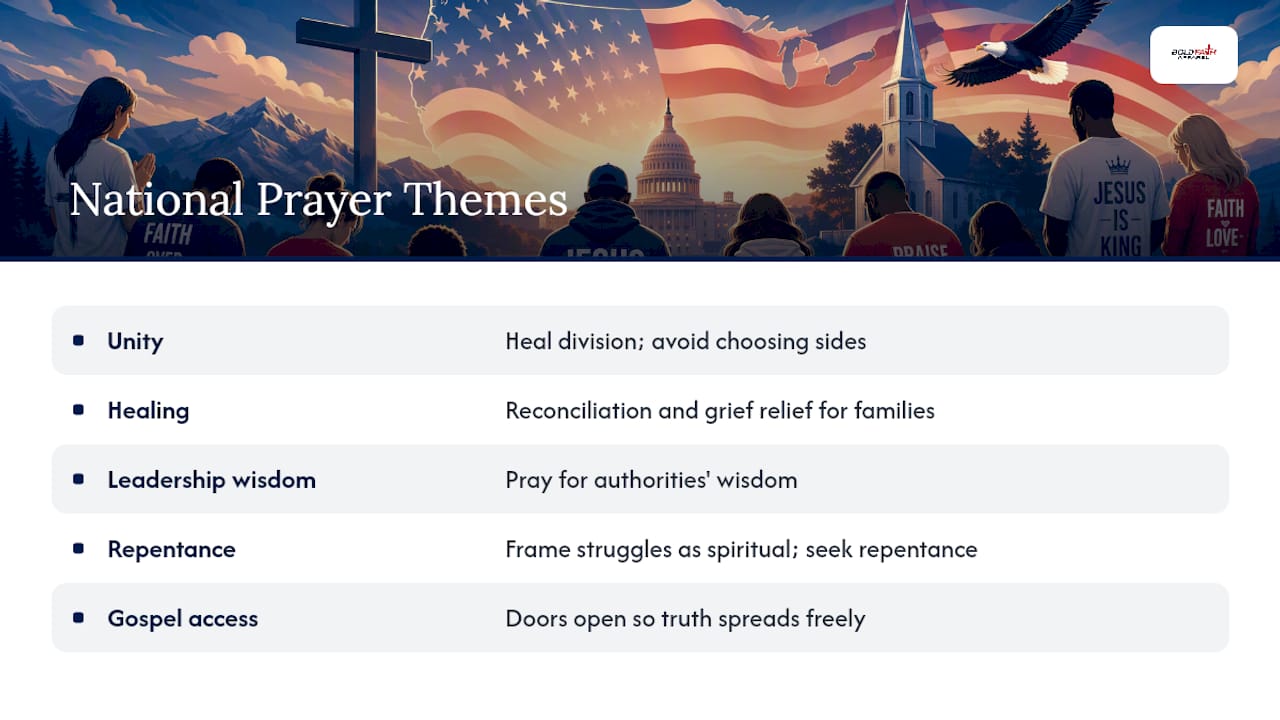
Notice what’s largely absent: partisan language, candidate names, and policy demands. That absence is intentional. The strongest national prayers ask God to work on hearts and circumstances, then trust Him to work out the specifics.
Which National Prayers Have Shaped How Christians Pray for America?
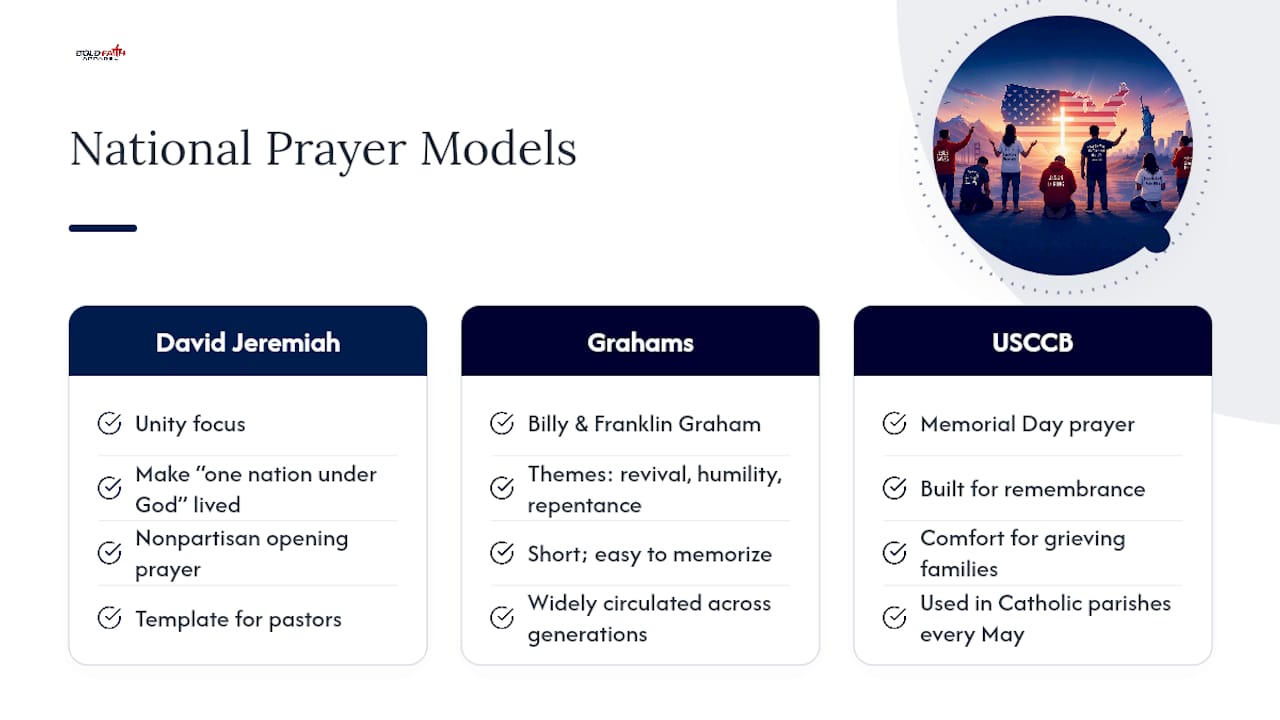
A handful of prayers have become reference points that other believers adapt and echo. David Jeremiah’s prayer stands out for its unity focus, asking God to make “one nation under God” a lived reality rather than a phrase on currency. It’s become a template for pastors who want a nonpartisan opening prayer for civic events.
Billy Graham and his son Franklin have produced some of the most widely circulated national prayers over the decades, consistently returning to themes of revival, humility, and repentance rather than political triumph. Their prayers tend to be short enough to memorize and adapt on the spot, which is part of why they’ve stayed in circulation across generations of churches.
The USCCB’s Memorial Day prayer occupies a different lane entirely, built specifically for remembrance rather than general national intercession. It’s used in Catholic parishes nationwide every May, and its focus on comfort for grieving families gives it a tone distinct from the more sweeping prayers aimed at leadership and unity.
None of these prayers claims to be the definitive national prayer, and that’s a strength, not a gap. Having several trusted models gives you flexibility depending on the occasion and the tone you need.
How Should You Reflect Personally Before You Pray for the Nation?
Praying for a country as large and complicated as the United States can feel abstract if you skip straight to words. Sit with a single verse first, Psalm 33:12 works well: “Blessed is the nation whose God is the Lord.” Ask yourself what that actually looks like in your own city, your own workplace, your own family, before you widen the lens to the whole country.
Personal reflection also means checking your own heart for bitterness before you pray for unity. It’s easy to ask God to heal division while quietly holding onto contempt for people who vote differently than you do. A few quiet minutes of self-examination, guided by a passage like James 1:19 on being slow to anger, tend to produce more honest prayers than jumping straight into a list of national requests.
Journaling helps too. Write down what specifically concerns you about the nation this week, then write a single verse next to each concern. That pairing turns vague anxiety into focused intercession, and it gives you a record over time of how God has answered, or reshaped, what you were asking for.
Why Bold, Public Faith and Prayer Still Matter
Private prayer changes hearts, but public faith changes culture. When you pray for America and then live out that prayer where people can see it, you become part of the answer, not just someone asking for one. That’s the conviction behind Bold Faith Apparel: faith that stays hidden rarely moves anyone. Faith worn boldly, spoken boldly, and lived boldly gives others permission to do the same.
Prayer-in-action looks like showing up for a grieving military family with a meal, not just a verse. It looks like serving your local community the same week you prayed for national healing. Pray boldly. Then live visibly for Christ, because a nation changes one bold witness at a time.
— Larry
Wear Your Testimony While You Pray for America
Faith-based apparel turns quiet conviction into a visible statement, giving you a way to carry your prayers into the rest of your day instead of leaving them behind when you close your Bible; explore how Gulf of America® patriotic apparel helps you wear your testimony with pride. A shirt or hoodie with a message like “Faith Over Fear,” “Jesus Saves,” or Psalm 23 printed across it starts conversations that a silent prayer never will, and it reminds you of what you prayed the moment you glance in the mirror.

Every design pairs a bold statement with real Scripture, built for men and women who want their clothing to match their conviction instead of blending in. Whether you’re heading to a prayer gathering, a Memorial Day event, or just running errands, a shirt reading “Not My Strength but His”" or “There Is Power in the Name of Jesus” turns an ordinary day into a quiet act of witness. Pair it with practical ideas from Bold Faith Apparel’s patriotic clothing lookbook for outfit inspiration that works for church, community events, or everyday errands.
If you want apparel that stands alongside your prayers for the nation, browse the Bold Faith Apparel collection and pick a design that says what you’ve been praying.
Sources
- 17 Prompts to Help You Say a Prayer for America | Revive Our Hearts
- A Prayer for America - David Jeremiah Blog
- A Prayer for America by Franklin Graham - National Day of Prayer
- Prayer for Memorial Day (Last Monday in May) | USCCB
- 5 Prayers for America from Billy and Franklin Graham
FAQ
How do you pray for the United States of America?
Start with Scripture, cover leaders, families, the military, and gospel access, and keep the language nonpartisan by praying for wisdom and character rather than specific political outcomes. Structured lists like the 17 prompts from Revive Our Hearts give you a reliable starting point.
What is the national prayer for America in 2026?
There’s no single official national prayer. Trusted models from David Jeremiah, Billy and Franklin Graham, and the USCCB each offer a different emphasis, and most believers adapt phrases from several sources rather than reciting one fixed text.
What are some prayer points for the USA today?
Common prayer points include national unity, leadership wisdom, repentance, healing from division, protection for the military, and open doors for the Gospel. The 17 prompts covered earlier in this guide organize these points by theme with a Scripture reference attached to each.
What is the prayer for America by Billy Graham?
Billy Graham’s prayers for America focus on revival, humility, and repentance rather than political victory, a theme carried forward in his son Franklin’s own national prayer. Both emphasize turning the nation’s heart back toward God rather than toward any specific policy.
Can I use these prayers in a small group or family devotion?
Yes. The short one-line prayers work well for quick family devotions, while the mid-length and corporate prayers fit small-group settings or a National Day of Prayer gathering.


