

Title VII of the Civil Rights Act generally protects your right to wear religious clothing and symbols at work, and it requires your employer to provide reasonable accommodation unless doing so creates undue hardship. This applies to employers with 15 or more employees. If a manager tells you to remove a headscarf, cover a cross necklace, or take off a faith-based T-shirt, document what was said, ask for the reason in writing, and raise it with HR before considering a complaint with the U.S. Equal Employment Opportunity Commission (EEOC).
TL;DR:
- Employers must accommodate religious clothing unless it causes significant safety, security, or operational hardship supported by documented standards.
- Requests should be made in writing, specifying the belief and proposed accommodation, and involve an interactive process to explore reasonable solutions.
- Most accommodation disputes are resolvable at the manager-HR level, with formal denial needing detailed documentation of the specific hardship.
- Workplace safety concerns, like head coverings near machinery or beards affecting respirator fit, require narrowly tailored, documented solutions rather than blanket bans.
- State and local laws may offer broader protections than federal law, especially for small employers or specific industries like healthcare or education.
Table of Contents
- What Title VII Says About Religious Clothing at Work
- Real Workplace Examples: Headscarves, Beards, Jewelry, and Faith-Based Shirts
- How to Request a Religious Accommodation (Step by Step)
- When Employers Can Legally Say No
- Religious Clothing Rules for Public Employees and School Staff
- What to Do If Your Employer Denies Your Request
- Employee Rights Beyond Federal Law: State and Local Protections
- How Different Industries Handle Faith-Based Attire
- Building an Inclusive Dress Code Policy That Works
- Religious Attire and Safety Gear: Finding the Resolution
- Faithful Presence at Work Doesn’t Require a Fight
- Wear Your Faith to Work Without the Guesswork
- Sources
What Title VII Says About Religious Clothing at Work
Religion is a protected class under Title VII, alongside race, sex, and national origin. That protection covers more than what you believe. It covers how you practice it, including the clothes you wear, the jewelry you choose, and the grooming standards you follow because of your faith.
Coverage kicks in once an employer has 15 or more employees, a threshold set by DOL guidance on religious discrimination and accommodation. Smaller businesses fall outside federal Title VII protection, though many states apply their own anti-discrimination laws to employers below that size. If you work for a company that size or larger and your faith calls you to wear a hijab, a cross, tzitzit, or a shirt that says “Jesus Saves,” your employer has a legal duty to work with you, not against you.
What counts as a sincerely held belief? The EEOC and courts don’t grade your theology. They look at whether your belief is sincere and religious in nature, not whether it lines up with official doctrine or whether every member of your congregation shares it. A Christian employee who feels called to wear a cross necklace doesn’t need to prove that every Christian wears one. Sincerity is about your personal conviction, not group consensus. Employers rarely win by arguing an employee’s belief isn’t “real” religion. That argument backfires quickly and invites a discrimination claim.
The accommodation requirement isn’t unlimited. Once an employee raises a religious conflict, the employer must accommodate it unless doing so causes undue hardship, according to the EEOC’s Q&A on religious discrimination in the workplace. Here’s where a lot of employees get confused, because “undue hardship” sounds like it means “some inconvenience.” It doesn’t.
The de minimis standard. For religious accommodation, courts and the EEOC have historically applied a “de minimis” test, meaning the burden on the employer has to be more than trivial or minor. That’s a lower bar for employers to clear than the “significant difficulty or expense” standard used under the Americans with Disabilities Act. In practice, that means:
- A minor scheduling adjustment usually doesn’t qualify as undue hardship.
- A small dress code exception, like allowing a modest head covering, rarely rises to the level of real burden.
- Genuine safety risks, meaningful cost increases, or real disruption to other employees’ rights can qualify.
- Vague discomfort, customer complaints about appearance, or a manager’s personal preference generally do not qualify.
Employers sometimes assume that “we have a strict uniform policy” ends the conversation. It doesn’t. The EEOC’s guidance on religious garb and grooming is direct on this point: employers must make exceptions to dress and grooming rules for religious practices unless they can show undue hardship, and customer preference alone generally doesn’t satisfy that standard. A retail chain can’t ban headscarves just because a district manager thinks they clash with the store’s aesthetic.
There’s also a practical wrinkle worth knowing. An employer can’t refuse to hire or start disciplining you over a religious practice you haven’t even mentioned yet, but you also carry a responsibility to raise the issue. If your employer has no reasonable way of knowing that your faith requires a certain garment, they can’t be blamed for not accommodating something they were never told about. That’s why the request process (covered further down) matters so much for both sides.
Real Workplace Examples: Headscarves, Beards, Jewelry, and Faith-Based Shirts
Legal standards are easier to understand once you see them applied. Here’s how accommodation questions typically play out across different industries.
- Retail and customer-facing roles. A cashier who wears a hijab or a yarmulke usually doesn’t conflict with a uniform policy at all. Most retailers can pair a company polo worn alongside religious head coverings without any operational problem. Faith-based T-shirts (something with “Blessed” or a small cross graphic) rarely trigger dress code conflicts either, unless the company bans all graphic tees for branding reasons applied evenly to everyone.
- Healthcare and food service. These are the settings where legitimate hygiene and safety questions actually arise. A loose headscarf near open flames or rotating equipment is a real concern; a fitted, tucked, or color-matched covering usually resolves it. Hospitals frequently accommodate hijabs, turbans, and religious jewelry by asking staff to use disposable or washable coverings that meet infection-control standards, rather than banning the garment outright; learn more about how we ensure every garment reflects genuine craftsmanship to meet workplace standards.
- Manufacturing and security. Jobs involving heavy machinery, secure facilities, or metal detectors raise the most complex questions, covered in more depth further down. A turban or long beard may need a temporary adjustment during airport-style screening, but a blanket ban isn’t usually defensible.
- Office settings. A small cross pendant, a “Faith Over Fear” lapel pin, or a modest scripture-themed shirt on casual Friday almost never requires any formal accommodation process at all. Most office dress codes have enough flexibility that these items simply don’t register as a conflict, which is exactly why so many Christian employees wear their faith visibly without ever filing a request.
Pro Tip: If you’re unsure whether your workplace attire needs a formal accommodation, ask yourself whether it’s a change from a strict written policy. A “Jesus Saves” T-shirt worn on a jeans day usually needs nothing. A headscarf worn against a “no head coverings” policy does need a documented request.
Beards present an interesting case. Some Christian, Sikh, and Muslim men grow beards for religious reasons, and employers with “clean shaven” policies (often justified by respirator fit or a professional image) have had to build in exceptions. The EEOC’s guidance treats beard-length accommodation the same way it treats head coverings: presumptively required unless a specific, provable hardship exists.
How to Request a Religious Accommodation (Step by Step)
Neither side needs a lawyer to handle this well. Most accommodation requests get resolved at the HR level, and a clear process protects everyone.
If you’re the employee:
- Notify your supervisor or HR that you have a religious practice that conflicts with a workplace policy.
- State plainly that the practice stems from a sincerely held religious belief. You don’t need to write a theological essay. A sentence is enough.
- Propose a specific accommodation, whether that’s wearing a headscarf in company colors, keeping a beard trimmed to a certain length, or wearing a cross necklace tucked under a collar.
- Offer flexibility where you can. If there’s a safety-based alternative that still respects your practice, mention it.
- Put the request in writing, even if you already discussed it verbally. Email is fine. Keep a copy.
If you’re the employer:
- Engage in what the EEOC calls the “interactive process”: a real back-and-forth conversation aimed at finding a workable solution, not a rubber stamp denial.
- Ask only for the information needed to evaluate the request. You generally can’t demand proof of church membership or a note from a clergy member as a precondition.
- Consider every reasonable alternative before concluding that undue hardship exists, including the low-cost fixes outlined in the EEOC’s religious garb guidance.
- If you deny a request, document the specific hardship you identified and why no accommodation could resolve it.
A short written request template covers most situations: “I’m writing to request a religious accommodation regarding [specific policy]. My faith requires [specific practice]. I’d like to propose [specific solution]. Please let me know what additional information you need.” Keep dated copies of every email, the names of everyone involved in the conversation, and any written response you receive. If your request gets denied, that paper trail becomes essential later.
Federal law also doesn’t require employers to grant paid time off specifically for religious holidays, according to state and agency accommodation guidance. What it does require is a reasonable accommodation, which often looks like flexible scheduling, voluntary shift swaps with coworkers, or unpaid leave when paid time off isn’t available. An employee observing Good Friday or a Muslim employee needing time for Eid prayers can generally request a schedule adjustment even if the company has no formal “religious holiday” policy on the books.
When Employers Can Legally Say No
Undue hardship isn’t a magic phrase employers can invoke to shut down a request. It has to be backed by something real and specific.
Legitimate reasons for denial typically include:
- A genuine safety conflict, such as loose fabric near moving machinery or a beard interfering with a respirator seal required by workplace safety standards.
- A security concern, like an item that could conceal contraband or interfere with required identification checks.
- A substantial cost or major disruption to business operations, not a minor inconvenience.
- A conflict with another employee’s own legally protected rights.
What generally does not justify denial:
- Customer preference or complaints about appearance.
- A manager’s personal comfort level with religious expression.
- A general company “image” or branding preference, applied without any case-by-case analysis.
That last point deserves attention because it trips up a lot of employers. Some court decisions have found that protecting a company’s public image can qualify as undue hardship in narrow, specific circumstances, but relying on “image” as a blanket excuse is risky. Guidance under federal employment discrimination regulations warns that an image-based denial can amount to Title VII discrimination if it’s really just customer bias dressed up as a business rule. A store that lets employees wear novelty hats but bans yarmulkes has an image policy in name only.
The de minimis standard means most employers can’t clear the bar with “it would be annoying to update the schedule” or “some customers might stare.” They generally need to show the accommodation would meaningfully disrupt operations, safety, or cost. Before denying anything, a responsible employer should walk through real alternatives: could a head covering be color matched to the uniform? Could a shift swap solve the scheduling conflict? Could a removable religious item replace a fixed one during a specific safety task? Documenting that process protects the employer if a complaint follows, and it usually produces a better outcome for the employee too.
Religious Clothing Rules for Public Employees and School Staff
Government employees and school staff live under a slightly different set of rules than private-sector workers. Title VII still applies, but the First Amendment adds another layer, because the government itself is the employer.
Public employees generally keep Title VII’s religious accommodation rights. But courts have also given government employers somewhat more latitude to regulate speech and appearance when a public employee is acting in their official capacity, particularly in roles that carry symbolic government authority.
Teachers face the sharpest version of this tension. A public school teacher generally has the right to wear a cross necklace, a hijab, or a “Faith Over Fear” bracelet without losing their job over it. Where things get more complicated is classroom conduct. Courts have generally held that public schools can restrict active proselytizing or religious instruction by teachers during instructional time, out of concern that students might perceive the school itself as endorsing a religion. Wearing a symbol is different from leading a class in prayer, and the distinction matters legally.
Practical guidance for public-sector and school employees:
- Put accommodation requests in writing and route them through your agency’s HR or legal counsel rather than assuming private-sector norms apply automatically.
- Keep personal religious expression (jewelry, apparel, grooming) separate from instructional or official duties where your role carries government authority.
- If you’re unsure where the line falls in your specific role, ask your agency’s counsel before a conflict arises rather than after.
What to Do If Your Employer Denies Your Request
A denial isn’t the end of the road. It’s the point where documentation starts to matter more, not less.
Start by asking for the denial in writing, including the specific reason given. If your company has an internal grievance process or an appeals step through HR, use it before going further. Many disputes resolve at this stage once a second set of eyes reviews the original decision.
If internal options are exhausted and the denial stands, the next step is usually a charge with the EEOC, the federal agency responsible for enforcing Title VII and investigating religious discrimination claims. The EEOC accepts charges, investigates the claim, and can pursue mediation or further action depending on what it finds. Filing deadlines are tight, generally 180 days from the discriminatory act in most states (extended to 300 days in states with their own fair employment agency), so acting promptly protects your options.
Before filing, gather:
- Copies of your written accommodation request and any response.
- Names and titles of everyone involved in the conversation, with dates.
- Copies of the specific dress code or grooming policy in question.
- Notes on any similar requests from coworkers that were approved or denied differently.
Many states also maintain their own human rights or civil rights agencies that handle religious discrimination claims, sometimes with broader coverage than federal law (protecting employees at smaller companies below the 15-employee Title VII threshold). If your case involves retaliation, lost wages, or a pattern of denials rather than a single incident, an employment attorney can help you evaluate whether a private lawsuit makes more sense than an agency complaint alone.
Employee Rights Beyond Federal Law: State and Local Protections
Title VII sets the federal floor, not the ceiling. Many states extend stronger protections than federal law requires, and it’s worth knowing whether yours does.
Some states apply religious discrimination protections to employers with fewer than 15 employees, closing the gap Title VII leaves for small businesses. Others have codified specific accommodation language for religious dress and grooming into state statute, giving employees a more direct path than relying solely on EEOC interpretation. A handful of cities and counties have added local human rights ordinances covering workplaces that fall outside both federal and state jurisdiction.
This matters practically because an employee at a 10-person company might assume they have no recourse under federal Title VII (correct) and stop there (incorrect), when a state civil rights division could still take the case. Before assuming you have no protection, check with your state’s labor or human rights agency. It costs nothing to ask, and many state complaint processes are simpler and faster than a federal EEOC charge.
Local protections can also address gaps federal guidance leaves open, like specific rules for religious accommodation in scheduling, or explicit language protecting religious jewelry and head coverings that federal guidance addresses only through case-by-case interpretation. If you’re an employer operating across multiple states, building your dress code policy around the strictest applicable standard, rather than the federal minimum, avoids a patchwork compliance headache later.
How Different Industries Handle Faith-Based Attire
The accommodation conversation looks different depending on what industry you’re in, and knowing the pattern helps set realistic expectations.
Retail and hospitality tend to have the most flexibility, since most uniform policies are aesthetic rather than functional. A hijab, turban, or faith-based T-shirt worn under a company vest rarely creates friction. Healthcare sits at the opposite end: infection control and patient safety introduce real constraints, so accommodations there often involve substituting materials (disposable head coverings, scrub-compatible fabrics) rather than granting blanket exceptions.
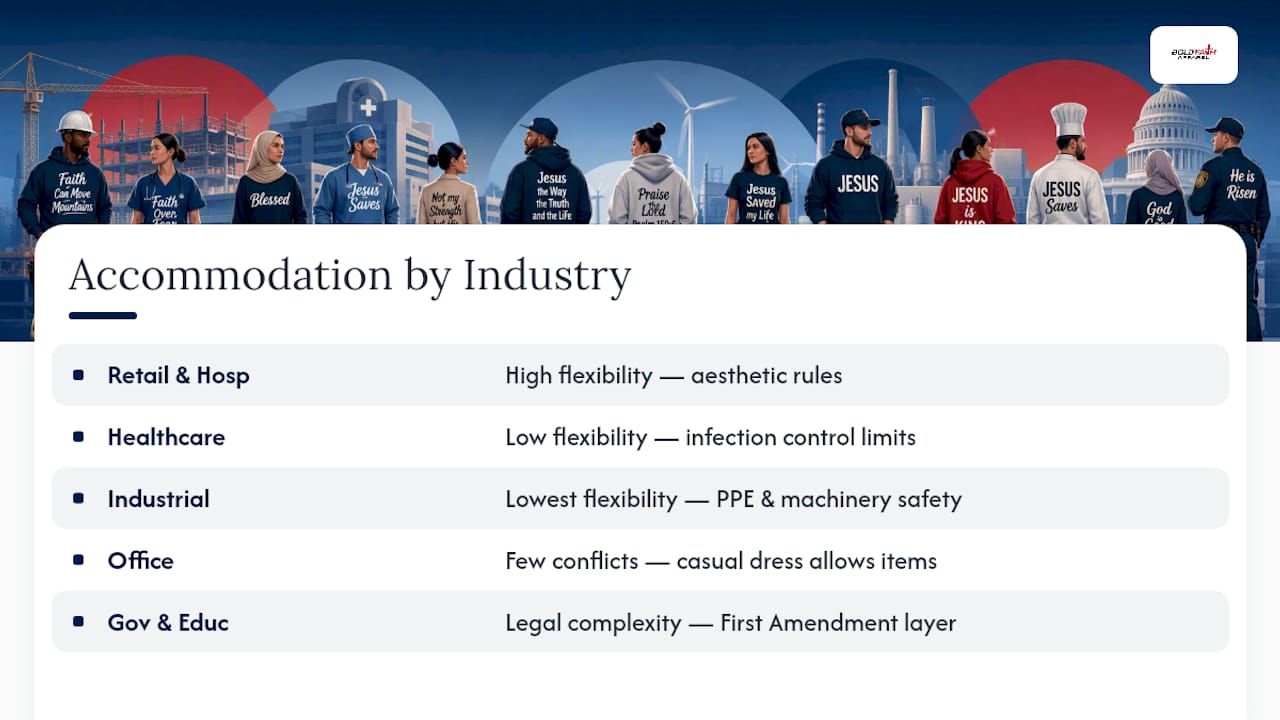
Manufacturing, construction, and industrial roles carry the highest volume of genuine safety-based limits, particularly around loose clothing near machinery and PPE fit. That doesn’t mean accommodation is impossible. It means the interactive process usually needs to involve a safety officer, not just HR.
Office and professional services roles see the fewest conflicts of all, largely because most office dress codes are casual enough that religious jewelry, modest clothing, and even faith-themed apparel on casual days simply don’t collide with policy. Government and education roles carry the First Amendment layer discussed earlier, adding legal complexity beyond what most private employers face. Knowing which category your workplace falls into helps you gauge, realistically, how much friction to expect before you even raise the issue.
Building an Inclusive Dress Code Policy That Works
Employers who get ahead of this issue write policies once and rarely deal with disputes. Those who don’t end up handling every request as a surprise, which breeds inconsistency and legal risk.
A strong policy starts with a general statement that religious accommodation requests will be considered individually rather than banned by category. Blanket rules (“no head coverings,” “no visible religious jewelry”) almost always create legal exposure, because they can’t account for the case-by-case analysis Title VII requires. A better structure lists the general dress code, then explicitly states that employees may request modifications for religious, disability, or medical reasons through a named HR contact.
Training matters as much as the written policy. Frontline managers are usually the ones fielding the first conversation, and a manager who reflexively says “company policy doesn’t allow that” without checking with HR creates a discrimination problem the company didn’t need to have. A five-minute training module covering “how to respond when an employee raises a religious dress question” prevents most of the disputes that end up at the EEOC.
Documentation habits round it out. Employers who keep a simple log of accommodation requests, whether approved or denied and why, build a defensible record and often notice patterns (like a supervisor who denies requests more often than peers) before they become a legal problem.
Religious Attire and Safety Gear: Finding the Resolution
The sharpest conflicts show up where a religious item physically interacts with required safety equipment. A hard hat over a turban, a respirator seal against a beard, a loose headscarf near a conveyor belt: these aren’t hypothetical HR debates, they’re daily realities in construction, manufacturing, and food processing.
The resolution almost always starts with a specific, documented safety standard rather than a general impression. If a respirator manufacturer specifies a clean-shaven seal area for effectiveness, that’s a real, provable hardship tied to a health standard, not a vague preference. In that specific case, an employer may lawfully require a trimmed beard length or reassignment to a role that doesn’t require that respirator, rather than banning the beard outright everywhere in the facility.
Turbans and hard hats have a documented solution already in wide industrial use: hard hats designed to fit over a turban, or a policy limiting the no-turban rule strictly to the specific task requiring head protection rather than the whole shift. Headscarves near moving machinery are usually solved with a tighter, tucked style or a shorter, fitted covering rather than an outright ban.
The pattern across all of these cases is the same: identify the specific, provable hazard, then look for the narrowest fix that addresses it. A blanket ban solves nothing that a targeted fix couldn’t solve better, and it’s usually the version that ends up in front of the EEOC.
Faithful Presence at Work Doesn’t Require a Fight
Most religious accommodation conversations never make it anywhere near a courtroom or an EEOC charge. They happen in a five-minute conversation between an employee and a supervisor who’s willing to listen. The law matters, and knowing it protects you, but the posture you bring to that first conversation usually matters just as much as the legal standard behind it.
There’s a temptation, especially for Christians who feel strongly about representing their faith visibly, to treat every dress code question as a battle. Sometimes it is one, and this guide exists precisely because some employers do deny requests they’re legally required to grant. But the strongest witness at work often isn’t the loudest one. An employee who wears a small cross, keeps a “Blessed” sticker on a laptop, or wears a scripture-themed shirt on casual Friday, and does it while being genuinely excellent at their job, tends to open more doors than one who leads with confrontation.
Professionalism and conviction aren’t opposites. You can hold your ground on a legitimate accommodation request while still being the coworker people trust, the employee who shows up early, and the one who treats a difficult customer with patience. That combination, quiet consistency plus visible faith, tends to outlast any single policy dispute. The goal isn’t just winning an accommodation. It’s representing Christ well in the process of asking for one.
Pursue what you’re legally entitled to. Don’t shrink your faith to avoid an awkward conversation with HR. But hold the relationships steady while you do it, because how you handle the request often says as much about your faith as the shirt you’re asking to wear.
— Larry
Wear Your Faith to Work Without the Guesswork
Boldfaithapparel designs Christian T-shirts and hoodies specifically with everyday wear in mind, including the office, the job site, and casual Friday. A graphic tee that reads “Faith Over Fear” or “Not My Strength but His” rarely triggers any dress code conflict at all, since most workplace policies restrict profanity or offensive graphics, not scripture.
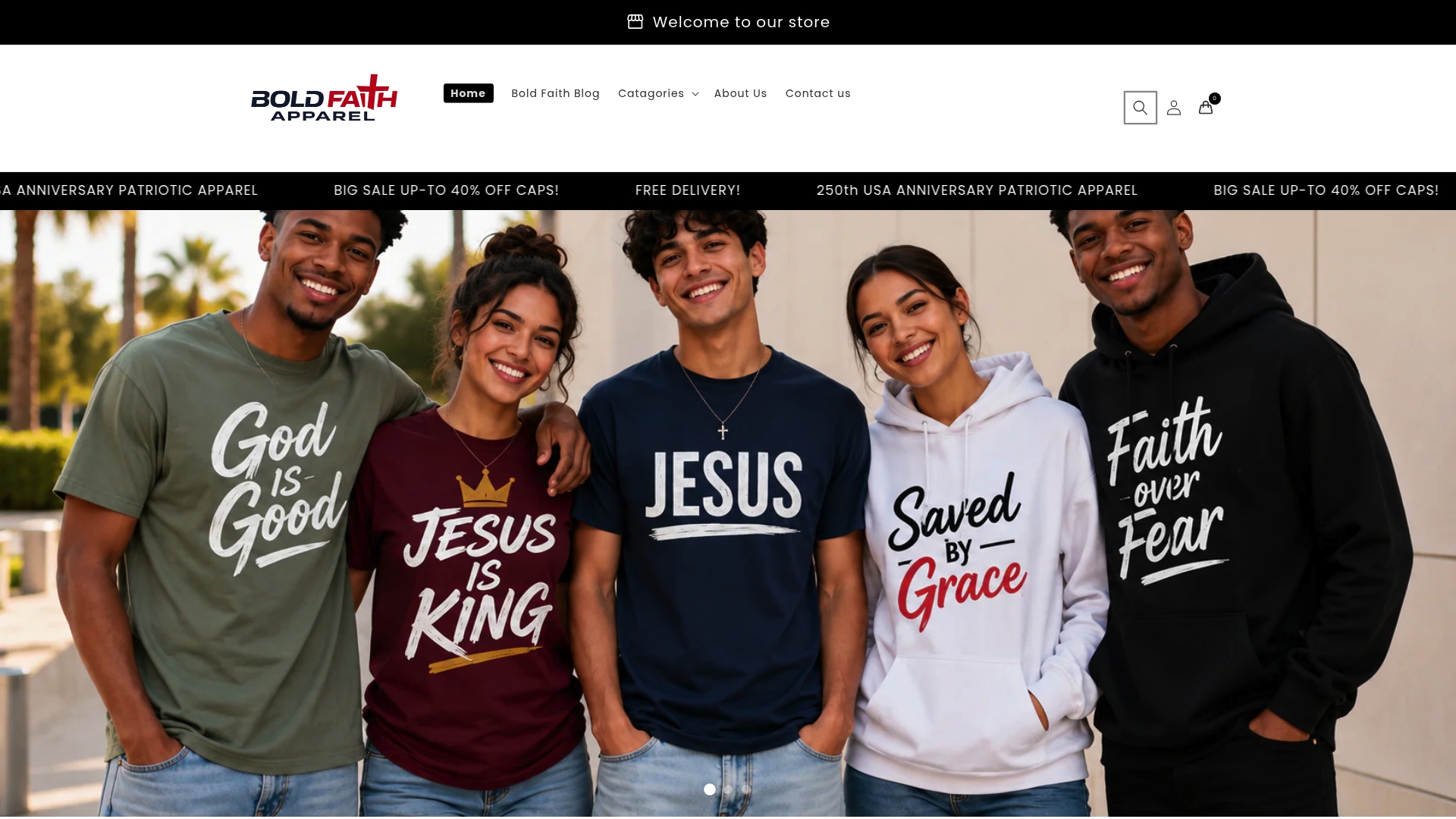
Designs featuring “Blessed,” “God Is Good,” “JESUS is KING,” or the full text of Psalm 23 work well under a cardigan or blazer in more formal office settings, and hoodies with faith-based statements like “There Is No Name of JESUS” or “He Is Risen” make an easy, low-key statement on casual days without needing any accommodation request at all. For roles with stricter uniform requirements, subtler pieces (a cap with a small cross, or a shirt with a faith message in a muted color scheme) tend to fit under company policy without drawing attention. Read more on how faith-based clothing carries testimony into everyday spaces, including the workplace.
Browse the full lineup of patriotic and faith-forward apparel at Boldfaithapparel and find a design that lets you represent Christ boldly, wherever you clock in.


