

Christian streetwear culture turns faith into a visible, conversational form of witness and belonging, giving believers, especially Gen Z, a daily tool for evangelism that fits naturally into contemporary life.
- Evangelistic utility: Brittany Winter’s research shows that updated streetwear designs give Gen Z a means to represent Jesus proudly and spark gospel conversations in spaces where traditional Christian messaging would be ignored.
- Visual language: Cultural critic Kevin Coval frames streetwear as an everyday embodiment of pluralism, a form of expression that restores depth and meaning to gestures in an image-saturated world.
Brands like Boldfaithapparel participate directly in this dynamic, producing T-shirts and hoodies printed with phrases like “Faith Over Fear,” “Jesus Saves,” and “Faith, Love, Hope” so that every wear becomes a public statement of conviction.
Table of Contents
- Where did Christian streetwear culture come from?
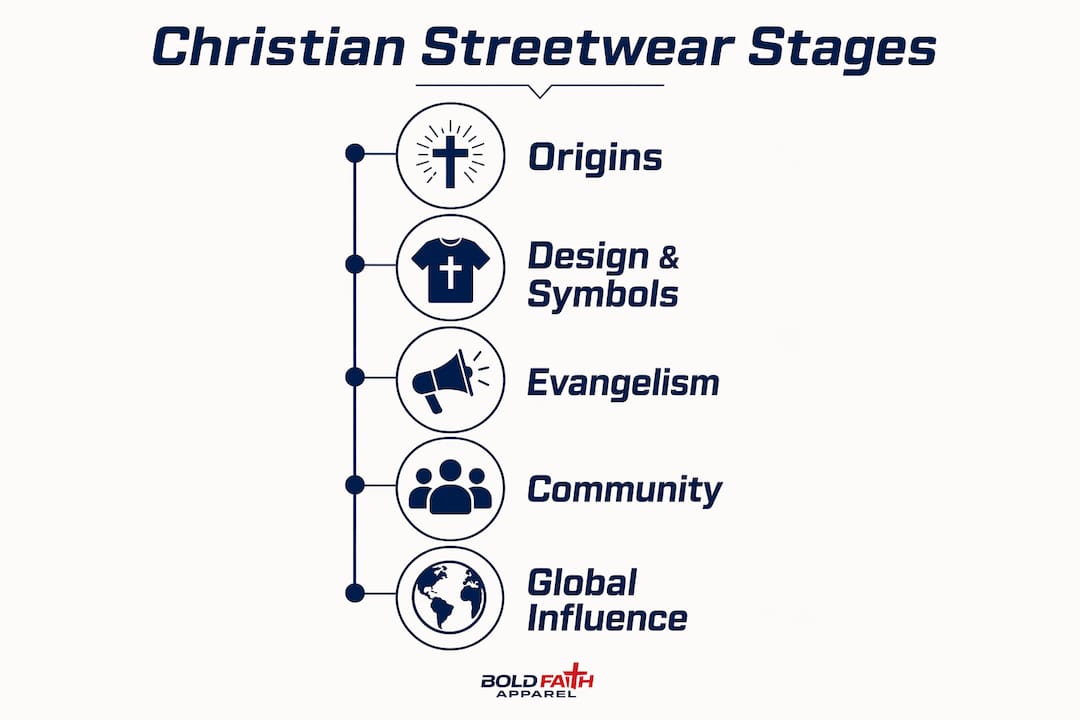
- How garments communicate faith through design and symbols
- How does streetwear function as evangelism and daily discipleship?
- How streetwear builds belonging among young Christians
- What are the main criticisms of Christian streetwear?
- How can individuals, churches, and brands participate responsibly?
- Boldfaithapparel’s perspective: faith-forward design as public testimony
- How does Christian streetwear look beyond the United States?
- Where does Christian streetwear meet mainstream pop culture?
- How has social media shaped Christian streetwear culture?
- Key Takeaways
- Why public witness through clothing still matters
- Further reading and sources cited
Where did Christian streetwear culture come from?
The movement did not appear overnight. Christian merchandise has existed since at least the 1970s, when bumper stickers and novelty tees carried simple slogans. That era’s designs aged poorly. By the 2000s, Gen Z was growing up with a largely negative view of Christian apparel, associating it with outdated fonts and clichéd phrases that felt embarrassing rather than bold.
The 2010s changed the equation. Streetwear itself, rooted in skateboarding, hip-hop, and workwear, had become the dominant youth aesthetic in America. When Christian creators began applying streetwear’s design logic, limited drops, clean typography, bold graphics, to faith-based messages, the results resonated. Then TikTok and Instagram accelerated everything. The Christiancore aesthetic turned silver crosses, biblical phrases, and sacred imagery into social-media content that millions of young people engaged with voluntarily, not because a church told them to.
How garments communicate faith through design and symbols
A Christian streetwear piece works because of specific design choices, not just the message it carries. The most common message types include:
- Verse tees: Full scripture references like “John 14:6” or “Psalm 150:6” printed in clean, readable type
- Single-word slogans: “JESUS,” “Faith,” “Blessed” in bold, high-contrast lettering
- Jersey-style scripture: Athletic-cut fonts that read like a team name, making faith feel like an identity, not a lecture
- Subtle iconography: Cross emblems, fish symbols, or crown graphics that signal belief without demanding a conversation
Typography and color do real work here. A navy hoodie with white block lettering reading “JESUS is KING” reads as culturally current. The same phrase in Comic Sans on a pale yellow tee reads as dated. Christian streetwear trends in 2026 favor high-contrast palettes, deep navy, red, black, and white, with clean sans-serif or bold serif fonts that hold up at a distance.
Cultural analysis from Worldcrunch notes that turning religious symbols into aesthetics offers young people a form of contemplation and identity in digital culture, which means design quality is not vanity. It is witness strategy.
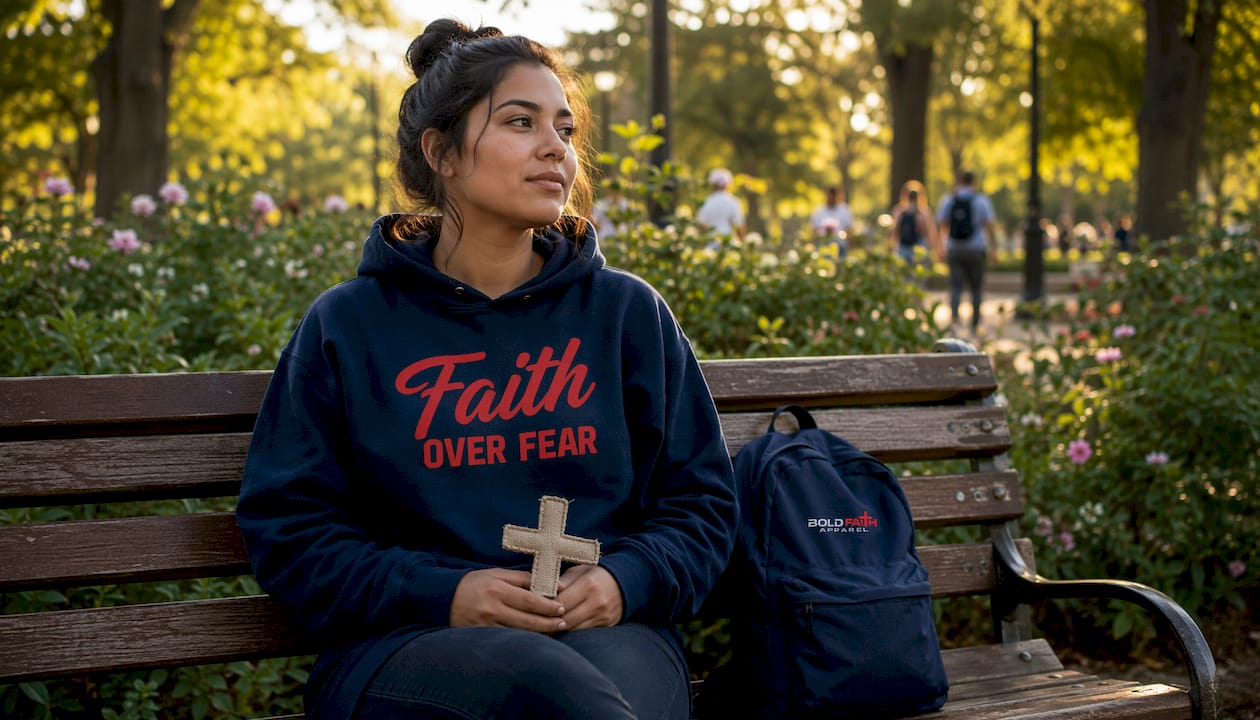
Pro Tip: Design for conversation, not just proclamation. A tee that asks “Not my Strength but His” invites a question. A tee that simply states a creed closes the loop before it opens. Open prompts placed on the chest or sleeve, in readable 36pt-plus type, generate more organic dialogue than back-print declarations.
How does streetwear function as evangelism and daily discipleship?
A garment worn daily is a repeated witness. Every commute, coffee shop visit, and gym session becomes a moment where faith is visible without a word spoken. That is the core mechanism: apparel as a conversation starter for outreach that requires no platform, no microphone, and no formal setting.
A hoodie printed with “Faith Can Move Mountains” worn to a college class does something a church bulletin cannot: it meets people where they are. Brittany Winter’s thesis documents that attractive Christian streetwear designs pique the interest of both Christian and non-Christian individuals, creating entry points for gospel conversations that feel natural rather than forced. That is discipleship in motion, not just decoration.
How streetwear builds belonging among young Christians
Platforms and formats that sustain Christian streetwear culture today:
- TikTok lookbooks and styling videos under faith-themed hashtags
- Instagram merch drops with countdown timers that create community anticipation
- Church youth-group branded hoodies that signal group membership
- Resale communities where limited Christian streetwear pieces trade hands
| Platform / Format | Scale Indicator |
|---|---|
| TikTok #christianfashion | More than 10 million videos accumulated |
| Instagram faith-apparel accounts | Millions of followers across category |
| Local streetwear pop-ups and hubs | Community-building and ethnic pride amplified |
| Church merch drops | Group identity and outreach combined |
Local hubs matter as much as digital platforms. Reporting from Interfaith America highlights how streetwear spaces, stores, pop-ups, and collaborative pieces, foster community and foreground identity in ways that purely online engagement cannot replicate. Boldfaithapparel connects both dimensions, offering faith-forward apparel that works in digital feeds and physical spaces equally.
What are the main criticisms of Christian streetwear?
Three tensions deserve honest attention:
- Commercialization: When faith becomes a product category, profit motives can crowd out mission. A brand selling “Jesus Saves” hoodies at premium prices with no charitable component raises fair questions about who benefits.
- Performative faith: Wearing a “He is Risen” tee without living that conviction publicly is a form of signaling that critics, inside and outside the church, notice quickly. Surface-level faith expression without depth undermines the witness the garment is meant to create.
- Cultural sensitivity: Faith and fashion research documents contested definitions of modesty and appropriateness across Christian communities. A design that resonates in one cultural context may feel tone-deaf or appropriative in another.
Many Christian brands address the commercialization concern directly. Reporting on Christian fashion brands indicates that many donate a portion of income to local Christian organizations, which builds purchaser trust and demonstrates mission alignment.
Pro Tip: Before launching or buying, ask three questions: Does this message reflect how I actually live? Does the brand give back to the community it claims to serve? Did anyone from the cultural context this design draws from have input on it? Honest answers to all three protect both integrity and witness.
How can individuals, churches, and brands participate responsibly?
For buyers:
- Confirm the message is one you can back up in conversation
- Check whether the brand supports churches, missions, or social projects
- Choose quality construction so the garment lasts and keeps representing well
For churches:
- Define the purpose before ordering: outreach, unity, or both
- Integrate merch into discipleship, not just events
- Consult across generations before finalizing a design
For brands:
- Design with intent, not trend-chasing
- Be transparent about manufacturing and giving practices
- Build in a way to measure spiritual impact, not just sales
That verse is the simplest brand brief ever written. When the motivation is glory to God rather than revenue or recognition, the design decisions, the pricing, the partnerships, all follow a clearer line. Spiritual urgency in faith-driven design starts with that question of motive.
Boldfaithapparel’s perspective: faith-forward design as public testimony
At Boldfaithapparel, the mission is direct: help believers wear their faith without apology. Every design decision starts with the question of whether a garment will open a door to a gospel conversation or simply fill a closet.
The messages Boldfaithapparel endorses for T-shirts and hoodies are chosen for clarity and witness potential:
- “Faith Over Fear” (white on deep navy, chest placement)
- “Faith Can Move Mountains” (bold red on black, oversized back print)
- “Jesus Saves” (clean white block type, front center)
- “JESUS is KING” (gold on black, jersey-style font)
- “Praise the Lord Psalm 150:6” (full verse, sleeve or back)
- “Not my Strength but His” (subtle chest, conversation-starter format)
- “There is Power in the name of JESUS” (full statement, back print)
- “Faith, Love, Hope” (three-word stack, minimalist front)
Color guidance: deep navy with red accents reads as bold and authoritative. Black with white or gold reads as premium. Both palettes hold up in digital content and physical settings. Placement on the chest or upper back maximizes visibility in everyday movement. The faith-based clothing guide at Boldfaithapparel walks through how message, placement, and color combine to increase readability and witness potential.
For visual styling inspiration, the GfaceGear lookbook shows how faith-forward apparel can be presented with confidence and cultural relevance.
How does Christian streetwear look beyond the United States?
The movement is not exclusively American. Christian streetwear brands have emerged across Latin America, sub-Saharan Africa, South Korea, and Australia, each adapting the core visual language to local cultural contexts. Australian brands like Project Sainthood produce hoodies and shirts explicitly for believers who want to “evangelise without speaking,” as founder Paula Tannous describes it. South Korean Christian youth culture has produced its own streetwear aesthetic, blending K-fashion minimalism with scripture-based graphics. In Latin America, brands lean into vibrant color palettes and community-centered drops tied to local church networks. The common thread across all these markets is the same: apparel as a daily, public declaration that faith is active, not private.
Where does Christian streetwear meet mainstream pop culture?
Christianity has shaped mainstream fashion for decades. Designers from Versace to Dolce & Gabbana have drawn on Christian imagery, crosses, saints, Marian figures, as high-fashion reference points. What Christian streetwear does differently is reclaim that imagery for actual believers rather than leaving it as aesthetic borrowing by secular houses. When a young Christian wears a “God is Good” hoodie in the same cultural moment that luxury brands are printing “anno domini” on runway garments, the message lands differently. It is not ironic. It is not borrowed. It is lived conviction wearing the same visual grammar as the culture around it. That convergence gives Christian witness clothing a cultural credibility it lacked when Christian apparel existed in a separate aesthetic universe from mainstream fashion.
How has social media shaped Christian streetwear culture?
Social media did not just spread Christian streetwear. It restructured how it works. TikTok’s #christianfashion tag has accumulated millions of videos, turning individual believers into micro-evangelists with global reach. A teenager in Ohio wearing a “Jesus Saved my Life” tee and posting a styling video reaches viewers in Brazil, Nigeria, and the Philippines within hours. Instagram’s visual format rewards high-quality photography, pushing Christian brands toward professional-grade content that competes directly with secular streetwear aesthetics. Limited drops announced via Instagram Stories create the same scarcity-driven community energy that secular streetwear brands use, but with a missional purpose behind the urgency. Digital platforms have also made accountability visible: brands that donate to churches or missions can document it publicly, and brands that do not are equally visible.
Key Takeaways
Christian streetwear culture functions as active evangelism, community identity, and public discipleship, most powerfully when design quality, mission clarity, and cultural sensitivity work together.
| Point | Details |
|---|---|
| Faith made visible | Streetwear turns belief into a daily, public witness without requiring a formal setting. |
| Gen Z evangelism tool | Updated designs give Gen Z confidence to represent Jesus and start gospel conversations naturally. |
| Design quality matters | Typography, color, and placement determine whether a garment opens conversations or gets ignored. |
| Tensions are real | Commercialization, performative faith, and cultural insensitivity each undermine the witness streetwear is meant to create. |
| Responsible participation | Buyers, churches, and brands should align message, mission, and giving practices before engaging. |
Why public witness through clothing still matters
Wearing faith publicly is not a new idea. The early church wore it in their conduct, their generosity, and their willingness to be identified with Jesus in spaces that were not safe. Today’s version of that looks different, a hoodie in a coffee shop, a tee at a concert, a cap on a commute. The form changes. The call does not.
The spiritual call here is simple: before you put on a garment with a faith message, ask whether your life backs it up. Apparel opens the door. Relationship, humility, and genuine love for the person asking the question are what walk through it. Use what you wear to build connections, not to perform conviction you have not yet lived. That is the difference between a costume and a testimony.
Further reading and sources cited
- Brittany Winter, “Evangelizing in Style: How Gen Z Youth Can Use Apparel as a Means of Evangelism” — Liberty University
- Worldcrunch, “Faith Filter: Sister Rosalía and TikTok’s Revival of Christiancore”
- EL PAÍS English, “Pretty girls love Jesus: Christian fashion brands for young people are on the rise”
- Interfaith America, “Faith in the Culture: The Pluralism in Being Fly”
- Academia.edu, “Faith and Fashion: Christian Dress and Identity”
- Boldfaithapparel — Faith-Forward Apparel for Bold Believers


