

The gospel is the good news that God sent Jesus Christ to live, die for sinners, and rise from the dead, so that anyone who repents and trusts him is forgiven and made new. Paul summarized it this way: “Christ died for our sins… he was buried, he was raised on the third day” (1 Corinthians 15:3–4). John put it another way: God gave his Son so “whoever believes in him should not perish but have eternal life” (John 3:16). At Boldfaithapparel, that message is the reason the brand exists.
TL;DR:
- The gospel is solely based on God’s decisive action in Christ’s death and resurrection, not human effort or moral improvement.
- Key scriptures like 1 Corinthians 15:3-4 and Romans 3 explain that all humans are sinners incapable of self-salvation.
- Salvation requires genuine repentance and faith, not performance, as it is a free gift from God, not earned by works.
- Distinguishing the gospel from law, justification from sanctification, and understanding its place in Scripture are essential for accurate faith.
- Sharing the gospel begins with simple explanations and can be reinforced through everyday witness and visible faith, like wearing apparel that sparks questions.
Table of Contents
- What Does “Gospel” Actually Mean?
- The Gospel in Four Parts: God, Man, Christ, Response
- The Core Bible Passages Every Believer Should Know
- How Do You Respond to the Gospel?
- What the Gospel Is Not
- Living Out the Gospel: The Great Commission and Everyday Witness
- Why the Gospel Shapes Everything Boldfaithapparel Makes
- Sources
What Does “Gospel” Actually Mean?
The word “gospel” translates the Greek term euaggelion, which simply means “good news.” It appears frequently across the New Testament, showing it was a central topic for the apostles. It was the message. Paul, Peter and the Gospel writers kept returning to it because the early church understood that everything else in Christian faith and practice flows from this one announcement.
Why call it “good news” instead of good advice or good instructions? Because news is something that has already happened, not something you’re told to go do. Good news, in the biblical sense, means God has acted, not that he has issued a new to-do list. That distinction matters more than it sounds like it should, and it’s the difference this article keeps coming back to.
Whether an announcement counts as “good” depends on what it’s being measured against. Against a holy, just God who cannot overlook sin, the natural news for humanity is bad. Against that backdrop, the announcement that God himself has provided a way of rescue is genuinely, urgently good.
The gospel doesn’t stand alone in Scripture. It’s the hinge point of the entire biblical story:
- Creation establishes God as maker and humanity as bearing his image.
- Fall explains how sin entered and broke that relationship.
- Redemption is where the gospel lives, God’s rescue plan through Christ.
- Restoration points to the future when God makes all things new.
Understanding the gospel means understanding where it sits in that larger story. It’s not a stray teaching. It’s the climax.
The Gospel in Four Parts: God, Man, Christ, Response
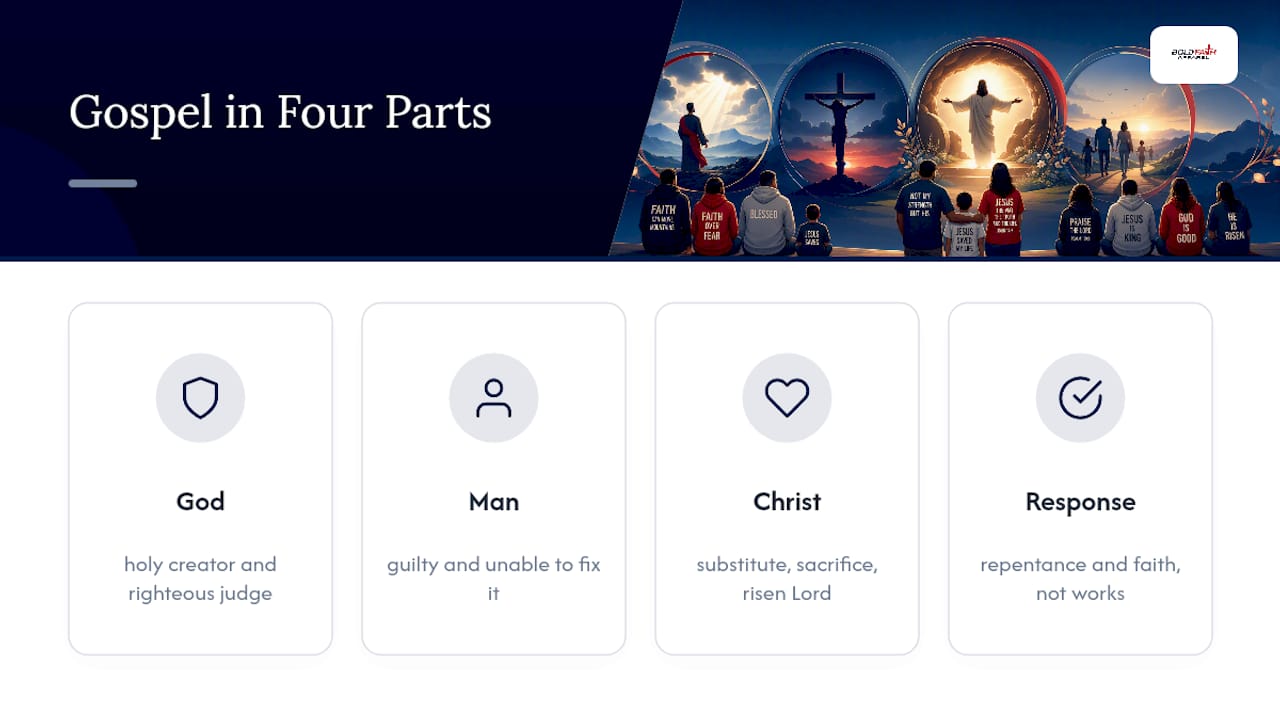
Ministries like 9Marks have popularized a four-part structure for explaining the gospel clearly, and it holds up well because it answers the questions any honest person asks: Who is God? What’s wrong with me? What did Jesus do about it? What am I supposed to do now?
1. God: holy creator and righteous judge
The gospel starts with who God is, not with human need. Skip this step and the rest of the gospel loses its weight. If God isn’t holy and just, sin isn’t a real problem and rescue isn’t really needed.
2. Man: guilty, and unable to fix it alone
Romans 3 lays this out without softening it: “All have sinned and fall short of the glory of God” (Romans 3:23). Not most people. Not the obviously bad ones. All of them. Romans 3:10-12 goes further, describing a universal condition, not a scattering of individual mistakes. This is the part of the gospel modern audiences resist hardest, because it means moral effort alone can’t close the gap between a holy God and a sinful person.
3. Christ: substitute, sacrifice, risen Lord
This is where the gospel turns from diagnosis to rescue. God the Son took on human flesh, lived the sinless life no one else could live, and died in the place of sinners. Paul states it directly: God “made him to be sin who knew no sin, so that in him we might become the righteousness of God” (2 Corinthians 5:21). That’s substitution: Christ takes what sinners deserve, and gives them what he earned.
The resurrection is not a postscript. Without it, the gospel has no proof and no power. Paul makes the stakes explicit in 1 Corinthians 15: if Christ wasn’t raised, Christian faith is worthless and believers are still in their sins (1 Corinthians 15:17). The empty tomb is what separates the gospel from every other religious claim about a good teacher who died.
4. Response: repentance and faith, not performance
The gospel demands a response, but the response isn’t a payment. Jesus opened his ministry with it: “Repent and believe in the gospel” (Mark 1:15). Paul echoes it in Romans 10:9-10: confess Jesus as Lord, believe God raised him, and you are saved. Ephesians 2:8-9 nails down why this can’t be earned: “By grace you have been saved through faith. And this is not your own doing; it is the gift of God, not a result of works, so that no one may boast.”
Quick fact: The word for “gospel” (euaggelion) appears 93 times in the New Testament, more than almost any other theological term the apostles used to describe their central message.
Put those four pieces together and you have a gospel presentation that doesn’t require theological training to follow, just an honest look at who God is, who we are, what Christ did, and what he’s asking in return.
The Core Bible Passages Every Believer Should Know
If you only had five passages to explain the gospel meaning to someone, these would carry the weight.
- 1 Corinthians 15:3-6 — Paul’s earliest recorded gospel summary: Christ died for sins, was buried, rose on the third day, and appeared to over 500 witnesses. This is the apostolic core, treated by scholars as the earliest creed of the Christian church.
- John 3:16-18 — God’s motive (love), his method (giving his Son), and the two possible responses (belief or condemnation), all in three verses.
- Romans 3, 5, and 10 — Romans 3 diagnoses universal sin, Romans 5 explains justification through Christ’s blood, and Romans 10 spells out the confession and belief that bring salvation.
- Ephesians 2:8-9 — The clearest single statement that salvation is a gift received by faith, not wages earned by effort.
- Matthew 28:18-20 — The Great Commission, where Jesus tells his followers to make disciples, baptize them, and teach them everything he commanded.
Pro Tip: Memorize 1 Corinthians 15:3-4 first. It’s short, it’s the earliest gospel summary on record, and it gives you a ready answer any time someone asks what Christians actually believe.
How Do You Respond to the Gospel?
Hearing the gospel and responding to it are two different things. Scripture consistently points to two inward postures paired with one outward step.
- Repent. Turn from trusting yourself, your morality, or your effort, and turn toward God. Jesus commanded it plainly: “Repent and believe in the gospel” (Mark 1:15). Repentance isn’t just regret; it’s a change of direction.
- Believe. Trust that Jesus’ death paid for your sin and his resurrection secured your new life. Romans 10:9 ties belief and confession together: “If you confess with your mouth that Jesus is Lord and believe in your heart that God raised him from the dead, you will be saved.”
- Confess and be baptized. Peter’s instruction on the day of Pentecost still applies: “Repent and be baptized every one of you in the name of Jesus Christ for the forgiveness of your sins” (Acts 2:38). Baptism doesn’t save you, but it’s the first public act of obedience for someone who does trust Christ.
- Get connected to a local church. The New Testament has no category for a lone believer with no community. Find a Bible-teaching congregation, a pastor, or a small group and tell them where you are in your faith.
If you’re ready to respond right now, it doesn’t require special language. Something as simple as, “God, I know I’ve sinned and I can’t fix that myself. I believe Jesus died for me and rose again. I’m turning to you and trusting him,” reflects exactly what Scripture calls for. What matters is the honesty of it, not the wording.
Pro Tip: If you just prayed something like that for the first time, tell someone today. A verbal confession to another believer, even just one text message, turns a private decision into the public step Scripture describes in Romans 10:9-10.
From there, four things build a foundation fast: get baptized, join a church family, start reading the Gospel of John or Mark, and ask someone spiritually mature to walk with you for the next few months.
What the Gospel Is Not
Confusion about the gospel usually comes from mixing it up with something adjacent but different.
- The gospel is not moral self-improvement. It’s not “try harder to be a good person.” It’s news about what God already did, not a coaching program for better behavior. Leaning gospel presentations toward a moral checklist is one of the most common ways churches accidentally water down the message.
- The gospel is not the whole Bible. Scripture contains history, law, poetry, prophecy, and wisdom. The gospel is the specific announcement of what Christ accomplished. All Scripture supports it, but not every verse in the Bible is “the gospel” itself.
- Justification is not the same as sanctification. Justification, being declared righteous, happens the moment you trust Christ. Sanctification, growing in obedience and character, happens over a lifetime afterward. Confusing the two leads either to “cheap grace” (professing faith with no life change) or to legalism (thinking your obedience is what saves you).
- Good works follow salvation; they don’t earn it. Genuine faith produces fruit, but that fruit is evidence of new life, not the payment for it.
Living Out the Gospel: The Great Commission and Everyday Witness
Jesus didn’t end his ministry with a private message. He ended it with a mandate: “Go therefore and make disciples of all nations, baptizing them… and teaching them to observe all that I have commanded you” (Matthew 28:19-20). In the original Greek, the single command is “make disciples”; going, baptizing, and teaching are the means of carrying it out. Evangelism and discipleship were never meant to be separated. You don’t just get someone to pray a prayer and walk away.
Sharing the gospel with friends doesn’t require a script, but a simple structure helps: “You know how none of us are perfect? The Bible says our sin separates us from a holy God. But Jesus died for that sin and rose again, and anyone who turns to him is forgiven and made new. That’s what changed my life.” Four lines. No jargon. Easy to remember and repeat.
Visible faith often opens that door before you even speak. A shirt with “Jesus Saves” or “Faith Over Fear” printed across it draws a glance, and a glance can turn into a question, and a question is an opening. Boldfaithapparel builds its apparel for evangelism around exactly that moment. It doesn’t replace a spoken gospel, but it starts conversations that might not happen otherwise.
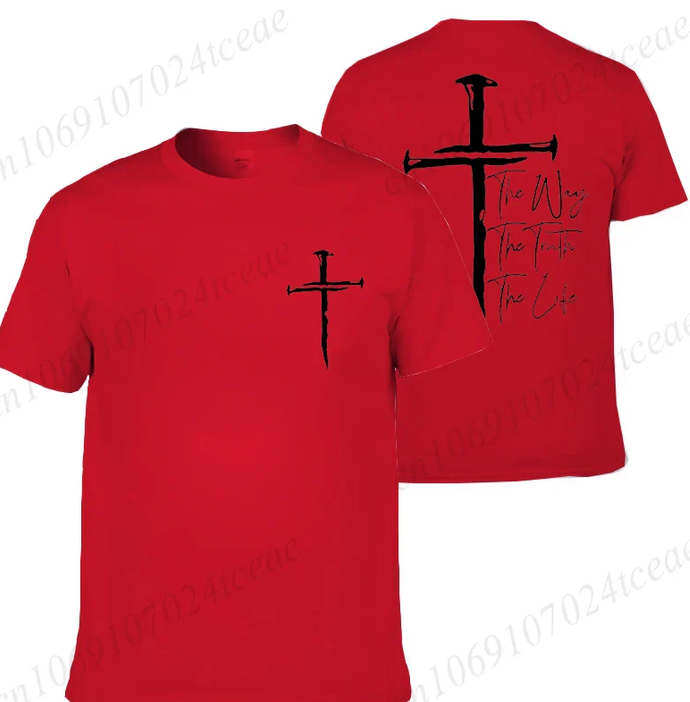
Pro Tip: Don’t force it. Wear the shirt, let someone ask about it, and answer honestly. A question they asked lands better than a sermon they didn’t.
Why the Gospel Shapes Everything Boldfaithapparel Makes
Every shirt and hoodie Boldfaithapparel prints exists because the gospel is real and worth saying out loud. This isn’t a company that added faith slogans to look relatable; the mission runs the other direction, apparel as a tool for testimony because the message underneath it changed everything first. “JESUS Saves,” “He is Risen,” “Not My Strength but His,” each design is a small, wearable confession that Christ’s death and resurrection are worth building a business around.
If this article helped clarify what you believe or what you’re still wrestling with, don’t let it stay private. Tell someone. Wear something that says it for you when the words don’t come easy.
— Larry
Sources
For deeper study, start with the Scripture passages themselves: 1 Corinthians 15:3-6, John 3:16-18, Romans 3–10, Ephesians 2:8-9, and Matthew 28:18-20. Beyond the biblical text, these resources go further:


