

Living faith today requires courage because faithful obedience to Christ regularly asks you to risk comfort, reputation, and social standing for an eternal good that the world cannot see. Joshua 1:9 frames this not as a motivational suggestion but as a direct command: “Be strong and courageous. Do not be afraid; do not be discouraged, for the Lord your God will be with you wherever you go.” Hebrews 11 catalogs believer after believer who acted on promises they could not yet touch. Matthew 10:28 cuts straight to the priority: fear God, not people. The Holy Spirit is the engine behind all of it. Courage is not a personality trait you either have or lack. It is a gift the Spirit develops in you as you trust God’s promises and act on them, one obedient step at a time.
Table of Contents
- Why Faith and Courage Are Inseparable in Scripture
- Why Courageous Faith Today Matters More Than Ever
- Biblical and Contemporary Examples of Courage in Action
- How to Build Courageous Faith: A 30-Day Starter Plan
- Common Misunderstandings About Fear, Courage, and Prudence
- Practical Scripts for Workplace, Family, and Online Witness
- Scripture Reading Plan, Prayers, and Recommended Books
- Take One Courageous Step This Week
- Key Takeaways
- A Word from Larry
- Useful Sources and Further Reading
Why Faith and Courage Are Inseparable in Scripture
Courage is the outward fruit of trusting God’s promises, not a separate virtue you bolt onto faith after the fact. When God tells Joshua to “be strong and courageous” four times in a single chapter, He is not coaching Joshua’s emotional state. He is commanding obedience grounded in a specific promise: I will be with you. The command and the promise are inseparable, and that pattern runs through the entire Bible.
Joshua 1:9 is a foundational command precisely because it links strength and courage directly to God’s presence rather than to human preparation or natural ability. Joshua did not feel fearless stepping into Moses’ role. He acted anyway because the promise was real.
Here are eight passages that anchor the faith-courage connection:
- Joshua 1:9 — Courage commanded because God’s presence is guaranteed.
- Daniel 3 — Shadrach, Meshach, and Abednego refuse to bow to Nebuchadnezzar’s idol; their courage rests on God’s ability to deliver, and their willingness to obey even if He does not.
- Daniel 6 — Daniel prays openly despite a royal decree; his faith in God outweighs the threat of the lions’ den.
- Hebrews 11 — The “hall of faith” shows that every act of courage listed (Abraham leaving home, Moses refusing Pharaoh’s court, Rahab sheltering the spies) flows from belief in an unseen promise.
- Acts 4:29–31 — The apostles, threatened by the Sanhedrin, pray not for safety but for boldness, and the Holy Spirit fills them to speak.
- Matthew 10:28 — Jesus reorders fear: do not fear those who kill the body; fear the One who holds eternity.
- 2 Corinthians 4:8–9 — The Apostle Paul describes being “hard pressed on every side, but not crushed,” a portrait of endurance powered by faith.
- Psalm 27:1 — “The Lord is my light and my salvation — whom shall I fear?” Courage here is a logical conclusion drawn from who God is.
The Holy Spirit is central to this formation. Fortitude is not willpower. It develops through spiritual formation as the Spirit equips believers to face both internal fear and external pressure. A Christian without courage, as Pope Francis has put it, is a useless Christian — not because God demands heroics, but because a faith that never risks anything has stopped trusting God’s promises.
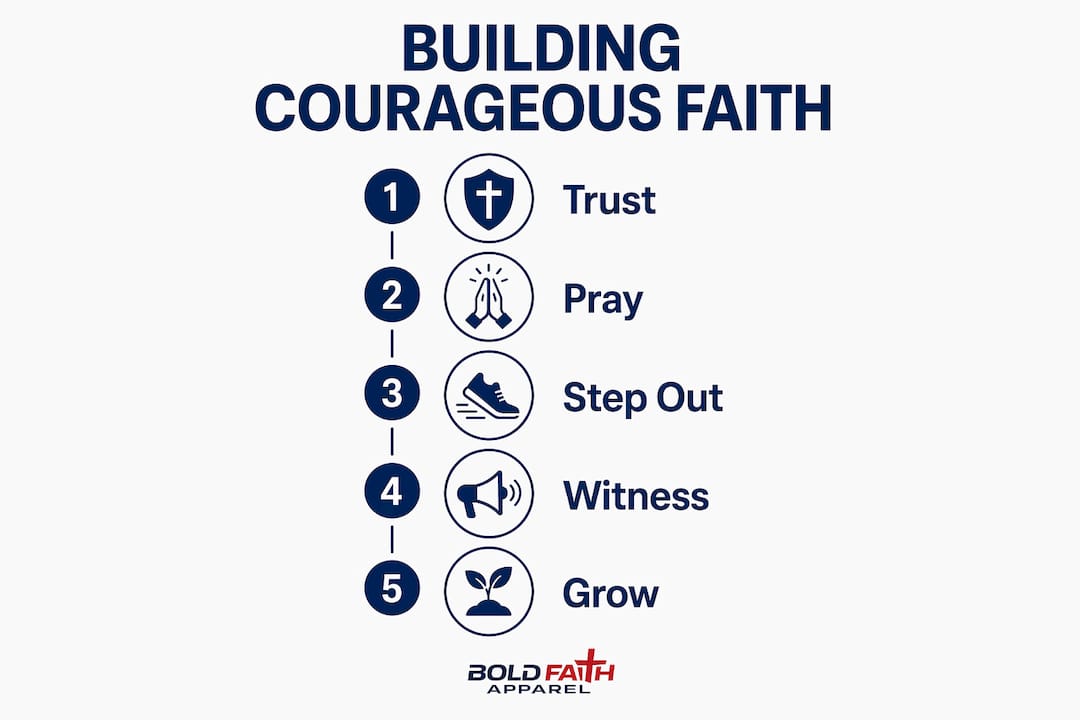
Why Courageous Faith Today Matters More Than Ever
The cost of courageous faith in the United States today is rarely physical. It is social, professional, and reputational. That shift does not make the cost smaller. For many believers, the fear of losing a friendship, a promotion, or a social media following feels just as paralyzing as any ancient threat.
Western moral courage means risking comfort, standing, or professional status rather than life itself. In stable, prosperous societies, Christians can drift into what theologians call a “soft faith” — one that prioritizes earthly approval and avoids any public witness that might generate friction. The church’s public witness erodes quietly, not through persecution, but through the slow habit of staying silent.
Consider where the pressure shows up most:
- Workplace — Sharing your faith, declining to participate in ethically compromised decisions, or simply praying before lunch can invite mockery or professional marginalization.
- Social media — Posting a Scripture or a conviction on a public platform invites immediate, often hostile, public response.
- Family gatherings — Disagreeing with a relative’s worldview or inviting someone to church can feel like the riskiest conversation of the week.
- Civic life — Holding a biblical position on contested cultural questions carries real reputational cost in many U.S. communities.
Public, fearless faith is not optional for the Christian. It is the natural expression of a life genuinely shaped by the gospel.
Pro Tip: Before you decide whether a situation calls for courage or prudence, ask one question: Am I staying silent because wisdom says this is not the right moment, or because I am afraid of what people will think? The answer usually clarifies the next step.
Biblical and Contemporary Examples of Courage in Action
Joshua steps into impossible shoes
After Moses’ death, Joshua faces the task of leading an entire nation into enemy territory. God’s command is not “feel confident.” It is “be strong and courageous” — act on the promise. Joshua moves forward. Ask yourself: Where is God calling you to lead when you feel completely unqualified?
Daniel refuses to compromise
Daniel prays three times a day in full view of his window, knowing the law forbids it and the penalty is death. His courage is not impulsive. It is the daily habit of a man whose relationship with God is non-negotiable. Ask yourself: What daily habit of faithfulness would you maintain even if someone were watching and judging?
The Apostle Paul and the early church speak under threat
After the Sanhedrin commands the apostles to stop preaching, Peter and John reply: “We cannot help speaking about what we have seen and heard” (Acts 4:20). The Apostle Paul later writes from prison, still urging churches to stand firm. Their courage is not bravado. It is the overflow of a Spirit-filled conviction that the gospel is worth every cost. Ask yourself: What truth about Jesus are you most tempted to soften in public?
A modern believer at work
A Christian engineer at a U.S. tech firm is asked to falsify a safety report. She declines, citing her integrity and her faith, and accepts the professional consequences. She does not lecture her colleagues. She simply holds the line. Bold Christian living often looks exactly like this: quiet, costly, and grounded in a specific conviction. Ask yourself: Where is your integrity being tested right now, and what would it cost you to hold it?
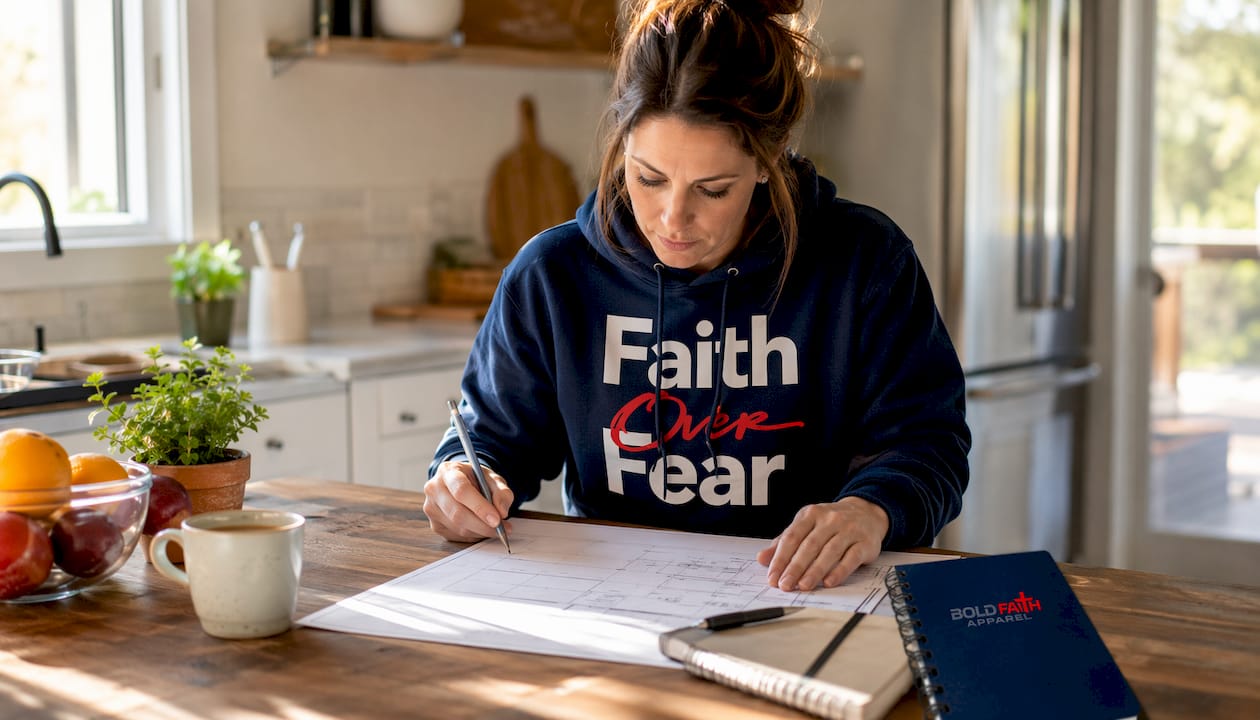
A hoodie that starts a conversation
A college student wears a hoodie printed with “JESUS Saves” to class. A classmate asks about it. That question opens a twenty-minute conversation about the gospel. Visible faith expression through apparel is a low-risk, high-frequency witness tool. Ask yourself: What does your everyday appearance say about what you believe?

How to Build Courageous Faith: A 30-Day Starter Plan
Courage develops through repetition. Avoiding small chances to witness atrophies your capacity for larger, costlier acts of faith. The 30-day plan below builds that capacity week by week.
Week-by-week milestones
- Week 1 — Foundation (Days 1–7): Memorize Joshua 1:9. Pray each morning for one specific person you want to witness to. Read Hebrews 11 in one sitting. Write down three promises of God you personally believe.
- Week 2 — Small acts (Days 8–14): Share one short testimony with a trusted friend. Wear or display one visible marker of your faith (a verse on a shirt, a Scripture on your desk). Fast one meal and spend that time in prayer for boldness.
- Week 3 — Stretch (Days 15–21): Invite one person to church or a small group. Post one Scripture on social media with a brief, gracious note. Memorize Acts 4:29 and pray it daily.
- Week 4 — Community and accountability (Days 22–30): Join or form an accountability pair. Share one area where fear has kept you silent. Commit to one recurring act of witness (weekly, not just this month).
Daily and weekly practices checklist
- Pray specifically for courage each morning (not just generally for “a good day”).
- Read one passage from Hebrews 11 or Acts each day.
- Confess one fear to God and one trusted believer each week.
- Offer one short, honest testimony per week in a natural conversation.
- Serve one person outside your comfort zone each week.
- Fast one meal per week and use that time to meditate on a specific promise of God.
Pro Tip: Pick your first brave step before you go to bed tonight — not a dramatic public declaration, but one small, bounded act: send a text with a Scripture, wear a faith-forward hoodie tomorrow, or pray out loud with a family member. Small acts train you for larger ones.
Anchoring decisions in specific scriptural promises, rehearsing those promises in prayer, and practicing simple acts of witness in community is the most practical method for translating faith into courage. Fasting sharpens focus and breaks the grip of comfort. Scripture memory gives you something to stand on when emotions argue the other way.
Common Misunderstandings About Fear, Courage, and Prudence
Fear does not equal faithlessness
Being afraid is normal. True courage is acting despite fear because you trust God’s presence and promises. Joshua trembled. The disciples panicked in the storm. Paul described his own weakness and fear in 1 Corinthians 2:3. None of that disqualified their obedience. Confusing emotional fear with spiritual failure is one of the most common and most damaging misconceptions in Christian life.
Boldness is not always public confrontation
Christian courage is best understood as courage directed toward a higher good. Suffering that serves no purpose is not virtue but needlessness. Prudence and justice shape true courage. Standing firm in a meeting is courage. Knowing when to withdraw from a toxic argument is also courage. The difference is whether the action serves the gospel and the other person, or whether it serves your ego.
Three questions before you act
Before taking a risky step in the name of faith, ask:
- Is this obedience or pride? Am I acting because God’s Word calls me to, or because I want to be seen as bold?
- Have I sought counsel? Isolated decisions made in emotional heat are rarely wise. A trusted pastor or accountability partner adds clarity.
- Does this serve the other person? Courage that humiliates, shames, or alienates without any gospel purpose is not courage. It is noise.
Red flags to watch
Watch for pride (wanting to be known as the brave one), isolation (making big decisions without community input), and a desire for notoriety (framing your witness primarily around your own story rather than Jesus). Any of these signals a pause and a conversation with a pastor or trusted mentor.
Practical Scripts for Workplace, Family, and Online Witness
Short scripts for common situations
- Workplace: “I appreciate the invitation, but I’m going to sit this one out. My faith shapes how I handle this kind of decision.”
- Family: “I love you, and I also believe this. Can we talk about it without it becoming a fight?”
- Online: “Here’s what I believe and why. I’m happy to keep talking if you’re genuinely curious.”
None of these scripts are combative. All of them are honest. That combination is what gracious, truthful witness looks like.
Comparing contexts: visibility, risk, and opportunity
| Context | Visibility | Control of tone | Likely social cost | Witness opportunity |
|---|---|---|---|---|
| Workplace | Medium | High (face-to-face) | Professional reputation | Integrity under pressure |
| Family | Low to medium | Medium (emotional) | Relationship friction | Long-term relational trust |
| Online | High | Low (public, permanent) | Broad reputational | Wide reach, low depth |
The workplace gives you the most control over tone. Online gives you the widest reach but the least ability to manage how your words land. Family conversations carry the highest emotional stakes but also the deepest long-term potential.
Dos and don’ts for online witness
- Do post Scripture with a brief, personal note about what it means to you.
- Do respond to hostile comments with one calm, gracious sentence and then stop.
- Do use faith-forward apparel photos as natural conversation starters on social platforms.
- Don’t argue in comment threads past the point of genuine dialogue.
- Don’t shame or mock people whose worldview differs from yours.
- Don’t amplify outrage. Amplify grace.
Scripture Reading Plan, Prayers, and Recommended Books
4-week reading plan
| Week | Passages | Focus |
|---|---|---|
| 1 | Joshua 1; Hebrews 11; Psalm 27 | God’s command and the history of faithful courage |
| 2 | Daniel 3 & 6; Acts 4; Matthew 10:28 | Courage under direct threat |
| 3 | 2 Corinthians 4; Philippians 1:12–30; Romans 1:16 | The Apostle Paul’s theology of courageous witness |
| 4 | 1 Peter 3:13–17; Ephesians 6:10–20; Revelation 2:10 | Armor, endurance, and the final word |
Recommended books
- Courage by R.C. Sproul — A short, theologically grounded case for why courage is a Christian duty, not a temperament.
- Mere Christianity by C.S. Lewis — Covers the virtue of courage as the form every other virtue takes at the moment of testing.
- The Insanity of God by Nik Ripken — A field report on persecuted believers whose faith under pressure redefines what courage costs.
- Spiritual Disciplines for the Christian Life by Donald Whitney — Practical formation through fasting, Scripture memory, and prayer; directly feeds courage-building habits.
- Onward by Russell Moore — Addresses how American Christians can hold convictions with courage and grace in a shifting cultural moment.
Sample prayers
Before a hard conversation: Lord, give me words that are true and kind. Let the other person hear You, not just me. Remove my fear of their reaction and replace it with love for their soul.
When fear is loudest: I am afraid. You are present. Your promises are true. I choose to act on what I know, not on what I feel. Be my strength today.
Take One Courageous Step This Week
Pick one small, specific act before this week ends. Share a short testimony with one person. Invite a neighbor to church. Post a Scripture on your social feed with a line about what it means to you. Wear a hoodie that says “Faith Over Fear” or “JESUS Saves” and let the conversation come to you.

Boldfaithapparel exists to help you make that step visible. A T-shirt or hoodie printed with “Not My Strength but His” or “There Is Power in the Name of JESUS” is not just clothing. It is a daily reminder of what you believe and an open door for the people around you. Shop bold faith apparel and wear your conviction.
The Holy Spirit does not ask you to be fearless. He asks you to be faithful. Take one step. He will meet you there.
Key Takeaways
Faith requires courage today because obedience to Christ consistently asks believers to risk social standing, comfort, and reputation for an eternal good the world cannot see.
| Point | Details |
|---|---|
| Courage is commanded, not optional | Joshua 1:9 frames courage as a direct command grounded in God’s promise of presence. |
| The Holy Spirit enables it | Courage is a gift of the Spirit developed through spiritual formation, not human willpower. |
| The modern cost is social | In the U.S., courageous faith typically risks reputation and relationships, not physical safety. |
| Small acts build capacity | Consistent small witness actions train believers for larger, costlier acts of obedience over time. |
| Community sustains it | Accountability partners and small groups are where courageous faith is formed and maintained. |
A Word from Larry
The believers who have impressed me most were not the ones who made the loudest declarations. They were the ones who showed up consistently: the man who prayed out loud before lunch in the company cafeteria every single day, the woman who wore a hoodie printed with “Jesus the Way the Truth and the Life John 14:6” to her college orientation and fielded three conversations about it before noon. Neither of them had a strategy. They just decided that their faith was worth being visible.
That is what Boldfaithapparel is built around. Not performance. Not noise. Just the quiet, daily decision to let what you believe show up in how you live and what you wear. Hebrews 10:23 says, “Let us hold unswervingly to the hope we profess, for he who promised is faithful.” The promise is real. The step is yours.
Useful Sources and Further Reading
Core Scripture references cited in this article
- Joshua 1:9; Joshua 1:1–18
- Hebrews 11:1–40; Hebrews 10:23
- Matthew 10:28; Matthew 14:26–27; Matthew 6:25–30
- Daniel 3:1–30; Daniel 6:1–28
- Acts 4:20, 29–31
- 2 Corinthians 4:8–9; 2 Corinthians 1:3–4
- Philippians 1:12–30
- Romans 1:16; Romans 10:17
- Psalm 27:1
- 1 Peter 3:13–17
- Ephesians 6:10–20
- Revelation 2:10
Recommended articles and books
- Let Your Heart Take Courage — Desiring God; connects faith, God’s promises, and the call to courage with pastoral depth.
- Why Courage Matters — Cru devotional; practical case for building courage through repeated small acts of witness.
- Be Strong and Courageous Is Not an Inspirational Hurrah — Bible Gateway; exegetical commentary on Joshua 1:9 as a command, not a feeling.
- Christian Courage Is More Than Suffering Bravely — Christianity Today; theological distinction between purposeful courage and gratuitous suffering.
- Willing to Die? Why Christians Need to Recover Their Moral Courage — Premier Christianity; maps the specific costs of moral courage in Western stable societies.
- Spiritual Disciplines for the Christian Life by Donald Whitney — Best single-volume guide to the habits (fasting, Scripture memory, prayer) that build courageous faith from the inside out.
Small-group and accountability resources
- Use the 4-week reading plan above as a small-group curriculum: one week per session, with the application questions from the case studies as discussion starters.
- Pair each participant with an accountability partner for the 30-day habit plan.
- Connect with your local church’s discipleship or men’s/women’s ministry for ongoing community support. Courage formed in isolation rarely holds.


