

Faith grows in suffering when you take four intentional actions: pray honestly, root your mind in Scripture, stay connected to Christian community, and serve others in small ways, starting today. This is not a passive process. James 1:2-4 tells believers that trials, faced rightly, produce perseverance and complete the work of maturity. That means growth during hardship is not automatic, but it is available to anyone willing to practice these disciplines on purpose.
Start this hour with the following:
- Pray one honest sentence, even if it’s just “God, this hurts and I don’t understand.”
- Read one short passage, Psalm 23 or Philippians 4:6-7 work well for a starting point.
- Text one trusted believer and ask for prayer, don’t wait for a “good” moment.
- Do one small act of service, a note, a call, a meal for someone else in pain.
- Write down one specific need you’re facing right now. Naming it is the first faithful step.
Key Takeaways
Faith grows during suffering through the deliberate practice of honest prayer, Scripture immersion, Christian community, and small acts of service sustained over time.
| Point | Details |
|---|---|
| Prayer includes lament | Honest lament and thanksgiving, not just petition, is a biblical practice supported in Philippians 4:6-7. |
| Trials build perseverance | James 1:2-4 teaches that testing produces steadfastness and completes spiritual maturity over time. |
| Community prevents isolation | Reaching out to a small group, mentor, or counselor before you feel ready guards against spiritual stalling. |
| Second-arrow suffering is avoidable | Self-compassion and present-moment practices reduce the extra suffering added by rumination. |
| Apparel supports, doesn’t replace | Boldfaithapparel’s faith-based T-shirts and hoodies offer a visible daily reminder alongside prayer and counsel, not instead of it. |
Table of Contents
- Biblical Grounding: Why Suffering Can Grow Faith
- Step 1: Practice Honest Prayer, Lament, and Thanksgiving
- Step 2: Root Your Soul in Scripture Daily
- Step 3: Stay Connected to Christian Community
- Step 4: Serve Others in Small, Sustainable Ways
- Step 5: Build Daily Habits That Sustain Faith Long Term
- A 30-Day Plan That Blends Faith and Emotional Care
- Common Traps That Stall Faith Growth
- Prayers and Verses to Lean on Right Now
- A Pastoral Word for the Hard Days
- Wear the Reminder, Not Just Read It
- Sources
Biblical Grounding: Why Suffering Can Grow Faith
Scripture doesn’t treat suffering as an obstacle to faith. It treats suffering as the classroom where faith gets built. Three passages carry the weight of this claim.
- James 1:2-4 says trials test faith to produce steadfastness, “that you may be perfect and complete, lacking in nothing.” The testing of faith produces perseverance and maturity, not sinless perfection, according to biblical teaching on this passage.
- Romans 5:3-5 links suffering to endurance, endurance to character, and character to hope, a chain reaction Paul says “does not put us to shame.”
- Philippians 4:6-7 commands prayer with thanksgiving in place of anxiety, promising a peace that “surpasses all understanding.”
“Count it all joy” doesn’t mean pretending pain doesn’t exist. It means choosing to trust that God is using the trial to shape something durable in you, a posture pastoral teachers describe as honest grief paired with confident trust.
Testing, in biblical language, is not punishment. It’s refinement. Perseverance isn’t gritting your teeth. It’s staying engaged with God through the process instead of walking away from Him when the process gets hard. That distinction matters for anyone wondering whether their pain has any purpose at all.
Step 1: Practice Honest Prayer, Lament, and Thanksgiving
Lament is a biblical prayer form, over a third of the Psalms use it, and it exists because God wants your actual feelings, not a performance. Faking peace you don’t feel isn’t faith. It’s avoidance.
Two short prayers to adapt:
- Lament: “Lord, I feel abandoned right now, and I don’t understand why this is happening. But I remember You have not left me before.”
- Petition of trust: “God, I’m asking You to carry what I can’t. I trust Your character even when I can’t see Your plan.”
Build a small habit around this. Set a daily 5 to 10 minute window, morning or night, and journal one sentence about what you feel and one sentence about what you know to be true of God. Over weeks, that journal becomes evidence of growth you can look back on.
Pro Tip: Use the phrase “Lord, I feel… but I remember…” as a prayer scaffold. It lets you hold pain and trust in the same sentence without pretending either one away.
Step 2: Root Your Soul in Scripture Daily
Feelings shift hour to hour. Scripture doesn’t. Reading it daily during suffering isn’t a spiritual chore, it’s how your mind gets recalibrated to what’s actually true when everything else feels uncertain.
Start small. Pick one topical passage per week rather than trying to read broadly:
- Anxiety: Philippians 4:6-7, pray specific requests instead of generic worry.
- Endurance: Romans 5:3-5, remember suffering is producing something, not just draining you.
- Comfort: Psalm 23, “He restores my soul” is a promise, not a metaphor.
Memorize one verse a week. Write it on a note card or set it as your phone lock screen so it interrupts your day instead of waiting for you to seek it out. A simple morning rhythm, coffee first, then five minutes in one passage, builds consistency without demanding willpower you don’t have right now.
Pro Tip: Attach Scripture reading to something you already do daily, like coffee or your commute. Habit stacking beats willpower every time, especially when you’re exhausted.
Step 3: Stay Connected to Christian Community
Isolation is where faith goes to stall. Suffering tempts you to withdraw right when you need people most, which is exactly why reaching out has to be intentional, not optional.

A simple script for asking: “I’m going through something hard right now. Could you pray for me and check in this week?” That’s it. You don’t owe anyone the full story to ask for support.
Match the need to the right person:
- Small group: ongoing accountability and shared prayer for weekly rhythm.
- Pastor or mentor: wisdom and biblical counsel for bigger decisions or doubts.
- Christian counselor: trained support when pain runs deeper than a conversation can hold.
Pro Tip: Choose someone who has weathered hardship themselves, not just someone with good intentions. Frame the ask around a specific need, not a vague “I’m struggling,” so they know exactly how to support you.
Step 4: Serve Others in Small, Sustainable Ways
Suffering pulls your focus inward. Service pulls it back out, and that outward turn is often where bitterness loses its grip.
Low-cost options that fit even a depleted season:
- Write a short encouragement note to someone else who’s hurting.
- Prepare or deliver one meal.
- Make a five-minute check-in call to someone you know is struggling too.
Set a boundary here. Service should relieve pain, not mask it or become a way to avoid your own grief. If serving others is replacing your own prayer and rest, that’s avoidance, not growth.
Pro Tip: Pick one act of service this week, not five. Sustainability matters more than volume when your reserves are already low.
Step 5: Build Daily Habits That Sustain Faith Long Term
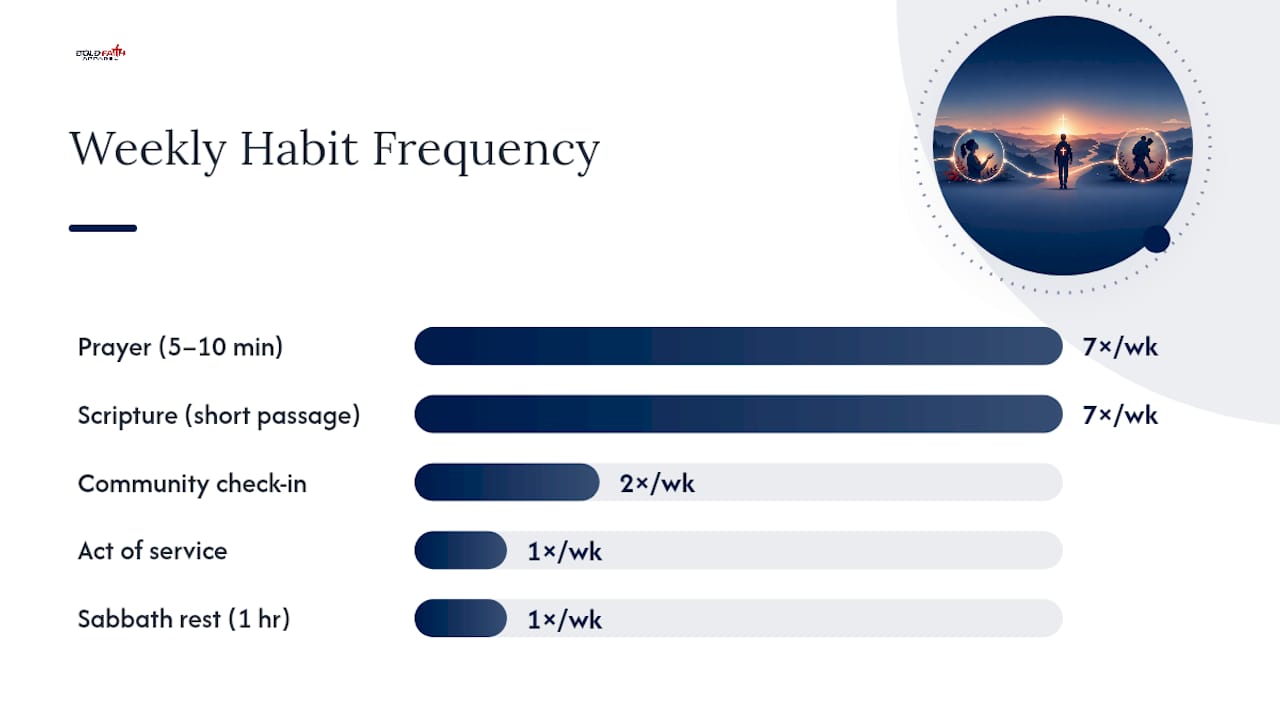
A single good day of prayer won’t carry you through a prolonged trial. A rhythm will. Endurance forms in the deep end of ongoing practice, not in occasional bursts of spiritual effort.
A sample weekly rhythm:
- Daily: five to ten minutes of prayer and one short Scripture passage.
- Twice weekly: a community check-in, text, call, or small group.
- Weekly: one act of service and one hour of Sabbath rest.
Disciplines worth rotating into that rhythm:
- Silence: quiets the noise long enough to hear what God is doing.
- Fasting: sharpens spiritual focus by removing a comfort temporarily.
- Sabbath rest: reminds you that your worth isn’t tied to output.
- Journaling: creates a record of growth you’d otherwise forget.
Pro Tip: Start with the smallest version of the habit. Two minutes of prayer beats zero, and a habit you’ll actually keep beats an ambitious one you’ll abandon by Thursday.
A 30-Day Plan That Blends Faith and Emotional Care
Spiritual growth and emotional health aren’t competing priorities during suffering. They work together, and pretending otherwise usually stalls both.
Weeks 1 to 4, a simple structure:
- Week 1, name it. Daily lament prayer, journal one honest sentence each day, read Psalm 23 twice.
- Week 2, root it. Add one memorized verse (Philippians 4:6-7), reach out to one community member for a standing check-in.
- Week 3, connect it. Attend or join a small group session, have one honest conversation with a pastor, mentor, or counselor about how you’re really doing.
- Week 4, serve and reflect. Complete one act of service, then journal what changed in your outlook over the past three weeks, even small shifts count.
Therapeutic literature describes a useful concept here: the “first arrow” is the suffering itself, unavoidable and real. The “second arrow” is the extra suffering you add through rumination, self-blame, or isolation. Practices like self-compassion and present-moment awareness reduce that second arrow without minimizing the first. Pausing before a spiral of “what if” thoughts and returning to one true statement about God’s character is a practical way to apply this daily.
Watch for red flags that call for more than spiritual disciplines alone. Persistent hopelessness, thoughts of self-harm, severe functional decline, or an inability to engage in basic spiritual practice for weeks at a time are signals to add a licensed counselor to your support system, not signs that your faith has failed. Seeking counseling alongside prayer is integration, not compromise.
Measuring progress during suffering is tricky because feelings lag behind spiritual reality. Look for these signs of growth instead of waiting to feel better:
- You’re praying more honestly, even if you’re praying more often about pain.
- You’re reaching out before isolating, even if it’s hard to do.
- You notice moments of gratitude, even small ones, amid the hard days.
Discouragement is not the same as spiritual failure. Feeling low while still showing up to pray, read, and connect is growth, not stagnation.
Common Traps That Stall Faith Growth
Three traps derail more believers than any theological confusion does.
- Bitterness shows up as replaying the injustice on repeat and resenting God or others. Correct it with honest confession and one trusted accountability conversation.
- Isolation feels like withdrawing from community “until I feel better.” Correct it by reaching out before you feel ready, not after.
- Doubt spirals masquerade as endless theological questioning that never lands anywhere. Correct it by bringing the doubt to a pastor or mentor instead of processing it alone in your head.
Pro Tip: The moment you notice yourself avoiding prayer, community, or rest, name it out loud. That single act of naming the red flag is often the first faithful step back.
Prayers and Verses to Lean on Right Now
Keep these close for the moments words won’t come easily.
- Complaint: “God, I don’t understand this, and I’m tired of pretending I do.”
- Trust: “I don’t have to see the end to trust You with today.”
- Thanks: “Thank You for staying close even when I can’t feel it.”
Verses worth memorizing this month: Philippians 4:6-7, Romans 5:3-5, James 1:2-4, and Psalm 23:1-4. Write one on a card, keep it visible, and pray it out loud once a day.
Faith that grows in suffering rarely feels dramatic in the moment. It looks like showing up to pray one more day than you wanted to.
A Pastoral Word for the Hard Days
Real pain doesn’t need to be minimized to be met by God. He is present in the waiting, the confusion, and the nights that feel endless, not just in the resolution. You don’t need a breakthrough today. You need one faithful step, a prayer, a verse, a phone call to someone who cares.
Keep taking that step. That’s how faith grows.
Wear the Reminder, Not Just Read It
Some days you won’t have words for what you’re carrying, but a shirt on your body can still preach a sermon your mouth can’t manage. Christian apparel that speaks your faith works as a quiet, visible anchor during the hard seasons, the kind of daily reminder that meets you before you’ve even prayed.

Boldfaithapparel carries T-shirts and hoodies built around messages like “Faith Over Fear,” “Not My Strength but His,” and “There Is Power in the Name of Jesus,” alongside pieces reading simply “Faith” or “Jesus Saves” in bold navy and red typography. A Christian bible verse hoodie or a comfort-print tee reading “God Is Good” can serve as a physical checkpoint on days when Scripture feels distant. Apparel is not a substitute for prayer, Scripture, community, or counseling, but it can support the practices this article walks through, a wearable reminder of truth on the days you need it most visible. Visit Boldfaithapparel’s collection to find a message that matches where you are right now.
Sources
These resources go deeper into the practices covered above.
- When God Uses Suffering to Build Your Faith | Truth For Life (Alistair Begg)
- 8 Ways Trials Help Us | The Gospel Coalition
- How Do We End Suffering? | Psychotherapy Networker


