

You can remain faithful and grow stronger under persecution by fixing your eyes on Christ, leaning on His promised strength, and taking three immediate spiritual actions. This is the bottom line: opposition does not have the final word over your faith. Right now, in the next hour, you can do three things to steady yourself.
- Pray a short prayer of surrender, naming exactly what you’re facing.
- Read one anchor verse aloud, slowly, twice.
- Text or call one trusted believer and ask them to pray with you today.
“Who shall separate us from the love of Christ? Shall trouble or hardship or persecution or famine or nakedness or danger or sword? … No, in all these things we are more than conquerors through him who loved us.” (Romans 8:35, 37)
Key Takeaways
Faith grows strongest under persecution when Scripture, prayer, and community work together instead of relying on any one alone.
| Point | Details |
|---|---|
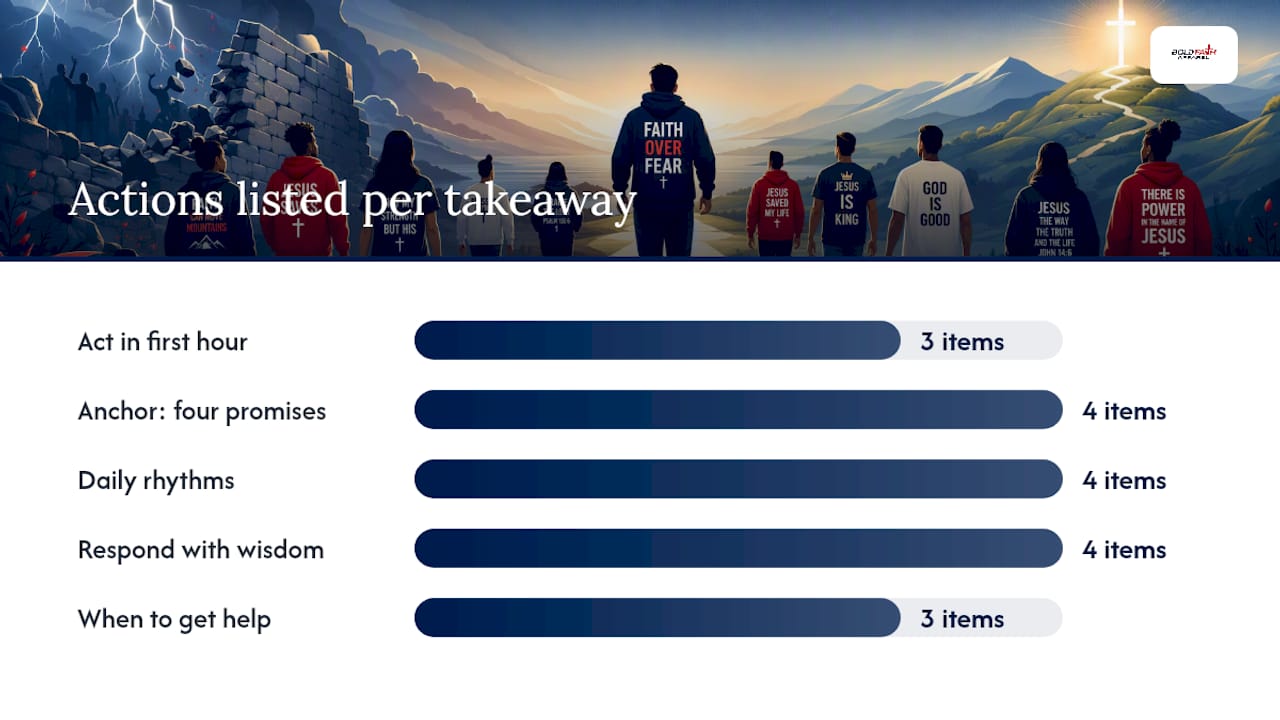
| Act in the first hour | Pray, read one anchor verse, and contact a trusted believer before the fear settles in. |
| Anchor in four promises | Fix your heart on God’s presence, strength, vindication, and future reward using memorized verses. |
| Build daily rhythms | Combine morning Scripture, midday prayer, evening confession, and weekly fellowship for steady endurance. |
| Respond with wisdom | Protect safety first, witness calmly and briefly, then document and call your community if needed. |
| Know when to get help | Seek pastoral or professional support immediately for isolation, suicidal thoughts, or trauma symptoms. |
Trusted Resources for Further Study and Support
Consult these for deeper study and support:
- How to stand fast in the faith — practical steps for steadfastness.
- Standing firm in faith when opposed — four anchors for hostile seasons.
- Your faith muscle needs exercise — on trials and maturity.
- Browse Christian Witness Clothing That Speaks Boldly for wearable reminders of your convictions.
Table of Contents
- Why Facing Persecution Can Make Your Faith Stronger
- What Bible Verses Anchor You During Persecution?
- What Daily Habits Keep Your Faith Strong Under Pressure?
- How Should You Respond When You’re Actually Persecuted?
- What Prayers and Practices Help You Endure Ongoing Trials?
- How Can You Turn This Trial Into Lasting Growth?
- When Should You Seek Pastoral or Professional Help?
- A Pastor’s Reminder: You’re Not Meant to Carry This Alone
- Sources
Why Facing Persecution Can Make Your Faith Stronger
Persecution can strengthen faith, but only when you meet it with a gospel-shaped response instead of bitterness or retreat. Scripture doesn’t pretend suffering feels good. It insists suffering has a purpose when it’s carried to Christ rather than carried alone.
Four passages form the backbone of this claim:
- Romans 8:35, 37 — nothing, including persecution, separates you from Christ’s love.
- James 1:2-4 — testing produces perseverance, and perseverance finishes its work.
- 1 Peter 1:6-7 — trials refine faith like fire refines gold.
- Hebrews 12:1-2 — you run the race by fixing your eyes on Jesus, not on the obstacle.
James 1:2-4 and Matthew 5:10-12 teach that trials produce perseverance, and that opposition should be expected by anyone pursuing a godly life. It isn’t a sign something has gone wrong. Pastor Kent Hughes puts the growth pattern in blunt, practical terms.
That toughness isn’t grit you manufacture. It’s dependence on Christ that deepens every time you choose Him over fear.
What Bible Verses Anchor You During Persecution?
Fix your heart on four promises: God’s presence with you, God’s strength through you, God’s vindication for you, and God’s reward waiting beyond you. These aren’t abstract comforts. They’re specific enough to pray word for word when your mind is racing.
- Romans 8:35, 37 — Nothing can separate you from Christ’s love, including the exact hardship you’re facing today.
- James 1:2-4 — Consider this trial an opportunity, because it’s producing endurance you don’t yet have.
- Philippians 4:13 — You can do what’s required of you today because Christ supplies the strength.
- Hebrews 10:23 — Hold unswervingly to hope, because God who promised is faithful.
- 1 Peter 1:6-7 — This suffering is temporary and it’s refining something in you more valuable than gold.
Memorize one verse this week. Say it out loud the moment fear rises, before you reach for your phone or your justifications.
Short memory verses work because stress shrinks your ability to think clearly. A verse already lodged in memory doesn’t require clear thinking. It just needs to surface.
What Daily Habits Keep Your Faith Strong Under Pressure?
Three daily rhythms carry the most weight: prayer, Scripture, and community. Everything else supports these three. Standing firm requires fixing your eyes on Christ, anchoring in His promises, walking with God’s people, and remembering future hope, and that framework works best as a daily habit, not a crisis response.
Here’s a simple daily pattern to follow:
- Morning — Read one short passage (five minutes) before checking your phone.
- Midday — Pray a breath prayer: inhale “Jesus,” exhale the fear or frustration by name.
- Evening — Spend five minutes in honest lament or confession, then thank God for one specific thing.
- Weekly — Meet with fellow believers, even briefly, for prayer or a meal.
Supporting tools matter more than most people admit:
- A short reading plan (start with the book of James, four chapters, four days).
- A ten minute prayer pattern: two minutes praise, three minutes confession, three minutes requests, two minutes listening.
- One accountability text sent each morning to a trusted friend.
Practical guidance for persecuted believers consistently points back to these same disciplines: fix your gaze on Christ, rely on His strength, and stay in Scripture and fellowship rather than isolating.
Pro Tip: Wear a visible reminder of your convictions. A Jesus Faith Over Fear tee or a hoodie carrying Scripture keeps your identity anchored publicly, and it quietly preaches to you every time you catch your reflection.

How Should You Respond When You’re Actually Persecuted?
Four things come first, in this order: protect immediate safety, witness with truth and grace, document what happened if needed, and call your community for support. Skipping the first step to prove a point rarely honors Christ or helps anyone.
Do:
- Speak calmly and briefly. A short, honest testimony outlasts a long argument.
- Answer questions about your faith directly, without hedging or apologizing for believing.
- Remove yourself from a situation that’s escalating toward violence.
Don’t:
- Match aggression with aggression.
- Assume every confrontation requires a full theological defense.
- Stay silent about your faith out of fear when a simple, respectful answer would do.
Guidance for believers under pressure recommends pairing spiritual conviction with practical caution: know when to step back, use lawful channels if you’re threatened, and never treat safety measures as a lack of faith.
Pro Tip: After any incident, ask yourself three questions: Did I represent Christ honestly? Did I protect those around me? Who do I need to tell?
What Prayers and Practices Help You Endure Ongoing Trials?
Three practices carry you through a long season: prayer, lament, and praise, held together rather than treated as separate stages. You don’t graduate from prayer into lament and then into praise. Most hard days require all three before breakfast.
Try these short prayers:
- For courage — “Lord, give me boldness to speak the truth You’ve given me, without fear of what it costs.”
- For endurance — “Father, I don’t have strength left today. Supply what I lack, one hour at a time.”
- For surrender — “Jesus, I’m handing You this burden because I was never meant to carry it alone.”
A simple psalm plan works well over a month: Psalm 23 in week one, Psalm 27 in week two, Psalm 34 in week three, Psalm 91 in week four. Read one lament psalm honestly, name your pain without editing it for God, then close by naming one thing you trust Him to do.
Surrendering a burden to Jesus shifts your focus from self-preservation to dependence on Christ, and that shift is what makes endurance sustainable instead of exhausting.
How Can You Turn This Trial Into Lasting Growth?
You can turn a season of persecution into lasting spiritual growth by pairing honest reflection with a short, structured plan. Trials that are processed become formative; trials that are only endured tend to leave scars without wisdom.
Ask yourself:
- Where am I tempted to hide my faith rather than live it out loud?
- How did a past trial actually change me for the better?
- What pattern (isolation, silence, resentment) needs to change now?
A basic 30-day plan:
- Week 1 — Focus on Scripture memory (one verse) and daily prayer.
- Week 2 — Focus on lament and honest confession before God.
- Week 3 — Focus on community: reconnect with two people you’ve withdrawn from.
- Week 4 — Focus on testimony: share what God has taught you with one other person.
Ask an accountability partner to check in weekly and ask how each focus actually went.
When Should You Seek Pastoral or Professional Help?
Seek professional or pastoral help immediately if there’s any risk to life, signs of severe depression, or a crisis your local church isn’t equipped to handle safely. Faith and wisdom aren’t opposites here. Getting help is an act of faith, not a failure of it.
Watch for these warning signs:
- Increasing isolation from family, friends, or church.
- Any thoughts of suicide or self-harm.
- Inability to function in daily responsibilities for more than a few days.
- Ongoing trauma responses: flashbacks, panic, or persistent numbness.
To find help: ask your pastor directly, use your denomination’s counseling directory, or contact a crisis line. Write down the key facts before your first session so you don’t have to relive everything from scratch.
If you or someone you know is in crisis, don’t wait. Call 988 (Suicide and Crisis Lifeline) or your local emergency number now.
A Pastor’s Reminder: You’re Not Meant to Carry This Alone
You are not the first believer to feel outmatched, and you won’t be the last one Christ carries through it. I’ve watched this pattern play out again and again: the people who endure well aren’t the toughest personalities. They’re the ones who stop pretending they can white knuckle their way through and start actually surrendering the weight to Jesus, daily, sometimes hourly.
That’s why something as simple as a shirt matters more than it sounds like it should. Putting on a Faith Over Fear sweatshirt some mornings isn’t about fashion. It’s a small, physical decision to remind yourself, and everyone who sees you, whose side you’re standing on before the day gets hard.
Share this guide with a friend. Walk the 30 day plan together. You’ll both need someone to check in with you.
Sources
- Christian persecution as explained by Jesus (Matthew 5:10–12) — SBTS Equip Journal
- Gotquestions
- Your faith muscle needs exercise — Biblical Counseling Coalition
- Standing firm in faith when opposed — Servants of Grace


