

Tithing functions as a biblically rooted stewardship benchmark, not a legally binding New Testament command; Christians are called to give voluntarily, sacrificially, and cheerfully, with 10% serving as a common and useful starting point. Scripture holds two pictures side by side: Malachi 3:8–10 rebukes Israel for withholding the tithe, while 2 Corinthians 9:6–7 and 1 Corinthians 16:2 describe New Testament giving as planned, proportional, and joyful rather than compelled by law. Groups like Crossway and Ligonier Ministries both frame the tithe this way, and it lines up with how Bold Faith Apparel talks about faith lived out loud, not just believed quietly.
“The tithe was never meant to be a ceiling on generosity. It was meant to be a floor.” This captures how many mainstream evangelical teachers now frame the practice: not a tax owed to God, but a baseline for a heart already surrendered to Him.
Start small if you need to. Pick a percentage, even if it’s less than a tenth, set it aside the moment you get paid, and build the habit before you worry about hitting a particular number.
Key Takeaways
Tithing is a biblically consistent stewardship practice rooted in Old Testament law and New Testament principle, functioning as a benchmark for generous, cheerful giving rather than a legal requirement binding on Christians today.
| Point | Details |
|---|---|
| No NT command for 10% | The Mosaic tithe was fulfilled in Christ; the New Testament emphasizes voluntary, proportional giving instead. |
| Threefold OT purpose | The tithe funded ministry (Levites), cared for the poor, and supported communal worship celebrations. |
| Firstfruits mindset | Setting aside a percentage immediately on receiving income builds consistency and reframes giving as worship. |
| Denominational variance | Some traditions teach tithing as ongoing law; most evangelical teaching treats it as a wise, non-binding benchmark. |
| Transparency matters | Healthy churches share how funds are used, which addresses legitimate skepticism about giving. |
Table of Contents
- What Is the Role of Tithing in Christian Life Today?
- How Did the Old Testament Tithe System Actually Work?
- Does the New Testament Require Christians to Tithe?
- How Should Christians Practically Apply Tithing Today?
- Is It a Sin Not to Tithe as a Christian?
- A Pastoral Word on What Tithing Actually Does to a Heart
- Frequently Asked Questions About Tithing
- Sources
What Is the Role of Tithing in Christian Life Today?
Tithing shows up in Scripture for reasons far more practical than most Christians realize. It wasn’t an arbitrary religious tax. It funded real ministry, fed real people, and pulled entire communities into shared worship. Understanding those original purposes explains why the practice still matters, even without a New Testament law requiring it.
Four purposes stand out across both testaments:
- Supporting ministers and missionaries. The Levites had no land inheritance in Israel, so the tithe was their livelihood. Paul echoes the same principle for New Testament ministry: “those who proclaim the gospel should get their living by the gospel” (1 Corinthians 9:14).
- Caring for the poor. Every third year, the tithe was redirected specifically toward marginalized groups like “the sojourner, the fatherless, and the widow.” This wasn’t charity as an afterthought. It was written into the system.
- Worship through firstfruits. Bringing the tithe was an act of worship before it was a financial transaction, an acknowledgment that everything a person has already belongs to God, captured beautifully in worship-themed fine art photography that reminds us of giving as a sacred act (Proverbs 3:9–10).
- Communal celebration. Some portions of the tithe were used for shared feasting in God’s presence, emphasizing joy and community alongside giving.
This continuity runs from Abraham’s voluntary tithe to Melchizedek, through the codified Mosaic system, and into later modifications after the exile. The purpose behind the practice barely changed even as the mechanics did.
In a modern local church, this looks like a pastor’s salary getting paid, a benevolence fund helping a family behind on rent, a missionary supported on the field, and a Sunday potluck that costs money but builds real community. Ligonier’s teaching on stewardship makes the point plainly: consistent giving is what lets ministry reach further than any single person could go alone.
Pro Tip: Reframe the tithe as “firstfruits,” not a tax. Instead of asking “What do I owe?” ask “What am I returning to the One who already owns it all?” That single shift in posture changes tithing from obligation to worship.
How Did the Old Testament Tithe System Actually Work?
The tithe didn’t appear all at once as a finished system. It developed over centuries, and tracing that development shows exactly what the New Testament writers were responding to.
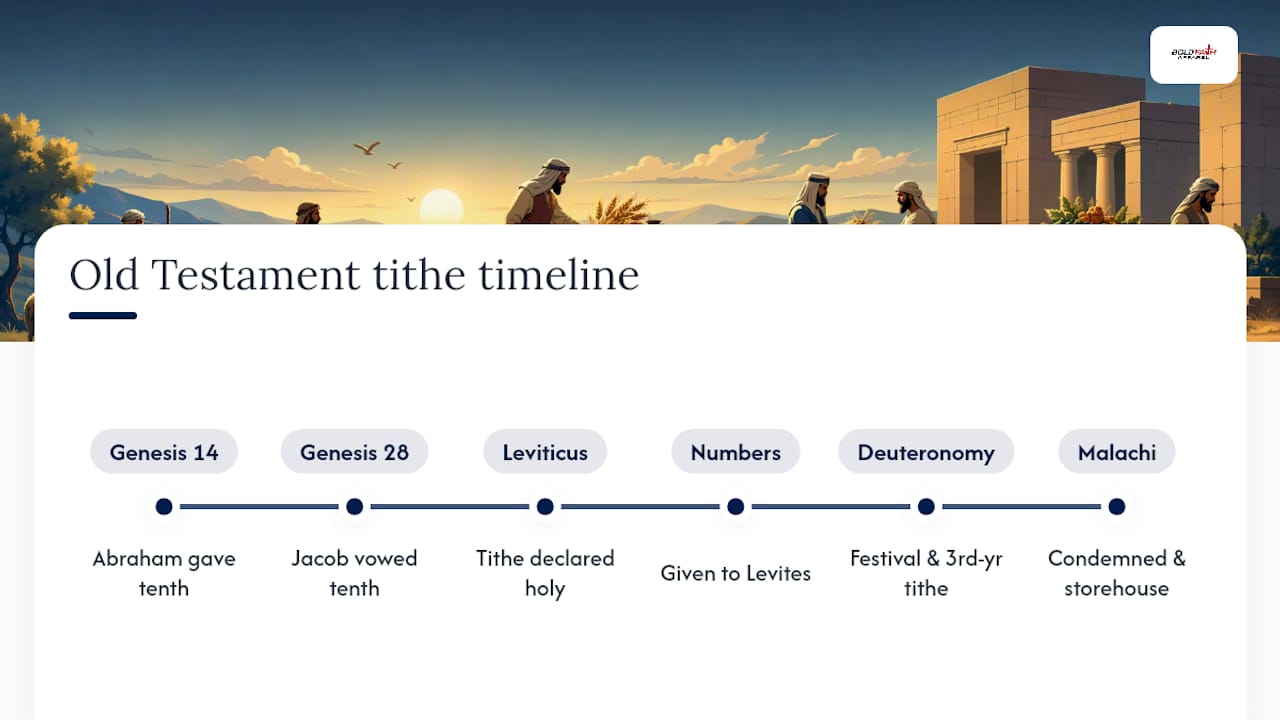
Abraham gave a tenth of the spoils of war to Melchizedek long before Moses (Genesis 14:20), and Jacob voluntarily vowed a tenth of his increase to God (Genesis 28:22). Neither man operated under a written law. The tithe started as a personal act of devotion, not a legal requirement.
That changed under Moses. Leviticus 27:30–33 establishes the tithe as holy, belonging to the Lord. Numbers 18:21–24 assigns it specifically to the Levites in exchange for their tabernacle service. Deuteronomy 14:22–29 adds detail: an annual tithe for festival celebration, and every third year, a tithe redirected to Levites, foreigners, orphans, and widows. By the time of Malachi, the prophet condemns the nation for withholding it entirely, accusing Israel of “robbing God” (Malachi 3:8).
“Bring the full tithe into the storehouse, that there may be food in my house.” Malachi 3:10 ties the tithe directly to a physical location, the temple storehouse, and a practical outcome: provision for those who served there.
The mental model is simple: source of increase leads to firstfruits set aside, which flows into the storehouse (temple or local leadership), which then supports both ministry and the poor in the community. According to WTS’s biblical teaching on the tithe, this threefold purpose (ministry support, poor relief, and celebration) is what the entire Mosaic system was built to accomplish.
Does the New Testament Require Christians to Tithe?
No New Testament passage commands Christians to give a specific 10%. The Mosaic tithe system was fulfilled in Christ, and the New Testament shifts the emphasis from a fixed legal percentage to voluntary, sacrificial, cheerful giving. That’s not a loophole for stinginess. It’s actually a higher standard, since it asks for a transformed heart rather than a check written under compulsion.
A few key texts shape this conclusion:
- Jesus mentions tithing once directly, rebuking Pharisees for tithing “mint and dill and cumin” while neglecting “justice and mercy and faithfulness” (Matthew 23:23). He affirms the practice existed but critiques hollow religious performance, not the tithe itself.
- Paul never invokes a tithe percentage. Instead, in 1 Corinthians 16:2, he instructs believers to set aside a sum “on the first day of every week, as he may prosper,” meaning proportional to income.
- 2 Corinthians 8–9 describes the Macedonian churches giving “beyond their means,” calling for giving that is planned, generous, and cheerful rather than reluctant or “under compulsion” (2 Corinthians 9:7).
- Hebrews 7 references Abraham’s tithe to Melchizedek to make a theological point about Christ’s priesthood, not to reinstate a tithing law for the church.
Early church writings support this trajectory. The Didache, a late first or early second century Christian instructional document, encourages generous support for traveling teachers and local leaders without prescribing a fixed percentage. Patristic writers continued urging generosity as a marker of Christian character, not a legal quota.
Mainstream evangelical scholarship largely agrees on this framework. Crossway states plainly that while the Mosaic tithe ended, the New Testament still calls believers to voluntary, sacrificial support of ministry and the poor, with 10% remaining a widely used and helpful benchmark. Denominational practice varies here: some conservative and restorationist bodies, including teaching from the Church of Jesus Christ of Latter-day Saints, treat tithing as an ongoing command tied to spiritual blessing. Most mainstream evangelical churches teach it as a wise, biblically consistent starting point rather than a binding law.
How Should Christians Practically Apply Tithing Today?
Healthy giving looks like this: regular, proportional to income, and joyful, funding both the local church and mercy work in the wider community. It’s not a one-time emotional decision made during a moving sermon. It’s a rhythm.
Here’s a workable path:
- Set a baseline. Ten percent remains the most common starting benchmark, backed by centuries of practice and biblical precedent, even though it isn’t a New Testament mandate.
- Calculate it against real numbers. If you track your income, set aside one-tenth as a starting point the moment income arrives, before other spending happens.
- Decide where it goes. Most of it should go to your local church, the modern equivalent of the “storehouse” in Malachi 3:10, since that’s where your pastor is paid, your community gathers, and your discipleship happens. A portion can go to missions or trusted parachurch ministries doing work you believe in.
- Review it on a rhythm. Check your giving monthly against your budget, and reassess annually as income changes.
A quick stewardship checklist helps keep priorities straight:
- Is giving the first line item in your budget, or an afterthought?
- Do you have a small emergency fund so giving doesn’t become financially reckless?
- Are you giving joyfully, or resentfully? (2 Corinthians 9:7 says God cares about this.)
- Is there room to give beyond the baseline as income grows?
Pro Tip: Treat the tithe as a diagnostic tool for your spiritual life, not just a budget line. Ligonier’s teaching on stewardship frames it well: your checkbook reveals what actually rules your heart. A simple household prayer to accompany this practice: “Lord, everything I have is Yours first. Teach me to give with a willing heart, not out of fear or obligation.” Say it the same day you set money aside, and let the habit shape the heart over time.
Is It a Sin Not to Tithe as a Christian?
Christians wrestling with guilt over giving usually land on one of three questions. Here are direct, scripture-informed answers.
Is it sin if you don’t tithe? Not in the sense of breaking a New Testament law, since no such law exists. But withholding generosity entirely, when you have the means to give, runs against the New Testament’s repeated call to sacrificial love and care for the church (1 John 3:17).
Did Jesus command tithing? He affirmed it existed under the Old Covenant and criticized hypocrisy connected to it (Matthew 23:23), but He never issued a new command establishing 10% giving for His followers.
Is tithing tied to prosperity teaching? Sometimes, and that’s worth caution. Prosperity theology promises financial return for giving, treating God like a vending machine. Scripture never frames giving as a transaction guaranteeing wealth back.
A few practical safeguards for congregants and leaders alike:
- Ask for transparency. A healthy church should be willing to share how funds get used.
- Watch for red flags: pressure tactics, guilt-based appeals, or promises of financial return tied to giving amounts.
- Give to ministries with a track record of accountability, not just charisma.
According to Christianity.com’s guidance on tithing, cultural skepticism toward church finances is real and often justified. The pastoral response isn’t defensiveness. It’s transparency.
A Pastoral Word on What Tithing Actually Does to a Heart
Watching a congregation grow in giving over years teaches something you can’t get from a spreadsheet: generosity rarely starts as a feeling. It starts as a decision, repeated often enough that it becomes character. The people who talk about tithing changing their faith almost never describe a dramatic moment. They describe a slow shift, a Tuesday morning where they realized money had stopped being the thing they trusted most.
Try this for three months: set aside a fixed percentage the day you’re paid, before you see the rest of your budget. Pair it with a short prayer, something as simple as asking God to show you where trust in money still competes with trust in Him. That’s the real work tithing is meant to do.
Frequently Asked Questions About Tithing
Is tithing still required for Christians under the New Covenant? No specific 10% requirement appears in the New Testament. The consistent call instead is toward voluntary, proportional, and cheerful giving, with 10% commonly used as a starting benchmark.
What’s the biblical difference between a tithe and an offering? A tithe traditionally refers to the baseline tenth; an offering is anything given above that baseline, often tied to specific needs, missions, or spontaneous generosity beyond the norm.
Where should Christians direct their giving today? Most teaching points first to the local church, the modern equivalent of Malachi’s “storehouse,” with room for additional giving to missions and trusted ministries.
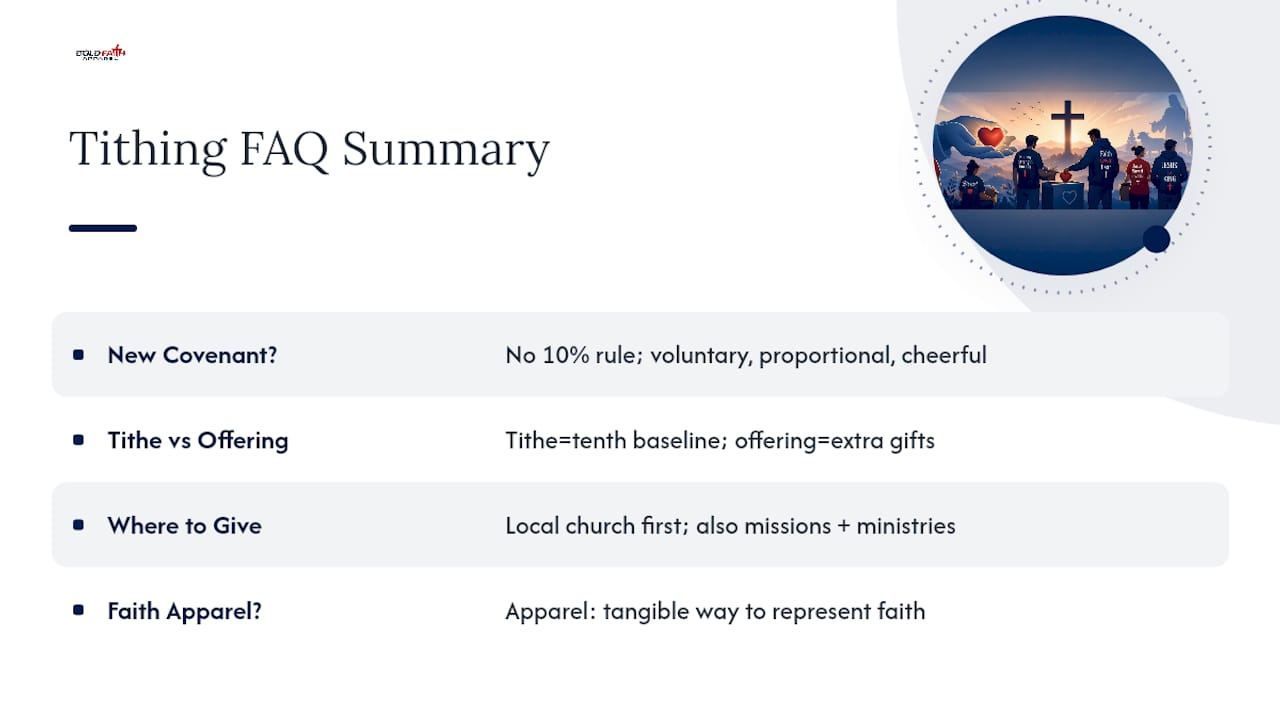
Does wearing faith-based apparel connect to living out these principles? Publicly representing your faith, whether through generosity or through wearing something like a shirt reading “Faith Over Fear” or “JESUS is KING,” reflects the same call to live convictions out loud rather than keep them private. Explore faith-based apparel that speaks your beliefs as one tangible way to carry that boldness into daily life. Bold Faith Apparel designs T-shirts and hoodies featuring messages like “Blessed,” “God is Good,” and “Praise the Lord, Psalm 150:6,” each crafted to spark conversation and stand as a quiet, visible testimony wherever you go. Browse the full collection at Bold Faith Apparel and pair generous living with a wardrobe that backs it up, with free delivery available on qualifying orders.
Sources
- How Much Should Christians Tithe? | Crossway
- Money and stewardship | Ligonier Ministries
- Biblical teaching about the tithe | WTS
- First Presidency message: Law of tithing (PDF) | Church of Jesus Christ


