

Spiritual growth is the lifelong process of becoming more like Jesus Christ, made possible by the Holy Spirit working in you day by day. It is not about trying harder to be a better person. It is about surrender, obedience, and time spent with God that slowly reshapes what you love and how you live.
Here is one step you can take today: give God 10 minutes of Scripture reading and 2 minutes of honest prayer before you touch your phone. That is it. Small, repeatable, doable.
- Read one short passage (start with Psalm 23 or John 15)
- Pray for 2 minutes, even if the words feel clumsy
- Repeat tomorrow
Pro Tip: Growth compounds. A believer who reads Scripture for 10 minutes daily for a year has spent over 60 hours in God’s Word, more than most people spend in a semester-long Bible course.
Peter told believers that God’s “divine power has given us everything we need for life and godliness” and urged them to add virtue, knowledge, self-control, perseverance, godliness, brotherly kindness, and love to their faith (2 Peter 1:3-8). That passage is your anchor. Growth is promised, and it is progressive.
Key Takeaways
Spiritual growth happens through grace, truth, and time as the Holy Spirit works through consistent disciplines like Scripture reading, prayer, and community.
| Point | Details |
|---|---|
| Definition matters | Spiritual growth means becoming more like Christ, empowered by the Holy Spirit, not just trying harder. |
| Fruit is the gauge | Track growth through the fruit of the Spirit (Galatians 5:22-23), not activity or attendance alone. |
| Disciplines are means, not merit | Practices like prayer, fasting, and solitude open space for God, but legalism turns them into a scoreboard. |
| Build a brief Rule of Life | Keep your self-assessment, practice plan, and accountability arrangement to about one page and realistic. |
| Wear your faith visibly | Boldfaithapparel offers Scripture-based T-shirts and hoodies that turn personal growth into public testimony. |
Table of Contents
- What Does the Bible Say About Spiritual Growth?
- How Does Spiritual Growth Actually Happen?
- What Spiritual Disciplines Should You Practice?
- How Do You Know You’re Growing Spiritually?
- How Do You Build a Personal Rule of Life?
- Where Can You Go Next?
- Why Discipleship Has to Be Lived Out Loud
- Wear Your Testimony, Not Just Your Beliefs
- Sources
What Does the Bible Say About Spiritual Growth?
Spiritual growth is not a vague feeling of being “closer to God.” It has a definition, and Scripture gives it to us directly. Peter’s list in 2 Peter 1:3-8 describes a chain reaction: God supplies everything needed for life and godliness, and believers respond by deliberately building character qualities one on top of another. This is becoming more like Jesus, and it shows up in observable ways, not just private feelings.
Paul gives the clearest checklist in Galatians 5:22-23: love, joy, peace, patience, kindness, goodness, faithfulness, gentleness, and self-control. This is the fruit of the Spirit, and it stands in direct contrast to what Paul calls “acts of the flesh” a few verses earlier. Fewer flesh patterns and more fruit is growth in action.
Jesus adds another layer in John 15, describing Himself as the vine and believers as branches. Nothing grows apart from staying connected to Him. And Luke 2:52 shows growth was even part of Jesus’ own earthly life. He grew:
- In wisdom (mental)
- In stature (physical)
- In favor with God (spiritual)
- In favor with man (relational)
How Does Spiritual Growth Actually Happen?
Growth is not magic and it is not mechanical. Cru’s framework describes it as a combination of grace, truth, and time. Grace is what God supplies through the Holy Spirit. Truth is Scripture, which renews the mind. Time is the patient, unhurried process that most modern believers resist because it does not deliver results on a 24 hour cycle.
The Holy Spirit does the actual transforming work, but that does not mean you sit passively. You respond. You show up. You read, pray, confess, and obey. Growth happens through this partnership:
- God’s Spirit convicts and empowers
- You respond with obedience and attention
- Truth reshapes how you think
- Time turns repeated choices into character
You do not drift into spiritual health. Left alone, habits drift toward comfort and distraction, not devotion. The RPMS framework, covering Relational, Physical, Mental, and Spiritual dimensions, gives you a way to check all four areas instead of only focusing on the one that feels most urgent that week.
Pro Tip: Set a recurring phone reminder for Sunday night: “How did I do this week, Relationally, Physically, Mentally, Spiritually?” Two minutes of honest reflection catches drift before it becomes a pattern.
What Spiritual Disciplines Should You Practice?
Spiritual disciplines are not a scoreboard. They are what the Spiritual Habits Project calls “means of grace,” practices that open space for God to work rather than tasks that earn His approval. Here is a realistic starting point for each:
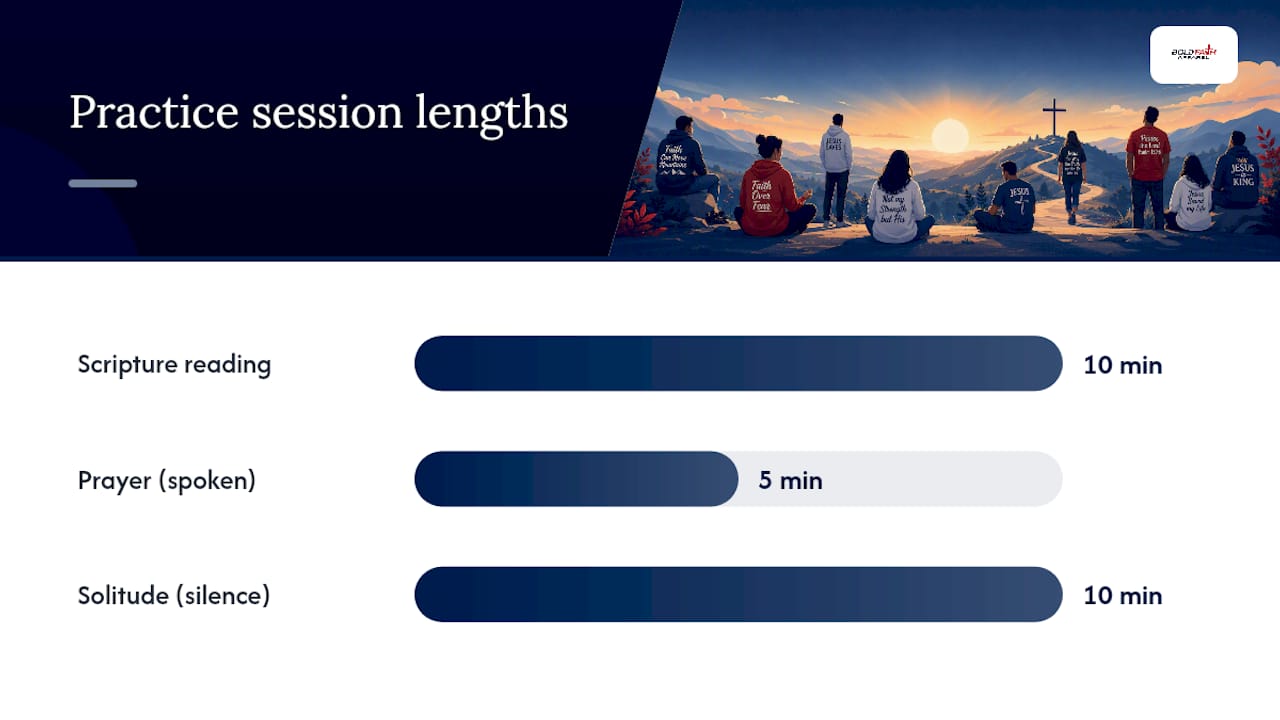
- Scripture reading: 10 minutes a day, one book at a time. Start with John or Psalms.
- Prayer: Speak out loud for 5 minutes. Include confession, gratitude, and one honest request.
- Worship: Sing along to two songs before your day starts, even off key.
- Fellowship: Commit to one weekly gathering, a small group, church service, or coffee with another believer.
- Service: Pick one recurring act, serving at church, helping a neighbor, volunteering monthly.
- Fasting: Skip one meal a week and pray during that time instead of eating.
- Solitude: Sit in silence for 10 minutes with no phone, no music, just attention toward God.
- Generosity: Give consistently, even a small percentage, before spending on anything else.
George Whitefield, one of the most influential preachers of the 18th century, practiced daily Scripture reading, secret prayer, meditation, and regular fellowship as his core rhythm for progress. None of it was complicated. All of it was consistent.
Do not turn any of this into legalism. If a discipline becomes about proving your worth instead of meeting God, adjust it. Reassess every few months, and consider an accountability partner who will ask how it is actually going.
How Do You Know You’re Growing Spiritually?
Activity is not the same as growth. You can attend every church event on the calendar and still be spiritually stagnant if nothing inside you is changing. Real growth shows up as fruit, not attendance.
Look for these markers:
- Increasing patience in situations that used to trigger anger
- Genuine joy that survives difficult circumstances
- A growing appetite for Scripture instead of a sense of obligation
- Willingness to serve without needing recognition
- Perseverance through hardship instead of abandoning faith when things get hard
A believer’s growth in Galatians 5:22-23 is measured against the “acts of the flesh” Paul lists just before it, things like jealousy, selfish ambition, and strife. Less of those, more fruit, is the honest gauge.
Run a quick weekly check using RPMS: Relationally, are you investing in people? Physically, are you caring for your body as a gift from God? Mentally, is Scripture shaping your thoughts? Spiritually, is your prayer life alive or dormant?
How Do You Build a Personal Rule of Life?
A Rule of Life is simply a planned rhythm of practices that keeps you from drifting. The Episcopal Church’s guide recommends keeping it to three quarters to one full page, with three components:
- Self-assessment: Where are you strong? Where are you neglected? Be specific.
- Practice plan: Choose 2 to 3 disciplines you will realistically maintain this season, not an idealized version of your life.
- Accountability: Name a person or group who will check in on you regularly.
Treat this as a minimum standard, not a spiritual ideal you will fail to reach. A sample weekly rhythm might look like this: Scripture and prayer each morning, one worship gathering, one service commitment, and a Sunday night RPMS check with a friend or spouse. Adjust it as your season changes. A new parent’s Rule will look different than a college student’s, and that is fine.
Where Can You Go Next?
Start with a short plan: read one Gospel chapter a day for the next 7 days, and end each day writing one sentence about what struck you. Extend it into a 30-day plan if it sticks.
For accountability, look at small groups, a spiritual director, or your church’s discipleship ministries. Community-based programs, like the Thriving Together series, show how structured group settings help sustain growth better than solo effort alone.
Continue reading on faith-based clothing as testimony for a practical way to carry this growth into public life.
Why Discipleship Has to Be Lived Out Loud
The discipline that shaped me most wasn’t prayer or fasting. It was solitude, ten minutes of silence that exposed how noisy my life had become. That silence eventually pushed me outward, not inward. Faith that stays private tends to shrink, but churches also find practical ways to share their mission, such as selling branded products like coffee, which fosters community and outreach Why Churches Sell Branded Coffee: Community and Mission. Faith that gets worn, spoken, and shared tends to grow.
A shirt with “Jesus Saves” across the chest has started more gospel conversations than most sermons I’ve heard. Visible faith invites questions.
Wear Your Testimony, Not Just Your Beliefs
Spiritual growth changes what you believe. Eventually it should change what you’re willing to show the world. That’s the gap Boldfaithapparel exists to close, apparel that turns quiet conviction into a visible, wearable testimony. Our T-shirts and hoodies carry messages like “Faith Over Fear,” “JESUS is KING,” “Not My Strength but His,” and “There Is Power in the Name of JESUS,” each in bold color schemes designed to be seen and start a conversation, not just blend in.

If your Rule of Life includes a commitment to represent Christ publicly, start with what you put on your body every morning. Browse the full collection at Bold Faith Apparel and pick one shirt that says what your life is already learning to say.
Sources
- How to Grow Spiritually | Cru
- What is spiritual growth? | GotQuestions
- A Personal Rule of Life | The Episcopal Church


