

Sharing your faith overcomes fear because it converts a fearful, self-focused mindset into an obedience-driven one. The moment you open your mouth for Christ, your attention shifts from “What if I get rejected?” to “I get to represent Jesus right now.” That shift is not a trick of positive thinking. It is what happens when belief meets action.
Here is what to do right now, before the fear talks you out of it:
- Pray a one-sentence prayer asking God for boldness and the right words.
- Pick one go-to verse you already know, like Romans 10:17, and say it out loud.
- Write down one sentence of your own testimony. Just one. Practice saying it to yourself in the mirror.
Pro Tip: When your mind jumps to “What if I fail?”, physically shift your posture and say out loud, “I am an ambassador for Christ, not a salesman for myself.” That single sentence, echoing 1 Peter 3:15, moves the pressure off your performance and onto God’s presence. A Bold Faith Apparel tee with a verse across the chest can even serve as a quiet reminder of that identity before you speak a word.
Key Takeaways
Sharing your faith overcomes fear because obedience redirects your focus from self-protection to Christ-centered purpose, and that redirection strengthens with repeated practice.
| Point | Details |
|---|---|
| Faith grows through speaking | Romans 10:17 shows that faith is built, not just spent, every time you speak the gospel aloud. |
| The Spirit supplies the words | Luke 12:12 promises help in the moment, removing the need to have every answer prepared. |
| Rehearsal beats improvisation | Practicing a 30 to 60 second testimony with a friend reduces panic when a real conversation starts. |
| Track obedience, not outcomes | Measure prayers offered and conversations started, not visible conversions, to keep discouragement low. |
| Apparel can open conversations | Bold Faith Apparel’s verse-centered tees and hoodies, like “Faith Over Fear” designs, give others a natural reason to ask what you believe. |
Table of Contents
- Why Sharing Faith Overcomes Fear, According To Scripture
- How Does Sharing Your Faith Actually Build Courage?
- What Should You Say This Week? A Practical Plan
- What Do Acts And Church History Teach About Bold Witness?
- What Are Believers Most Afraid Of, And How Do You Answer That Fear?
- How Do You Turn One Bold Moment Into A Lifelong Habit?
- What I’ve Learned From Stepping Out Scared Anyway
- How Faith-Forward Apparel Can Open The Door
- Recommended Resources For Going Deeper
- Frequently Asked Questions
- Sources
Why Sharing Faith Overcomes Fear, According To Scripture
Fear and faith cannot occupy the same space for long. One of them has to move, and Scripture consistently shows that faith is what pushes fear out the door.
Romans 10:17 says faith comes by hearing the word of Christ. That means faith is not a static reserve you draw down. It grows every time the gospel gets spoken, including when you are the one speaking it. Every conversation you have about Jesus feeds your own faith, not just the listener’s.
1 Peter 3:15 tells believers to always be ready to give an answer for the hope they carry, but to do it “with gentleness and respect.” That single verse dismantles two fears at once: the fear of not knowing enough, and the fear of coming across harsh. You are not asked to win an argument. You are asked to explain a hope.
Luke 12:8-12 goes further. Jesus promises that when you are brought before others for His name, the Holy Spirit will teach you what to say in that very hour. That promise is not aimed at professional preachers. It is aimed at ordinary, nervous believers standing in an ordinary, nervous moment.
A few more scriptural threads consistently displace fear:
- The Great Commission (Matthew 28:18-20) puts Christ’s authority behind every believer’s witness, not just apostles or pastors.
- Paul’s boldness in Acts, even while chained, shows that circumstances do not dictate courage.
- The early church’s growth under persecution (Acts 4-8) proves the Spirit’s presence outweighs hostile environments.
“Perfect love casts out fear” (1 John 4:18) is often quoted about relationships, but it applies just as directly to evangelism. A heart anchored in God’s love has less room left for the fear of rejection.
How Does Sharing Your Faith Actually Build Courage?
Something measurable happens in your mind and spirit every time you speak about Jesus, even when it feels shaky.
On the psychological side:
- Exposure reduces anxiety. The first conversation is the hardest. The tenth feels almost normal, because repeated exposure to a feared situation consistently lowers the anxiety response over time.
- Rehearsed language reduces cognitive load. When you already know your opening line, you are not improvising under stress, which frees up mental space to actually listen.
- Action restores a sense of agency. Fear often grows in passivity. Speaking, even imperfectly, hands control back to you.
On the spiritual side, speaking Scripture aloud anchors your mind in truth instead of fluctuating feelings, which is exactly why memorized verses matter more than clever phrasing. Obedience also tends to invite the boldness Acts 4:31 describes, where believers prayed and were filled with the Spirit to speak the word with confidence. Your testimony, told honestly, realigns your own identity with Christ’s, reinforcing what you already believe.
Pro Tip: Shrink the task before you speak. Do not aim to “share the gospel.” Aim to say one sentence. Pray a quick, silent acknowledgment (“Lord, this is Yours”), then speak that first sentence. Momentum takes care of the rest.
What Should You Say This Week? A Practical Plan
Fear shrinks when you have specific words ready, not vague good intentions. Build this over the next seven days.
- Pray daily for boldness and for the specific people on your heart.
- Make a Top Five list of people you want to see come to Christ, and pray for them by name.
- Memorize one or two verses you can quote from memory under pressure, such as Romans 10:9 or John 3:16.
- Rehearse a 30 to 60 second testimony using a simple three-part structure.
That testimony template only needs three beats:
- Before: What your life or mindset looked like without Christ.
- Turning point: The moment or season faith became real to you.
- After: What is different now, stated in plain, ordinary language.
For quick, low-pressure openers, keep a few one-sentence lines ready:
- At work: “I’ve been praying for you. Can I ask what’s been weighing on you?”
- With a neighbor: “I go to church down the street. Would you ever want to come with me sometime?”
- On social media: “Grateful for grace today. Anyone else need a reminder that God’s not done with them?”
Role-play this with a friend or small group before you try it in the wild. Say your testimony out loud to one other person, then ask them to point out where you rambled or where you sounded most natural. That feedback loop matters more than most people expect, and it lines up with the guidance in 7 tips for sharing your faith, which stresses keeping Christ central and pairing words with genuine relationship.
Pro Tip: If someone asks a question you cannot answer, say so plainly: “That’s a great question, I don’t know, but I’ll look into it.” Honesty builds more trust than a bluffed answer ever will. And when a conversation feels stuck, “Can I pray for you about that?” is one of the lowest-pressure redirects available.
What Do Acts And Church History Teach About Bold Witness?
Scripture and history both show fear was never the deciding factor in whether the gospel spread.
Philip meets an Ethiopian official reading Isaiah in Acts 8 and simply asks, “Do you understand what you are reading?” He does not force a conversation. He asks a good question and lets Scripture do the rest, a pattern Crossway highlights as one of the most reproducible evangelism moves in the New Testament. Takeaway: ask before you preach.
Paul writes Philippians from a prison cell, explaining that his chains have actually advanced the gospel among the guards (Philippians 1:12-14). His circumstances were worse than anything most modern believers will face, yet his focus stayed on Christ rather than his comfort. Takeaway: let the gospel, not your situation, set the agenda.
The early church, scattered by persecution in Acts 8:4, “went about preaching the word” anyway. Fear did not disappear. It simply stopped being the deciding vote. Takeaway: courage is a decision made repeatedly, not a feeling you wait to arrive.
What Are Believers Most Afraid Of, And How Do You Answer That Fear?
Most hesitation about evangelism traces back to a handful of repeat fears, and each one has a short, usable response.
- Fear of rejection. Shift your target from human approval to faithfulness to God; you are only responsible for being faithful with the message, not controlling the response.
- Fear of feeling unprepared. You do not need a theology degree. Luke 12:12 promises the Holy Spirit will give you words in the moment.
- Fear of offending someone. Lead with genuine care, not a script. A love-first posture rarely offends, even when the message itself is hard to hear.
- Fear of an awkward silence. Have one redirect ready: “Can I pray for you about that right now?”
Pro Tip: When your chest tightens before a conversation, take one slow breath and silently pray, “Lord, this is Yours.” That short anchor calms the body’s stress response while reminding you the outcome was never yours to control.
How Do You Turn One Bold Moment Into A Lifelong Habit?
One good conversation does not make you fearless forever. Consistency does.
Build a simple weekly rhythm:
- Spend ten minutes rehearsing your testimony out loud.
- Spend twenty minutes role-playing gospel conversations with a friend or small group.
- Spend ten minutes praying by name for your Top Five list.
Add low-pressure, relational practices around that rhythm. Hosting people in your home creates natural, unhurried opportunities to build trust before a spiritual conversation ever starts. Track your progress with simple, honest numbers: how many times you shared this week, how many prayers you offered for your list, how many invitations you extended. Measuring obedience instead of visible results keeps performance anxiety from creeping back in.
What I’ve Learned From Stepping Out Scared Anyway
The first time I shared my faith with someone outside my church, my hands were shaking and my opening line came out clumsy. It still landed. The conversation did not end in a dramatic conversion. It ended in a real question and an open door for next time.
Try one low-risk step this week: offer to pray for a coworker, or tell one friend your one-sentence testimony. Success here is not measured in visible results. It is measured in whether you obeyed.
How Faith-Forward Apparel Can Open The Door
A shirt will never replace a real conversation, but it can start one. Wearing a message like “Faith Over Fear” or “Jesus Saves” across your chest gives someone a natural, low-pressure reason to ask what you believe, without you having to force the topic into a room. That single question, “What does your shirt mean?”, is often easier to answer than an unprompted conversation you started yourself.
Bold Faith Apparel builds its T-shirts and hoodies around exactly this kind of witness. Messages like Jesus Faith Over Fear work best placed front and center, where someone standing across from you in line or at work will actually see it. A bold navy shirt with red lettering reading “JESUS is KING,” or a hoodie with “Not My Strength but His” across the back, does the same quiet work: it puts your convictions in plain sight before you ever say a word.
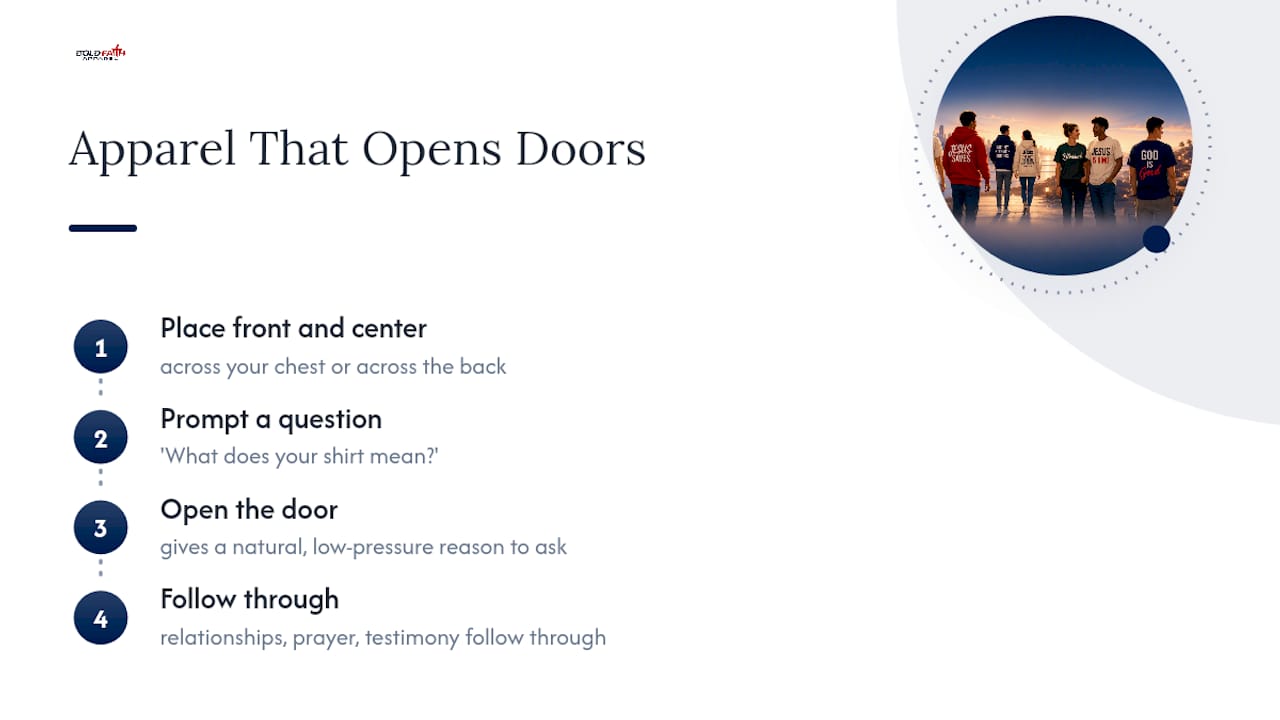
Treat apparel as a tool, not a strategy. It opens doors. Relationships, prayer, and your own testimony still have to walk through them. If you want ideas for verses and colors that fit your personality and context, Bold Faith Apparel’s collection is worth a browse before your next conversation starter walks by.
Recommended Resources For Going Deeper
- Overcoming fear when sharing your faith for rehearsal and go-to verse strategies.
- Street evangelism for prayer-centered public witness practices.
- How to Witness Through Clothing With Bold Faith for pairing apparel with genuine relationship.
Frequently Asked Questions
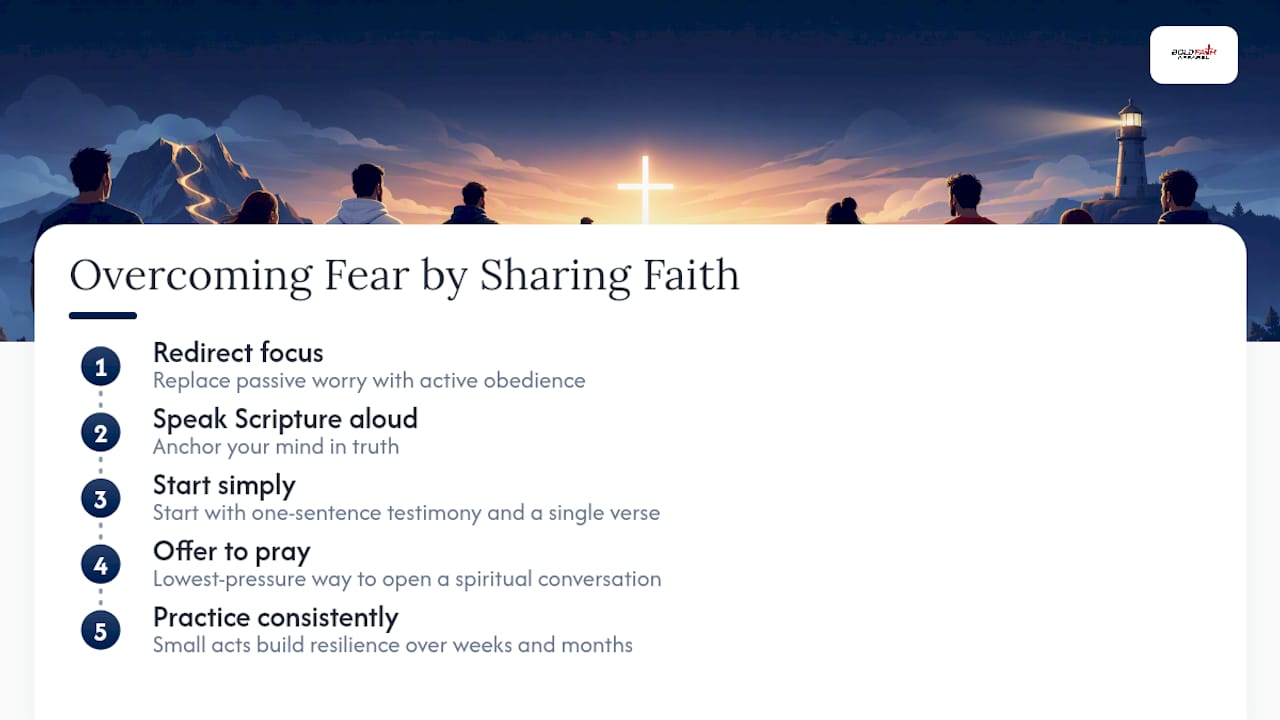
Why does sharing faith overcome fear instead of increasing it? Sharing faith replaces passive worry with active obedience. Speaking Scripture aloud, as noted in why we should share the gospel even in fear, anchors your mind in truth rather than fluctuating emotions, which steadily lowers anxiety with each conversation.
What if I don’t know how to answer someone’s tough question? Say so honestly, then offer to find out. Luke 12:12 promises the Holy Spirit will give you words when you need them most, not necessarily before.
How do I start sharing my faith if I’ve never done it before? Start with a one-sentence testimony and a single verse you already know. Offering to pray for someone is one of the lowest-pressure ways to open a spiritual conversation.
Can wearing Christian apparel actually help with evangelism? It can open natural conversations without you forcing the topic, especially messages placed where they are easily seen. It works alongside relationship and prayer, not instead of them.
How long does it take for fear to actually decrease? Most believers find fear does not vanish overnight, but consistent, small acts of obedience steadily build resilience over weeks and months of practice.
Sources
- Why We Should Share The Gospel Even In Fear
- Overcoming fear: Sharing your faith with boldness
- 7 tips for sharing your faith


