

Biblical femininity is the calling to bear God’s image as a woman in ways that glorify Him, rooted in Genesis 1:27, expressed through strength and service as in Proverbs 31, and anchored by settled trust as described in 1 Peter 3. It is not passivity, and it is not a personality type. It is an identity.
TL;DR:
- Biblical femininity is rooted in the equal worth of women as image bearers of God, emphasizing their distinct, complementary roles rather than sameness with men.
- Passages like Genesis 2 and Proverbs 31 highlight partnership, strength, and service as core traits, modeled by women such as Deborah, Ruth, Esther, and Mary.
- Cultivating biblical femininity involves daily spiritual practices, relational mentorship, and active demonstrations of character and faithfulness in various life stages.
- Misconceptions equate biblical femininity with passivity or silence, but Scripture presents women in leadership and bold action, including roles like judging, teaching, and risking vulnerability.
- Living out biblical femininity is a pattern of identity, expressed through character and calling, not a personality type, with practical steps to grow in strength, trust, and service.
Table of Contents
- What Does the Bible Say About Biblical Femininity?
- Which Bible Passages and Women Best Model Biblical Femininity?
- What Are the Core Characteristics of Biblical Womanhood?
- Common Misconceptions About Biblical Femininity
- How Do You Cultivate Biblical Femininity Today?
- How Boldfaithapparel Supports This Calling
- Historical and Cultural Context of Femininity in the Bible
- Biblical Femininity’s Role in Family and Church Life
- Theological Debates Surrounding Biblical Femininity
- How Biblical Femininity Shapes Modern Gender Identity
- Old Testament and New Testament Views on Femininity Compared
- A Closing Word on Living This Out
- Sources
- FAQ
What Does the Bible Say About Biblical Femininity?
Scripture does not define womanhood by hobbies, temperament, or cultural fashion. It starts somewhere far more foundational: creation itself.
Genesis 1:27 states that God created humankind, male and female, in His own image. Both sexes carry equal dignity and equal worth before God. This is the doctrine of Imago Dei, and BibleHub’s commentary aggregate on the sacred feminine points to this verse as the non-negotiable foundation for any honest definition of womanhood. Whatever else biblical femininity includes, it never starts by treating women as a lesser reflection of God’s character.
Galatians 3:28 sharpens this further: in Christ, there is neither male nor female regarding spiritual standing and access to God. Salvation, adoption, and the Holy Spirit belong to women exactly as they belong to men. Equality of worth, though, does not erase distinction of design. The Bible presents men and women as equally valuable but differently expressed image bearers, a pattern theologians describe as complementary rather than interchangeable. Crossway’s essay on the essence of femininity argues that reducing this distinction to a checklist of cultural stereotypes misses the point entirely. Femininity, in that framing, is closer to a revealed mystery tied to the Christ and church relationship than a personality profile.
Put simply: biblical femininity is what happens when a woman lives out her God-given identity, distinct from a man’s, without treating that distinction as a demotion.
A working definition, useful for teaching or conversation, looks like this:
- Rooted in equal worth as an image bearer of God (Genesis 1:27)
- Expressed through a distinct, complementary calling rather than an identical role to men
- Marked by strength, courage, and service, not fragility or silence
- Measured by character and faithfulness, not by appearance or cultural trend
That last point matters more than most articles admit. Scripture never asks a woman to shrink. It asks her to trust God and act.
Which Bible Passages and Women Best Model Biblical Femininity?
Three passages carry most of the theological weight on this topic, and four named women give that theology flesh and blood.
Genesis 2 introduces the Hebrew phrase “ezer kenegdo,” usually translated “helper fit for him.” The word “ezer” sounds subordinate in modern English, but Hebrew usage tells a different story. Scripture applies “ezer” to God Himself dozens of times, describing Him as Israel’s helper in battle and rescue. A helper, in Hebrew thought, is a position of strength brought alongside someone, not a servant beneath them. That single word reframes the entire creation narrative around partnership rather than hierarchy of value.
Proverbs 31 gives the fullest single portrait of a godly woman in Scripture, and it is almost nothing like the domestic stereotype often projected onto it. The Hebrew phrase describing her, “eshet chayil,” is martial language. Aleph Beta’s analysis of the term translates it closer to “woman of valor” or “woman of strength,” the same root used to describe warriors and men of standing elsewhere in the Old Testament. This woman runs a household, negotiates real estate, manages employees, extends her hands to the poor, and speaks with wisdom. She is entrepreneurial and publicly competent, not confined to a kitchen.
1 Peter 3:3–6 addresses inner adornment, calling wives to cultivate a “gentle and quiet spirit.” Modern readers often hear that phrase as a command toward meekness or silence. Pastoral commentary on the passage argues the opposite: it describes settled trust in God, the calm confidence that refuses to be shaken by fear or circumstance. That is not weakness. It is the internal posture that makes courage sustainable.
Four women illustrate these principles in action:
- Mary trusted God with her reputation, safety, and future the moment the angel spoke. Her response in Luke 1:38, “I am the Lord’s servant. May everything you have said about me come true,” models active surrender, not resignation.
- Deborah judged Israel, delivered military strategy, and led a nation during a period when leadership was scarce and dangerous, showing that biblical femininity includes public authority when God grants it.
- Ruth left her homeland, provided for her mother-in-law through hard labor, and pursued redemption with quiet determination, embodying loyalty as strength.
- Esther risked her life to approach the king uninvited, using position and courage to save her people, proof that vulnerability and boldness can occupy the same moment.
What Are the Core Characteristics of Biblical Womanhood?
LiveHope’s study on biblical femininity identifies five recurring traits across Scripture: relational capacity, a nurturing nature, vulnerability, beauty, and responsiveness. The research is direct on one point worth repeating: these are not personality-dependent. An introvert and an extrovert can both live them out fully.
- Relational capacity. Women are wired for connection, and Scripture treats that as a gift for building community, not a weakness to manage.
- Nurturing nature. This shows up in mothering, mentoring, discipling, and caring for the vulnerable, whether or not a woman has biological children.
- Vulnerability. Openness to being known and to depending on God and others is treated as strength in Scripture, the opposite of the self-sufficiency our culture often prizes.
- Beauty. 1 Peter 3:4 calls this “the unfading beauty of a gentle and quiet spirit,” placing character above appearance without dismissing outward care entirely.
- Responsiveness. The “helper” calling from Genesis 2 shows up here: an active readiness to support, initiate, and act in partnership rather than passive waiting.
None of these traits requires a woman to be soft-spoken or domestically inclined. Deborah’s leadership and Esther’s political courage prove responsiveness and nurture can look bold in public settings, not only quiet ones at home.
Common Misconceptions About Biblical Femininity
The biggest distortion floating around Christian and secular circles alike is this: biblical femininity equals doormat theology, a call to silence, weakness, or blind submission regardless of circumstance. Scripture does not support that reading.
- Esther confronted a king. Deborah led armies into strategy. Neither fits a doormat framework, and both are held up in Scripture as models of faithful womanhood.
- Femininity is not defined by hobbies, wardrobe, or temperament. A woman who loves construction work and one who loves flower arranging can both fully embody the biblical pattern, because the pattern is about identity and character, not preference.
- Passages like 1 Peter 3 are frequently lifted out of context to demand silence or diminish a woman’s voice. Read fully, the passage calls for settled trust, not muteness, and it addresses a specific first-century marital context, not a universal gag order.
- “Ezer kenegdo” is sometimes mistranslated in popular teaching as “assistant” or “subordinate helper.” The Hebrew text applies the same word to God as Israel’s rescuer, which should end that misreading permanently.
TrueWordsBaptist’s teaching on biblical womanhood makes the case that femininity, understood rightly, functions as countercultural witness. Beauty, nurture, and service become public testimony rather than private, invisible traits nobody notices.
How Do You Cultivate Biblical Femininity Today?
Living this out starts with ordinary habits, not a personality overhaul. The pattern Scripture gives is formation through practice, over time, in community.
Daily spiritual practices build the foundation everything else rests on. Regular Scripture intake, whether through a reading plan or slow study of a single book, keeps the mind anchored to God’s actual words rather than cultural noise. Prayer, including honest confession, keeps that gentle and quiet spirit realistic rather than performative. A woman who never admits fear or failure to God is faking the calm, not living it.
Relational practices carry the weight of transmission. Revive Our Hearts’ teaching on biblical womanhood points to Titus 2 as the primary mechanism: older women instructing younger women in love, self-control, and faithfulness. This is not a suggestion for church programming. It is the model Paul gives for how godly character actually spreads between generations. Seek a mentor if you do not have one. Become one if you are further along.
Character practices turn belief into visible action. Hospitality, financial stewardship, courage in service, and faithfulness in whatever vocation God has placed you in, whether that is nursing, law, ministry, or raising a household, all count as legitimate expressions of this calling. BibleProclaimer’s study on biblical femininity notes this pattern flourishes across every station: married, single, widowed, working. It is not reserved for one life stage.
Here is a five-step start for this week:
- Read Proverbs 31:10–31 slowly and note which trait you already carry.
- Ask one older woman in your church for thirty minutes of her time.
- Confess one specific fear to God in prayer, by name.
- Identify one act of hospitality or service you can do before Sunday.
- Write down one way you can represent your faith publicly, including through what you wear.
Pro Tip: Pair your Scripture reading with a physical reminder of what you’re studying. Wearing a shirt with a verse like Psalm 23 or a phrase like “Faith Over Fear” keeps the truth in front of you and starts conversations you didn’t plan for.
Faith worn publicly is one small but real form of this witness. A Christian sweatshirt built for bold public faith or a piece exploring what courage in Christian clothing actually looks like can turn an ordinary Tuesday into an open door for a gospel conversation. Elite Bloodlines Apparel’s research on identity-driven clothing makes a similar point outside the Christian space: what you wear communicates who you are before you say a word.

How Boldfaithapparel Supports This Calling
Some Christian apparel brands help believers express their faith visibly. Faith can be lived out publicly, and clothing can serve as a tool for making that visible in everyday settings.
- Apparel designed around messages like “Faith Over Fear,” “Blessed,” “God is Good,” and “There Is Power in the Name of Jesus” for daily, wearable testimony.
- T-shirts and hoodies carrying direct Scripture, including “Jesus the Way the Truth and the Life John 14:6” and “Praise the Lord, Psalm 150:6.”
- Color and design variety across product lines, so a message can fit a Sunday service or a Saturday errand.
- Resources like Christian apparel that speaks your faith for readers wanting practical ideas on public witness through what they wear.
A woman living out Proverbs 31 strength or 1 Peter 3 trust does not need a costume. She needs conviction, and sometimes a shirt that says it out loud for her.
Historical and Cultural Context of Femininity in the Bible
Scripture was written into cultures where women’s legal and social standing varied widely, from the patriarchal households of the ancient Near East to the more urban, mixed-influence world of the first-century Roman Empire. Old Testament women often operated within family and tribal structures where inheritance and legal standing ran through men, yet Scripture repeatedly elevates women beyond that cultural ceiling. Deborah judging Israel and Ruth negotiating her own protection are not incidental details. They are countercultural for their era.
The New Testament world added Greco-Roman customs to the mix, where women in some regions had more legal freedom to own property and conduct business, while still facing steep restrictions in public religious and political life. Jesus’s ministry regularly cut against those norms. He taught women directly, allowed them among His traveling followers, and appeared first to women after the resurrection, a detail no fabricated first-century document would have invented given how little legal weight a woman’s testimony carried at the time.
Understanding this backdrop matters because it shows Scripture consistently pushing against, not merely reflecting, the cultural limitations placed on women in both testaments. The biblical pattern was frequently ahead of its surrounding culture, not a product of it.
Biblical Femininity’s Role in Family and Church Life
Inside the home, biblical femininity shows up as active partnership. A wife described in Proverbs 31 co-manages a household economy, and Ephesians 5 frames marriage as mutual submission grounded in Christ’s love, not one-directional control. Mothering, mentoring children in the faith, and building a household culture around Scripture all fall under this calling, whether or not a woman is raising biological children of her own.
Inside the church, women have historically filled teaching, discipleship, hospitality, and mercy ministry roles, alongside financial and organizational leadership in many congregations. Titus 2 explicitly commissions older women to teach younger women, a clear, named ministry role rather than an informal suggestion. Debate continues among denominations over whether women should hold the office of pastor or elder, and churches land in different places on that question. What is not contested across traditions is that women are called to active spiritual leadership somewhere in church life, not sidelined from it entirely.
Family and church function best, according to this pattern, when a woman’s strength and a man’s strength operate as complementary forces aimed at the same mission rather than competing for the same authority.
Theological Debates Surrounding Biblical Femininity
Two major camps shape most of the modern conversation: complementarianism and egalitarianism. Complementarians hold that men and women share equal worth but are called to distinct roles, particularly in marriage and church leadership, with men typically holding the office of elder or pastor. Egalitarians affirm equal worth and argue Scripture permits, and in places models, women in every leadership office, pointing to Deborah, Junia, and Priscilla as precedent.
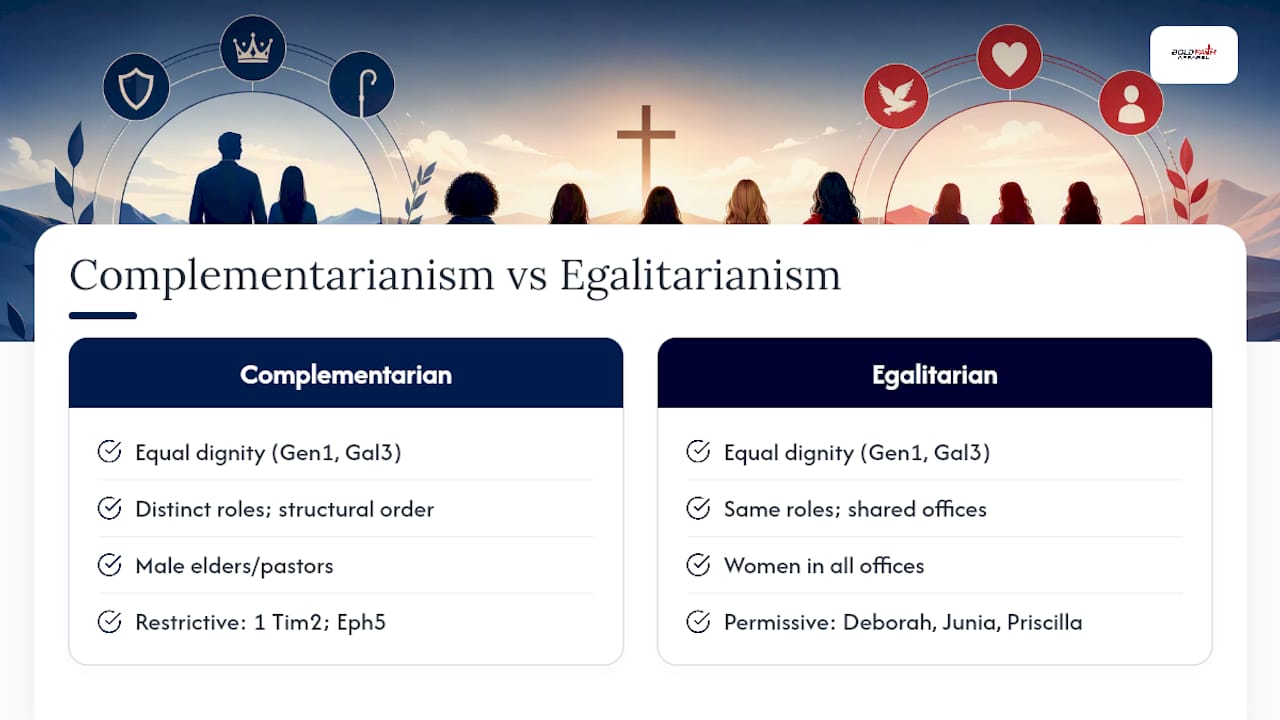
Both camps affirm Genesis 1:27 and Galatians 3:28 as foundational. The disagreement centers on how passages like 1 Timothy 2:12 and Ephesians 5:22–33 apply today versus how they applied to a specific first-century context. This is not a fringe argument. Serious, Bible-believing scholars land on both sides, and the debate has run for generations without full resolution.
What both sides typically reject is the caricature version of femininity: passive, silent, defined by appearance. The disagreement is about structure and office, not about whether women carry equal dignity or genuine spiritual authority in their own callings.
How Biblical Femininity Shapes Modern Gender Identity
Cultural conversations about gender have grown louder and more contested, and biblical femininity offers something increasingly rare in that noise: a fixed, non-negotiable starting point. Identity is not self-invented from scratch. It is received from the Creator, grounded in Genesis 1:27, and then lived out through choices, character, and calling.
This framework pushes back against two modern extremes at once. One extreme collapses all distinction between men and women, treating gender as purely a social construct with no meaningful design behind it. The other extreme reduces femininity to narrow cultural stereotypes, appearance standards, or domestic roles that Scripture never actually mandates. Biblical femininity refuses both. Deborah’s leadership and Mary’s surrender both count as authentically feminine, even though they look nothing alike on the surface.
For women navigating career pressure, singleness, motherhood, or public leadership today, this framework offers something practical: permission to be strong without apologizing for being a woman, and permission to be gentle without being mistaken for weak.
Old Testament and New Testament Views on Femininity Compared
The Old Testament presents femininity largely through covenant community and household strength. Women like Sarah, Ruth, and Deborah appear as builders of family, nation, and justice within a legal system that often limited their formal standing. Strength, valor, and practical wisdom, the eshet chayil pattern from Proverbs 31, define the ideal.
The New Testament shifts the emphasis toward the church as the primary community and adds Christ’s example as the interpretive key for every relationship, including marriage. Mary’s surrender, the women who funded Jesus’s ministry, and Priscilla’s teaching partnership with her husband Aquila all model femininity inside a redeemed community rather than a national one. Paul’s letters, including 1 Peter 3 and Titus 2, address specific household and church situations, applying timeless principles to a first-century context.
The throughline across both testaments never changes: women are equal image bearers called to distinct, God-glorifying expression. What shifts is the setting, from covenant nation to global church, not the underlying identity.
A Closing Word on Living This Out
Most articles on this topic either flatten femininity into a personality test or turn it into a rulebook nobody can actually follow. Both miss what Scripture is doing. The Bible gives a pattern, not a formula: rooted identity, distinct calling, lived through whatever vocation, season, or personality God has given you.
The gap most believers feel is not a lack of information. It is a lack of practice. Cultivating this kind of character happens in ordinary weeks, through mentorship, honest prayer, and small acts of courage repeated often enough that they become who you are. Find an older woman willing to speak into your life, and be willing to speak into someone younger than you. That exchange, more than any single sermon or article, is how this calling gets passed on.
For further study, the resources referenced throughout this piece are worth returning to on your own time.
— Larry
Sources
FAQ
What Does the Bible Say About Biblical Femininity?
Scripture defines it as equal image bearing under Genesis 1:27, distinct calling as seen in Proverbs 31 and 1 Peter 3, and expression through strength, nurture, and settled trust rather than passivity.
What Are the Five Aspects of Femininity According to the Bible?
Relational capacity, nurturing nature, vulnerability, beauty, and responsiveness are the five traits most commonly identified in LiveHope’s study on the topic, and none of them depend on a specific personality type.
What Makes a Woman a Woman According to the Bible?
Genesis 1:27 grounds womanhood in being created in God’s image with equal dignity to men, while Genesis 2’s “ezer kenegdo” describes a distinct, complementary design rather than an identical role.
What Are the Key Characteristics of Biblical Womanhood?
Strength paired with humility, courage paired with trust, and service paired with public competence, modeled through women like Deborah, Ruth, Esther, and Mary, and summarized in the Proverbs 31 portrait of a woman of valor.


