

Six verses will carry you through most fear: Joshua 1:9, Isaiah 41:10, Deuteronomy 31:6, 2 Timothy 1:7, Psalm 27:1, and Psalm 56:3–4. Every one ties courage to God’s presence and His Spirit’s power, not to how brave you feel that morning. Read them below in full, with a plain-English summary and a way to use each one the next time fear shows up.
TL;DR:
- The pairing of a command to be courageous with a promise of God’s presence is essential for building biblical courage.
- Memorizing specific verses like Joshua 1:9 and Isaiah 41:10 helps reinforce trust in God’s active help during fear.
- Different fears are best addressed with tailored verses, such as Psalm 23:4 for grief or Psalm 56:3–4 for panic in crisis.
- Biblical figures like David, Joshua, and Esther demonstrated courage through action rooted in reliance on God’s promises, not the absence of fear.
- Wearing Scripture-based apparel or reciting verses regularly encourages living out courage practically in daily situations.
Table of Contents
- Courage Bible Verses You Can Read or Memorize Today
- Why These Verses Actually Produce Courage
- How to Memorize and Apply These Verses
- The Biblical Context Behind Each Courage Command
- Biblical Figures Who Lived These Verses Out
- Applying These Verses to Your Actual Fear
- Living This Out Loud
- Wear the Verses You’re Memorizing
- Where to Study These Verses Further
- Sources
Courage Bible Verses You Can Read or Memorize Today
Scripture doesn’t give you a pep talk. It gives you a Person to stand on. These fourteen verses are the ones believers have leaned on for centuries when fear tried to make the final call. Read through them slowly. Pick two or three to memorize first.
Many of the most-cited courage passages follow the same pattern: a command to stand firm, paired with a promise of God’s presence, according to Crossway’s breakdown of key courage verses. That pairing isn’t decoration. It’s the engine.
-
Joshua 1:9 — “Have I not commanded you? Be strong and courageous. Do not be afraid; do not be discouraged, for the Lord your God will be with you wherever you go.” God gave Joshua a massive job and one guarantee: presence, not comfort. Use it when you’re staring down a decision that feels too big for you.
-
Deuteronomy 31:6 — “Be strong and courageous… for the Lord your God goes with you; he will not leave you nor forsake you.” Moses said this to a whole nation about to face armies. Recite it when you feel abandoned or outnumbered, literally or emotionally.
-
Isaiah 41:10 — “Do not fear, for I am with you… I will strengthen you and help you; I will uphold you with my righteous right hand.” This is God speaking in the first person, promising active help, not passive sympathy, as Isaiah 41:10 lays out. Pray this over a specific fear by name before you fall asleep.
-
2 Timothy 1:7 — “For God gave us a spirit not of fear but of power and love and self-control.” Courage isn’t a personality trait some people got and others didn’t. It’s given, which means you can ask for more of it. Say this verse out loud right before a hard conversation.
-
Psalm 27:1 — “The Lord is my light and my salvation; whom shall I fear?” This is a question, not a claim that fear disappears. Ask it back to yourself when anxiety starts listing everything that could go wrong.
-
Psalm 56:3–4 — “When I am afraid, I put my trust in you… I will not be afraid. What can man do to me?” David wrote this while actually running from enemies. It proves you can be afraid and trust God in the same breath. Use it as your go-to when panic hits mid-crisis.
-
Romans 8:15–17 — “You did not receive a spirit of slavery to fall back into fear, but you have received the Spirit of adoption.” You’re not approaching God as a nervous employee. You’re approaching Him as a child. Recite this when shame, not just fear, is the thing holding you back.
-
John 14:27 — “Peace I leave with you; my peace I give to you… Let not your hearts be troubled, neither let them be afraid.” Jesus said this hours before His own arrest. If He had peace to give away in that moment, it’s not situational peace. Pray it before checking bad news you’re dreading.
-
Ephesians 6:10-18 — “Put on the whole armor of God, that you may be able to stand against the schemes of the devil.” Paul frames courage as equipment, not emotion, a picture Crossway highlights alongside the other command-and-promise passages. Name one piece of “armor” (truth, faith, the Word) each morning this week.
-
2 Corinthians 4:8–12 — “We are afflicted in every way, but not crushed; perplexed, but not driven to despair.” Paul lists real hardship without pretending it away. Use this when you need permission to admit things are genuinely hard while still moving forward.
-
Matthew 10:28–31 — “Fear not, therefore; you are of more value than many sparrows.” Jesus grounds courage in your worth to God, not in the size of the threat. Say it when you feel replaceable or overlooked.
-
Psalm 23:4 — “Even though I walk through the valley of the shadow of death, I will fear no evil, for you are with me.” This isn’t about avoiding dark valleys. It’s about who walks through them with you. Read it during grief or a health scare specifically.
-
Isaiah 43:2–3 — “When you pass through the waters, I will be with you… you shall not be burned.” God names two of the worst-case scenarios, flood and fire, and promises presence through both, not rescue from ever facing them.
-
1 Chronicles 28:20 — “Be strong and courageous and do the work… for the Lord God, my God, is with you.” David spoke this to Solomon before a massive building project. Use it before starting something that feels bigger than your resources.
Pro Tip: Pick your preferred translation, ESV, NIV, or NKJV, and stick with it for memorization. Switching translations mid-memory-work is the number one reason people give up halfway through a verse.
Why These Verses Actually Produce Courage
The pattern isn’t accidental. Every major courage passage in Scripture pairs a command with a promise. God doesn’t say “be brave” and leave you to manufacture bravery out of willpower. He says “be strong and courageous… for the Lord your God will be with you,” according to the command-plus-promise structure Crossway identifies across Joshua, Deuteronomy, and Isaiah. The command tells you what to do. The promise tells you why it’s possible.
That distinction matters for how you read these verses. Courage in Scripture is never framed as a feeling you conjure up. It’s framed as an action you take because Someone reliable is present.
Three things hold this pattern together:
- The command (“be strong,” “do not fear”) assumes you can obey it right now, in your current state, fear and all.
- The promise (“I will be with you,” “I will uphold you”) is the reason the command isn’t cruel or unrealistic.
- The Spirit’s role in 2 Timothy 1:7 makes clear courage is given, not generated. It’s a gift you receive, not a trait you’re born lacking.
Fear and trust can occupy the same moment. David wrote “when I am afraid, I put my trust in you” in Psalm 56, not “once my fear passed, I trusted you.” Courage isn’t the absence of fear. It’s what you do with your trust while the fear is still there.
Joshua 1:9, Deuteronomy 31:6, and Isaiah 41:10 all repeat this same logic to different people in different centuries. That repetition is the point. Biblical courage is a settled pattern, not a one-time pep talk for one leader.
How to Memorize and Apply These Verses
Memorizing a verse and actually reaching for it in a panic are two different skills. Here’s how to close that gap.
- Pair command with promise. Memorize “be strong and courageous” alongside “for the Lord your God is with you” as one unit. Pairing improves recall and gives you emotional steadiness in real trials, not just quiz-night accuracy.
- Attach a cue. Tie a verse to something you already do daily, brushing your teeth, starting your car, so repetition happens without needing extra willpower.
- Set a phone reminder. Schedule one verse to pop up at the exact time your anxiety usually spikes, whether that’s 6 a.m. before work or right before you check email.
- Journal it in your own words. Rewrite the verse in a sentence describing your actual situation. This forces you to apply it, not just recite it.
- Recite before sleep. Fear often gets loudest at night. Say one verse out loud as the last thing you do before closing your eyes.
30-Second Fear-to-Prayer Template: Breathe in slowly. Recite Isaiah 41:10 out loud. Pray one sentence naming your actual fear and asking God to strengthen and uphold you through it specifically. That’s the whole practice, and it works because it’s short enough to actually do under pressure.
For more prayer language to build on this, read Prayer for Boldness: Scriptures That Strengthen.
The Biblical Context Behind Each Courage Command
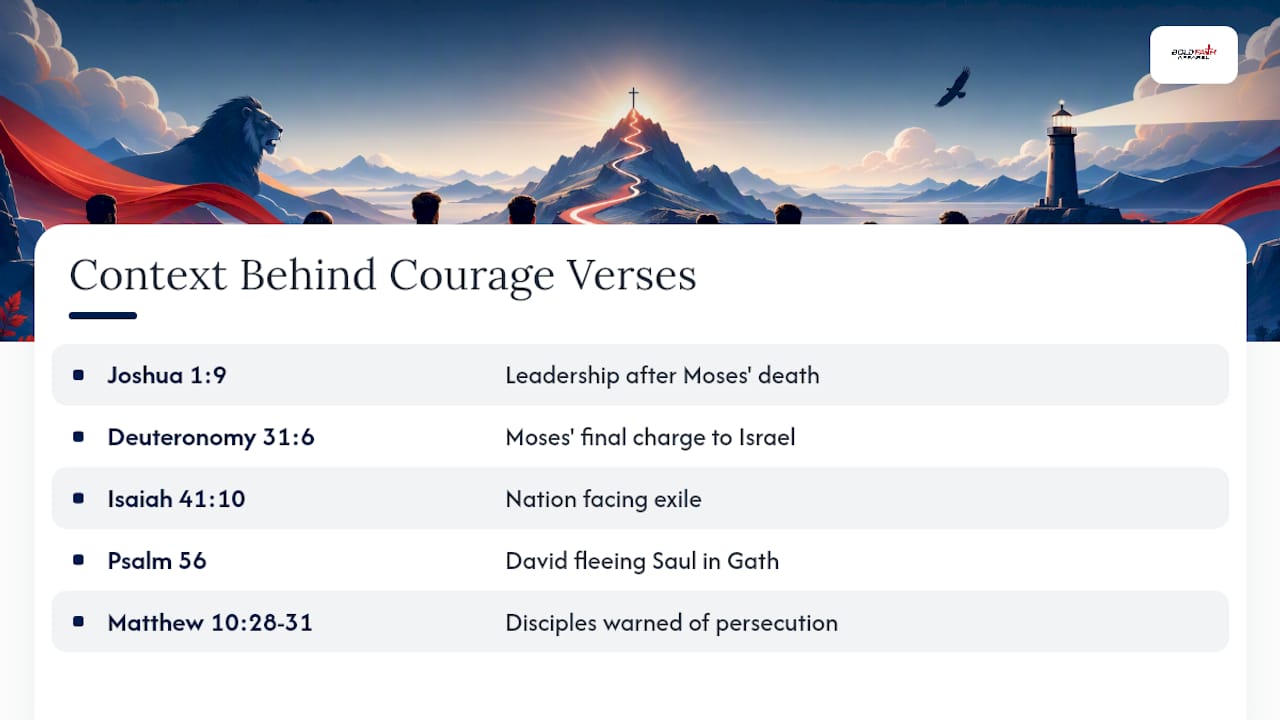
Context changes how a verse lands. Joshua 1:9 was spoken to a man about to lead a nation into a land full of walled cities, right after Moses died and Joshua lost his mentor. That’s not a verse about generic bravery. It’s a verse for someone taking over a job they never trained for.
Deuteronomy 31:6 comes from Moses’ final public address, spoken to an entire generation who watched their parents die in the wilderness for lack of trust. The promise “he will not leave you nor forsake you” directly answers their parents’ failure.
Isaiah 41:10 was written to a nation staring down exile, people who had every reason to believe God had abandoned them. The verse answers that specific despair.
Psalm 56 has a superscript noting David wrote it while fleeing King Saul’s men in Gath, actual, physical danger, not metaphorical stress. Matthew 10:28-31 was Jesus preparing His disciples for a mission where some of them would eventually face real persecution.
Knowing the setting behind each verse keeps you from treating Scripture like a motivational poster. These are battle-tested words, written by and for people in genuine crisis.
Biblical Figures Who Lived These Verses Out
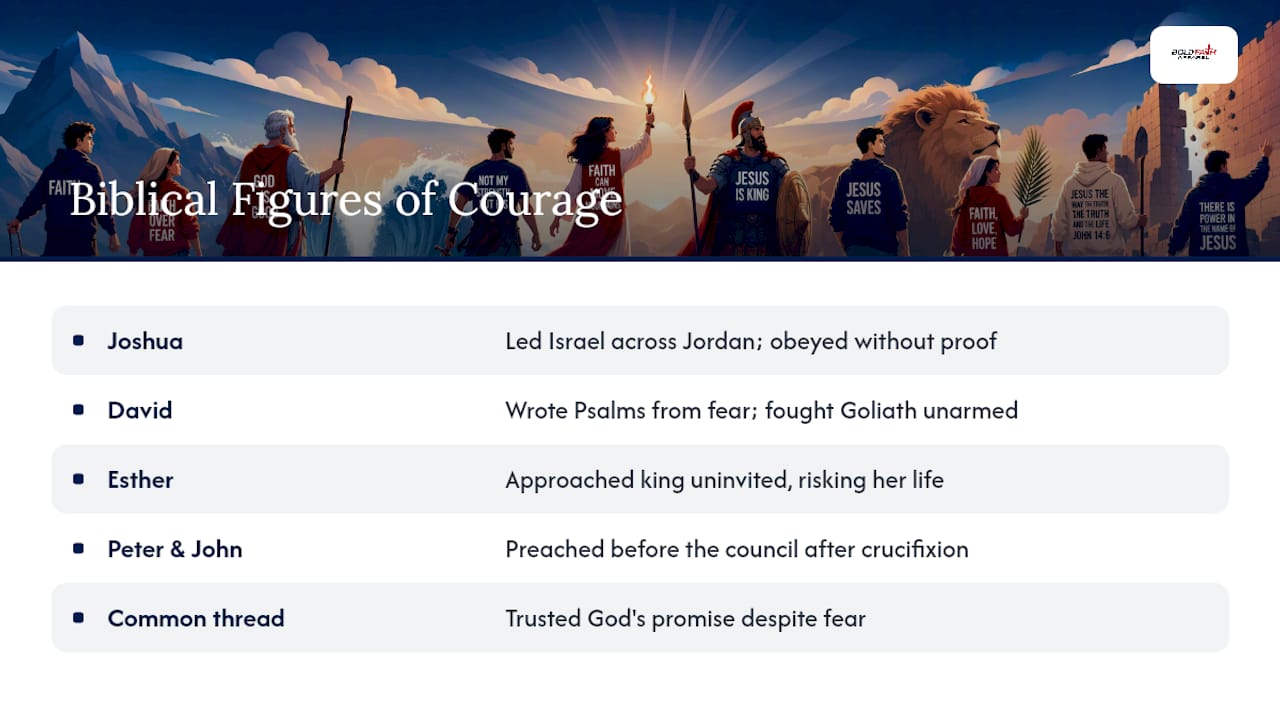
Joshua didn’t just receive the “be strong and courageous” command. He acted on it by leading Israel across the Jordan and into conflict at Jericho, obeying before he had proof it would work.
David wrote Psalm 56 and Psalm 27 from lived experience, running from Saul, later facing Goliath as a teenager with no armor and a sling. His courage wasn’t fearlessness. He named his fear directly in his own poetry and chose trust anyway.
Esther faced a decision with her life on the line and chose to approach the king uninvited, telling her cousin Mordecai, “if I perish, I perish.” That’s courage as a decision, made without any guarantee of the outcome.
Peter and John, ordinary fishermen, stood before the religious council that had just crucified Jesus and kept preaching anyway, described in Acts as men who had “been with Jesus.” Their courage traced directly back to time spent with the source of it, not to natural boldness.
Each of these figures had access to the same thing you do: a present, promising God. None of them were courageous because fear was absent. They acted because the promise outweighed the fear.
Applying These Verses to Your Actual Fear
Different fears call for different verses, and knowing which one to reach for saves you from fumbling through Scripture mid-crisis.
Facing a health scare or grief calls for Psalm 23:4, because it doesn’t promise avoidance of the valley, only presence within it. A hard decision with no clear right answer fits well with Joshua 1:9, since it’s a command to move forward despite incomplete information. Financial fear or job loss lines up with Isaiah 41:10’s promise of active help, not just comfort.
Social fear, speaking up at work, defending your faith in conversation, sharing your beliefs publicly, fits 2 Timothy 1:7 best, since it directly names the spirit of fear and offers power, love, and self-control instead. Relational conflict pairs well with Ephesians 6:10-18, which frames tension as spiritual, not just personal, and gives you armor language instead of self-help language.
The practical move is simple: identify which category your fear falls into before you open your Bible, not after. That way you’re not searching for a verse while already panicking. You’re applying one you already picked.
Living This Out Loud
Memorized verses only matter if you’re willing to act on them when it counts. I’ve watched believers quote Joshua 1:9 in private for years and never let it change one public decision. That gap between what we recite and what we risk is where most of our faith gets stuck.
Bold Faith Apparel exists partly to close that gap. Wearing Scripture isn’t a substitute for living it, but it does force a small, repeated act of courage every time you walk out the door. It’s a quiet way of putting your name behind what you believe. If this connects with you, read more in What Is Courage in Christian Clothing: A Bold Faith Guide.
— Larry
Wear the Verses You’re Memorizing
Bold Faith Apparel gives you a way to carry these verses with you between quiet time and everyday life, not as a replacement for Scripture memory, but as a visible reminder while you’re building it. A shirt that says “Faith Over Fear” or “Not My Strength but His”" does something a sticky note on your mirror can’t: it puts the verse in front of you and everyone you talk to that day.

The lineup includes T-shirts, hoodies, and caps carrying messages like “Jesus Saves,” “JESUS is KING,” “God is Good,” and full verses like John 14:6 and Psalm 150:6, each set against color schemes designed to make the message legible and bold rather than buried in busy design. A Christian bible verse hoodie works especially well for anyone memorizing “Not My Strength But His” this month, since you’ll see the words every time you get dressed. Browse the full Bold Faith Apparel collection and pick one piece that matches a verse you’re currently working to memorize.
Where to Study These Verses Further
- 10 Key Bible Verses on Courage | Crossway breaks down the command-plus-promise pattern across Joshua, Isaiah, and Ephesians.
- Bible Gateway — 2 Timothy 1:7 lets you compare this verse across translations side by side.
- OpenBible — What Does the Bible Say About Courage? aggregates crowd-ranked courage passages beyond this list.
- Everyday Courage: 10 Picture Books for Parents and Educators offers resources for teaching courage concepts to children at home.
Sources
- 10 Key Bible Verses on Courage | Crossway
- Bible Gateway — 2 Timothy 1:7
- Bible Gateway — Isaiah 41:10 (NIV)


