

If you need courage, pray this now: “Lord, be strong and courageous with me, for You go with me wherever I go” (echoing Joshua 1:9). This page gives you ready-to-pray courage prayers, both short and scripture-based, plus the exact verses behind them, including Joshua 1:9 and 2 Timothy 1:7. Pray the next section’s short prayer out loud before you keep reading.
TL;DR:
- Regularly praying scripture-based courage declarations, especially Joshua 1:9 and Isaiah 41:10, builds confidence in God’s presence during fears and transitions.
- Naming specific fears and details in prayer, then immediately declaring God’s promises, increases emotional and spiritual strength to face challenging situations.
- Making courage prayers a daily habit, including memorizing key verses and sharing them with a prayer partner, creates lasting resilience beyond emergency moments.
- Wearing faith-based apparel with messages like Faith Over Fear serves as a continuous, visual reminder to declare God’s promises and reinforce courage.
- Courage is rooted in honesty about fear and trust in God’s promise to be with believers, not in feeling fearless or lacking doubts altogether.
Table of Contents
- Ready-To-Pray Prayers for Courage and Strength
- Bible Verses to Pray and Declare Over Your Fear
- How to Pray for Courage: A Five-Step Pattern You Can Repeat
- When to Pray These Prayers and Habits That Build Lasting Courage
- Author Perspective: Encouragement From Larry and Bold Faith Apparel
- The Spiritual and Emotional Benefits of Praying for Courage
- Common Doubts About Praying for Courage and How to Answer Them
- Biblical Examples of Courage That Started in Prayer
- Different Kinds of Courage and How to Pray for Each
- What the Research and Scripture Actually Point To
- A Simple Reminder Worth Wearing
- Primary Sources and Further Reading
- Sources
- FAQ
Ready-To-Pray Prayers for Courage and Strength
You don’t need perfect words to pray for courage. You need honest ones, anchored in scripture, spoken out loud. Below are two kinds of prayers: short bursts for the moment fear hits, and longer scripture-based prayers for seasons that demand sustained boldness.
Short prayers for instant courage
These work when you have ten seconds, not ten minutes. Say them under your breath before a meeting, a diagnosis, a hard phone call, or a decision that scares you.
- “Lord, I am afraid, but You are with me. Make me strong right now.”
- “God, give me a spirit of power and love, not fear, at this moment.” (2 Timothy 1:7)
- “Father, You are my light and my salvation. I will not be afraid.” (Psalm 27:1)
- “Jesus, steady my heart. I choose courage over panic.”
- “Holy Spirit, fill the space where my fear is trying to sit.”
Short, direct prayers like these provide real relief in moments of need, which is why devotional writers keep recommending brief, honest appeals over long, polished ones. Fear rarely waits for you to compose a paragraph. It shows up in the elevator, in the exam room, in the silence before you knock on a door you’d rather avoid.
Longer scripture-based prayers for specific seasons
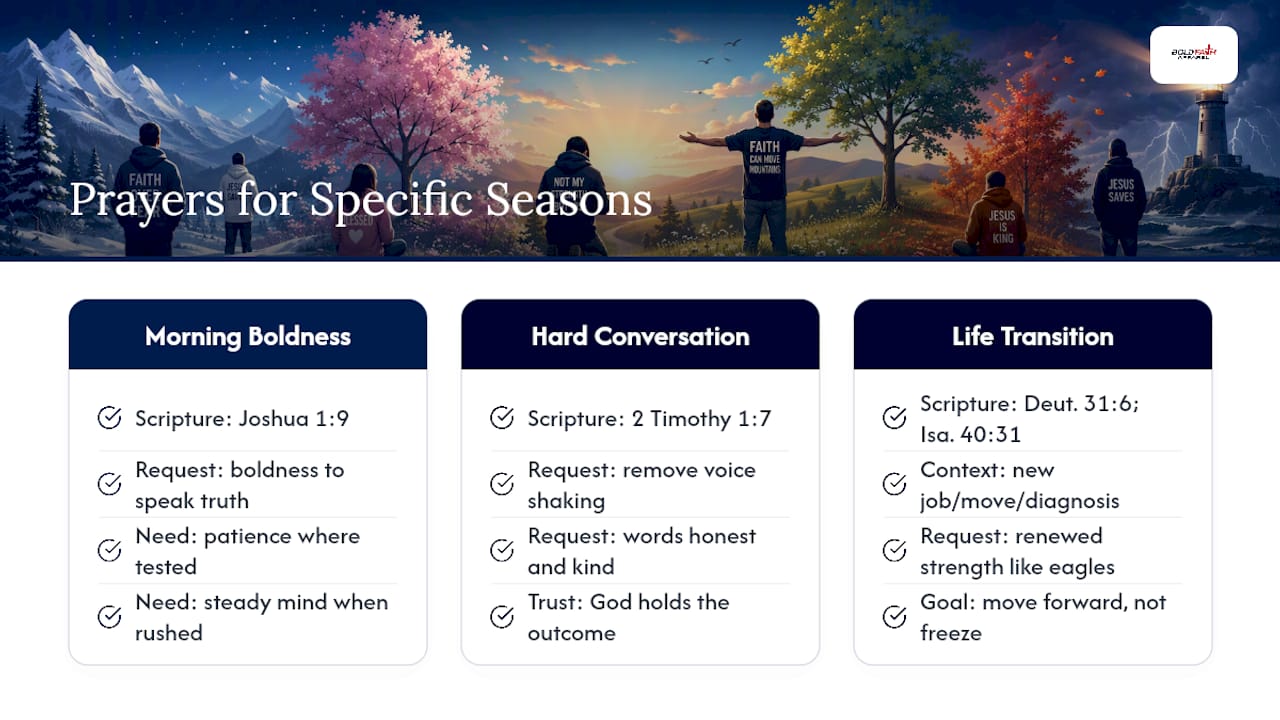
A morning prayer for boldness. “Father, before I face today, I ask for the courage You gave Joshua. You said, ‘Be strong and courageous. Do not be afraid; do not be discouraged, for the Lord your God will be with you wherever you go’ (Joshua 1:9). I don’t know everything today holds, but I know You go ahead of me into it. Give me boldness to speak truth, patience where I’m tested, and a steady mind where I feel rushed. I release today’s outcomes to You and walk into it strong.”
A prayer for courage before a hard conversation. “Lord, I’m about to say something difficult, and my stomach is in knots. You did not give me a spirit of fear, but of power, love, and a sound mind (2 Timothy 1:7). Take the shake out of my voice. Give me words that are honest and kind. Whatever this person says back, remind me that You are holding the outcome, not me. I will not shrink back from truth spoken in love.”
A prayer for courage during a life transition. “God, this season feels like standing at the edge of something unknown, a new job, a move, a diagnosis, a relationship ending. You told Israel, ‘Be strong and courageous, for the Lord your God goes with you; He will never leave you nor forsake you’ (Deuteronomy 31:6). I don’t have to see the whole path to trust the One walking it with me. Renew my strength like an eagle’s wings today (Isaiah 40:31), and let me move forward instead of standing frozen in fear.”
Personalize each of these before you pray them again. Swap “this person” for the actual name of the coworker, parent, or doctor you’re facing. Name the specific transition, the job title, the city, the diagnosis, rather than praying in vague terms. Scripture is precise; let your prayers be too. And say them out loud whenever you can. There’s something different about hearing your own voice declare God’s promises rather than just thinking them.
Bible Verses to Pray and Declare Over Your Fear
Praying courage prayers works best when the words come straight from scripture, not just from your own hopes. Here are the core verses behind nearly every courage prayer you’ll find, along with a short declaration you can speak from each one.
-
Joshua 1:9, “Be strong and courageous. Do not be afraid; do not be discouraged, for the Lord your God will be with you wherever you go.” This verse anchors more courage prayers than almost any other in scripture, largely because it was spoken to a leader facing an impossible assignment, not a comfortable one. Declaration: “I am strong and courageous, because God goes with me.”
-
Isaiah 41:10, “Do not fear, for I am with you; do not be dismayed, for I am your God. I will strengthen you and help you; I will uphold you with my righteous right hand.” Devotional writers repeatedly turn to this verse because it names three separate actions God takes, strengthening, helping, upholding, not just a vague promise of presence. Declaration: “God is upholding me right now with His own hand.”
-
2 Timothy 1:7, “For God has not given us a spirit of fear, but of power and of love and of a sound mind.” A practical courage prayer built on this verse starts by naming the actual fear out loud, then asking God to replace it with these three specific gifts instead. Declaration: “Fear is not mine to keep. Power, love, and a sound mind are.”
-
Psalm 27:1, “The Lord is my light and my salvation; whom shall I fear? The Lord is the strength of my life; of whom shall I be afraid?” This is a question turned into a weapon. David isn’t hoping he won’t be afraid; he’s asking a rhetorical question that answers itself. Declaration: “The Lord is my light. I will not be afraid.”
-
Deuteronomy 31:6, “Be strong and courageous… for the Lord your God goes with you; He will not leave you or forsake you.” Moses spoke this to a whole nation about to cross into unfamiliar territory without their longtime leader. Declaration: “God has not left me, and He will not forsake me.”
-
Isaiah 40:31, “But those who hope in the Lord will renew their strength. They will soar on wings like eagles.” This verse targets a different kind of fear, the exhaustion that makes courage feel impossible because you’re simply worn out. Declaration: “My strength is being renewed. I will not grow weary.”
Praying scripture back to God does something a general prayer can’t. Devotional leaders recommend this practice specifically because it shifts your petition from raw emotion to objective, unchanging biblical truth. Feelings fluctuate hour to hour. A promise God already made doesn’t. When you declare Joshua 1:9 instead of just saying “please help me feel brave,” you’re standing on something outside your own shifting emotions.
How to Pray for Courage: A Five-Step Pattern You Can Repeat
You don’t need a new prayer every time fear shows up. You need one structure you can lean on repeatedly, whether you have twenty minutes or two.
Many prayer guides settle on a version of this same pattern, moving a petition from raw feeling into scripture-anchored confidence. Here’s a five-step version built specifically for courage.
- Stillness. Stop moving for thirty seconds. Close your eyes if you can. Say silently, “I’m here, Lord,” and let your breathing slow before you say anything else.
- Acknowledgment. Name the fear out loud, specifically. Not “I’m anxious” but “I’m afraid this conversation with my boss will go badly.” Vague fear is hard to pray against. Named fear is a target.
- Scripture-based petition. Pick one verse, Joshua 1:9, 2 Timothy 1:7, Psalm 27:1, and pray it directly over the fear you just named. “Lord, You said You have not given me a spirit of fear, so I’m asking You to take this one.”
- Personalization. Add the real names, dates, and details. Who is involved? What is the actual situation? God already knows, but naming it sharpens your own focus and faith.
- Thanksgiving. Close by thanking God before you see the outcome. “Thank You that You’re already in this with me” trains your mind to expect His presence rather than just hope for it.
A two-minute version for urgent moments: Stillness (10 seconds), name the fear in one sentence, speak one verse aloud, add one personal detail, say one line of thanks. That’s it. You can pray this in a parking lot, a bathroom stall, or standing in a hallway before you walk into the room.
Pro Tip: Speak your declarations using “I” statements instead of “maybe” statements. “I am strong and courageous” carries more spiritual weight than “I hope I can be brave.” You’re not being arrogant, you’re agreeing with what God already said about you.
When to Pray These Prayers and Habits That Build Lasting Courage
Courage prayers work best when they’re not reserved for emergencies only. Believers who pray proactively, before the crisis hits, tend to find that scripture and declarations are already rooted when challenges actually arrive, rather than trying to memorize a verse mid-panic attack.
Common moments to pray for courage:
- First thing in the morning, before you know what the day holds
- Right before a difficult conversation, meeting, or confrontation
- During a major transition, a new job, a move, a diagnosis, a breakup
- The moment anxiety spikes and your chest tightens
- Before you have to speak up publicly about your faith
Three habits that root courage deeper than a single prayer can:
- Daily declaration. Speak one courage verse out loud every morning, even on days that feel calm. This builds the habit before you need it.
- Scripture memorization. Memorize Joshua 1:9 and 2 Timothy 1:7 so you can pray them without reaching for your phone or a Bible app mid-crisis.
- A prayer partner. Tell one trusted friend what you’re afraid of and ask them to pray Isaiah 41:10 over you specifically. Accountability turns a private fear into a shared battle.
A simpler, physical version of the same idea: wearing something with a message like Faith Over Fear printed on it. It’s not a substitute for prayer, but a shirt or hoodie you glance at in the mirror can function as a quiet, repeated reminder of a verse you’re trying to live inside of, not just recite once.
Author Perspective: Encouragement From Larry and Bold Faith Apparel
Larry writes with one conviction driving the work: faith that stays private rarely grows bold. Courage prayers matter because they train believers to say out loud what they might otherwise only think quietly, and there’s a real difference between the two.
The brand’s approach to apparel follows that same logic. A hoodie printed with “Not My Strength but His” or a T-shirt reading “Faith Over Fear” aren’t decoration. It’s a repeatable prompt, the same way a memorized verse is a repeatable prompt, pulling your attention back to a promise you might otherwise forget by 10 a.m.
Courage isn’t the absence of fear. It’s naming the fear honestly in prayer and choosing to move forward anyway, because you’ve already decided God’s promise outweighs your feelings. That’s not a slogan. That’s the whole shape of Joshua 1:9.
Bold Faith Apparel exists because visible faith and spoken faith reinforce each other. Neither replaces the other. Prayer builds the conviction. What you wear can help you remember it walked out the door with you.
The Spiritual and Emotional Benefits of Praying for Courage
Praying for courage does more than get you through one hard moment. It retrains how you approach fear the next time it shows up, and the next, and the next.
Emotionally, naming a fear out loud in prayer takes away some of its power. Fear that stays vague and unspoken tends to grow. Fear that gets named specifically, “I’m afraid of this conversation, this diagnosis, this decision,” becomes something you can actually pray against instead of just carry silently.
Spiritually, courage prayers shift your posture from self-reliance to dependence on God’s stated character. You stop asking “do I have what it takes?” and start declaring “God said He goes with me.” That’s a meaningful shift, because your own confidence fluctuates day to day, but God’s promises in Joshua 1:9 and Isaiah 41:10 don’t move.
Over time, believers who pray this way regularly report a kind of settled steadiness, not the absence of fear, but the ability to act despite it. That’s the biblical definition of courage anyway: not fearlessness, but strength and boldness that persist even while fear is present in the room.
Common Doubts About Praying for Courage and How to Answer Them
Plenty of believers hesitate to pray boldly for courage, often for reasons that sound reasonable but don’t hold up under scripture.
“Isn’t it weak to admit I’m afraid?” Naming fear honestly in prayer is not a sign of spiritual failure. It’s the exact starting point 2 Timothy 1:7 addresses, God offering power, love, and a sound mind specifically because fear was already present. You can’t receive a replacement for something you refuse to name.
“What if I pray for courage and still feel scared?” Courage prayers don’t promise the removal of every uncomfortable feeling. They promise God’s presence and strength inside the feeling. David wrote Psalm 27:1 while actively facing enemies, not after they’d disappeared.
“What if I don’t feel like praying at all?” Start with the shortest prayer on this page. Feeling ready isn’t a prerequisite for obedience. Say the words even when they feel mechanical; conviction often follows the practice rather than preceding it.
“Am I asking for something selfish?” Asking God for courage to speak truth, face a diagnosis, or walk into a hard season isn’t self-focused. It’s asking to be equipped to do what He’s already called you to do.
Biblical Examples of Courage That Started in Prayer
Scripture is full of people who prayed first and acted brave second, not the other way around.
Joshua received his marching orders directly from God, “Be strong and courageous,” before he ever led Israel across the Jordan into hostile territory (Joshua 1:9). The command came before the confidence did.
Moses, facing a nation about to enter unfamiliar land without his leadership, spoke Deuteronomy 31:6 as both a promise and a charge, reminding Israel that God’s presence, not their own readiness, was the basis for their courage.
David wrote Psalm 27 while surrounded by enemies, not after they retreated. His declaration that “the Lord is my light and my salvation” was spoken into an active threat, which is exactly what makes it useful as a prayer template today.
Esther fasted and prayed before approaching a king whose response could have cost her life. Her courage wasn’t spontaneous bravado; it followed a deliberate season of prayer and preparation among her people.
Each example shares the same pattern this article has already outlined: acknowledgment of real danger, followed by scripture-rooted confidence, followed by action.
Different Kinds of Courage and How to Pray for Each
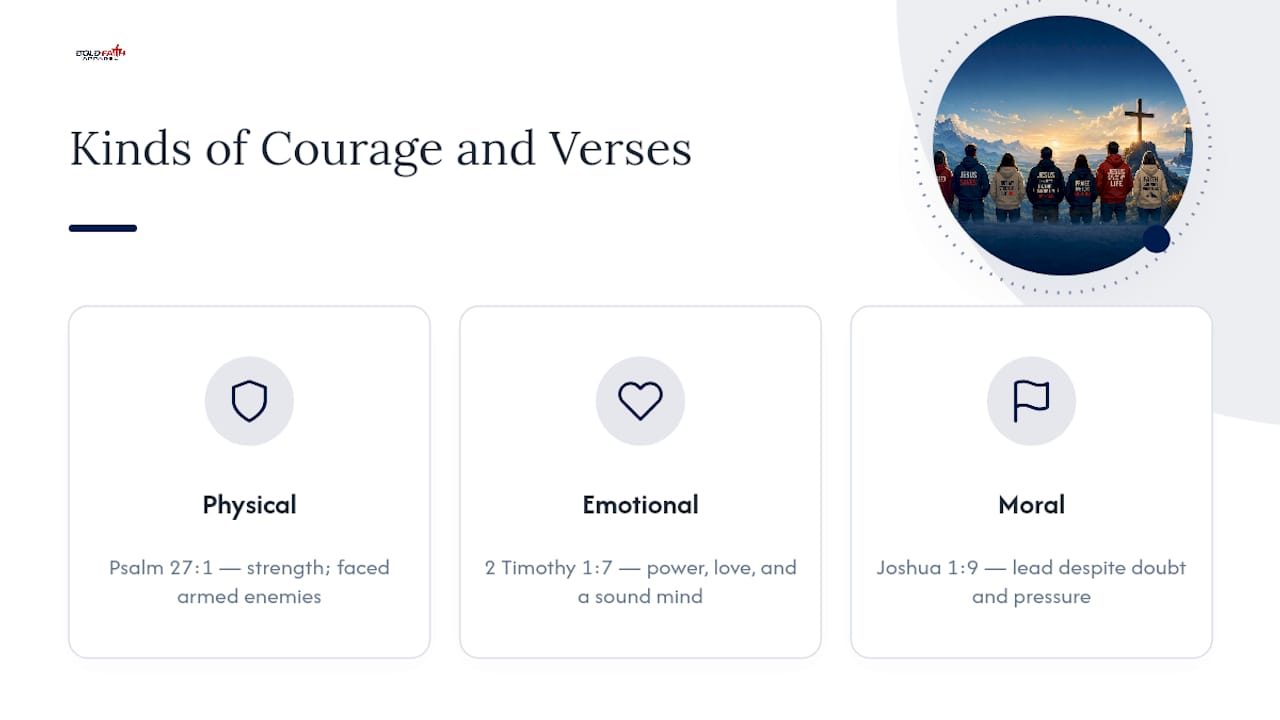
Courage isn’t one single thing you either have or lack. Scripture and daily life both point to at least three distinct kinds, and each response to a slightly different prayer emphasis.
Physical courage covers situations involving actual risk to your body or safety, a medical procedure, a dangerous job, a physically threatening situation. Pray Psalm 27:1 directly here: “The Lord is the strength of my life; of whom shall I be afraid?” This verse was written by someone facing literal armed enemies.
Emotional courage covers the fear of vulnerability, grief, rejection, or heartbreak, situations where nothing physical threatens you but everything inside you wants to shut down. 2 Timothy 1:7’s promise of “power, love, and a sound mind” speaks directly to this, since emotional fear often clouds clear thinking most of all.
Moral courage covers the fear of speaking truth, standing against popular opinion, or representing your faith publicly when it’s unpopular to do so. Joshua 1:9 fits here powerfully, since Joshua’s assignment wasn’t physically dangerous in the moment; it was the weight of leading a whole nation into obedience despite doubt and pressure.
Praying the matching verse for the matching fear sharpens your prayer. A vague “give me courage” prayer works fine in a pinch, but naming which kind of courage you need lets you reach for the verse that speaks most directly to it.
What the Research and Scripture Actually Point To
Larry’s take: most advice on facing fear tells you to “just be brave,” as if courage were a personality trait some people have and others don’t. Scripture never frames it that way. Every biblical example of courage, Joshua, Moses, David, Esther, follows the same order: acknowledge the fear honestly, then pray scripture over it, then act. Bravado skips step one. Courage prayers don’t.
The conventional wisdom that courage means feeling fearless is backwards. Psalm 27:1 was written in the middle of real danger, not after it passed. What the reader should prioritize first isn’t finding the perfect prayer, it’s building the habit of naming fear out loud and answering it with a specific verse before the crisis, not during it. A daily rhythm beats a one-time emergency prayer every time.
— Larry
A Simple Reminder Worth Wearing
Prayer does the real work. But a visible reminder, something you see in the mirror or feel against your skin, can help a verse stay present in your mind long after the prayer ends. That’s the whole idea behind Boldfaithapparel’s Christian T-shirts and hoodies: everyday clothing carrying messages like “Faith Over Fear”, “Faith Can Move Mountains”, and “Not My Strength but His”.

These aren’t required for courage prayers to work, scripture and prayer are what matter most. But if you’re the kind of believer who wants a daily nudge toward boldness, a Faith Over Fear hoodie or a scripture-printed sweatshirt can serve the same purpose a sticky note on your mirror does, just louder, and worn in public. Browse the full collection and pick a message that matches the verse you’re praying this week.
Primary Sources and Further Reading
- Christianity, scripture and devotional resources covering courage and simple prayers
- BibleHint — Prayer for Courage, verse-based courage prayer guide
- PrayerPrompt — Prayer for Strength and Courage, scripture-declaration prayer method
- Jomo Cousins — Prayer for Courage Over Fear, practical prayer emphasizing naming fear honestly
- Catholic Online — Prayer For Courage, traditional prayer-book phrasing for readers from liturgical backgrounds
- PrayerKey — Prayer for Courage, a longer prayer model with structured prompts
Sources
- Christianity
- BibleHint — Prayer for Courage
- PrayerPrompt — Prayer for Strength and Courage
- Jomo Cousins — Prayer for Courage Over Fear
FAQ
What is a good prayer for courage?
A good courage prayer names your fear honestly, then declares a specific promise like Joshua 1:9 or 2 Timothy 1:7 back to God, asking Him to replace fear with strength.
What is a simple but powerful prayer?
“Lord, You have not given me a spirit of fear, but of power, love, and a sound mind. I choose that now” (based on 2 Timothy 1:7) works as a short, honest prayer for nearly any fearful moment.
What Bible verse can I pray for strength and courage?
Joshua 1:9, Isaiah 41:10, and 2 Timothy 1:7 are the three most commonly prayed verses for strength and courage, each addressing fear from a slightly different angle.
What is a good psalm for courage?
Psalm 27:1 is the psalm most often prayed for courage, since David wrote it while actively facing danger rather than after it had passed.
How do I personalize a courage prayer for my situation?
Replace general language with specific names, dates, and details, the person you’re confronting, the diagnosis you’re facing, then speak the relevant scripture directly over that named situation aloud.


