

The Great Commission is Jesus’ final charge in Matthew 28:18 to 20: make disciples of all nations. Everything else in the passage, going, baptizing, and teaching, describes how that command gets carried out, not a separate to-do list. Jesus backs the command with a promise: “I am with you always, to the end of the age.” What follows unpacks what that means for how you actually live it.
TL;DR:
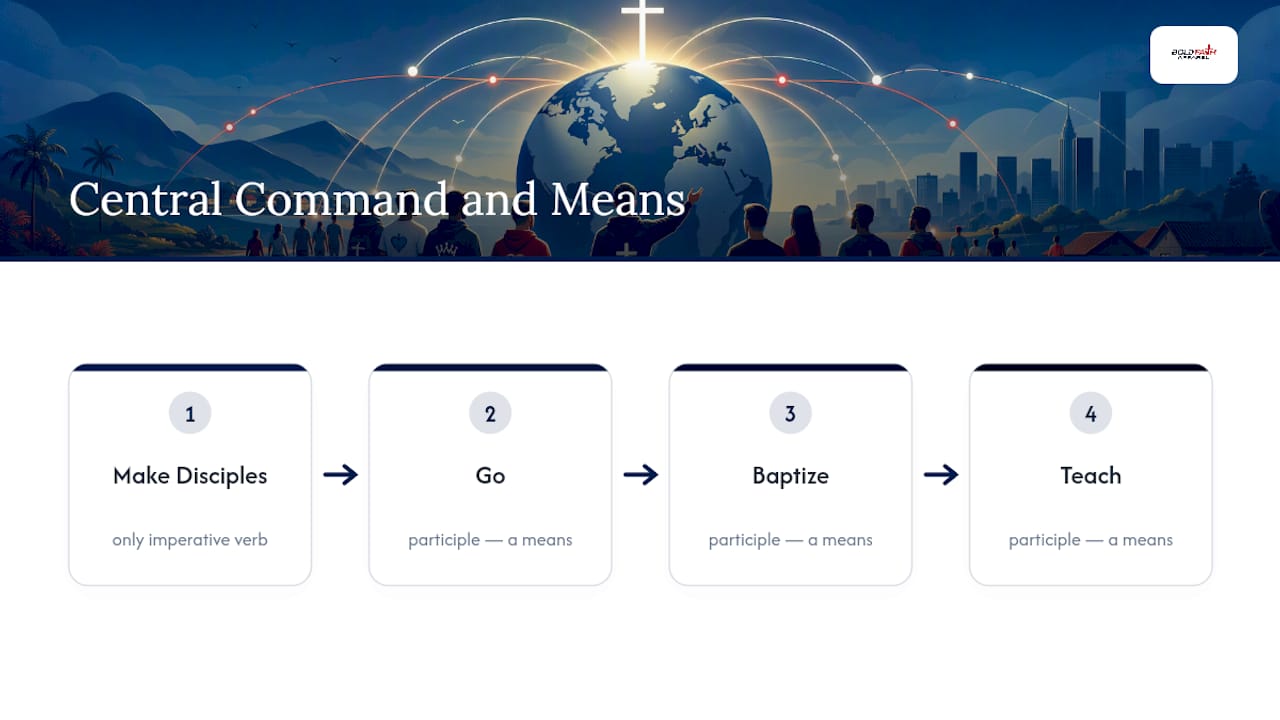
- The command to make disciples is the only imperative in Matthew 28:19, with going, baptizing, and teaching serving as means rather than separate tasks.
- Discipleship involves relational, ongoing effort focused on individuals in your immediate environment, not just large outreach events or mission trips.
- The mission continues today because most unreached people groups still exist, and every believer is mandated to participate, not just pastors or missionaries.
- Obedience depends on realizing the authority of Jesus over heaven and earth and actively linking baptism and teaching to the process of discipleship.
- Practical steps include praying specifically, identifying one person to disciple, starting simple routines, and focusing on multiplication rather than addition.
Table of Contents
- What Does Matthew 28:18 to 20 Actually Say?
- How Do Mark, Luke, John, and Acts Complete the Picture?
- Why Is “Make Disciples” the Only Command in the Greek Text?
- What Does the Great Commission Require of the Church?
- How Do You Actually Live Out the Great Commission?
- Has the Great Commission Been Fulfilled, and Who Is It For?
- What Are 6 Practical Steps to Start This Month?
- A Bold Take on What This Commission Costs You
- Wear Your Witness: Apparel That Opens the Door
- Sources
- FAQ
What Does Matthew 28:18 to 20 Actually Say?
The scene is Galilee, the same region where Jesus first called these men to leave their nets. Matthew places the risen Christ back on familiar ground before sending the disciples somewhere far less familiar. The text reads:
- “All authority in heaven and on earth has been given to me.”
- “Go therefore and make disciples of all nations, baptizing them in the name of the Father and of the Son and of the Holy Spirit.”
- “Teaching them to observe all that I have commanded you.”
- “And behold, I am with you always, to the end of the age.”
Jesus opens with authority, not instruction. That order matters. A commissioning scene in a first century Jewish context would have expected a rabbi to send disciples with some derived authority, but Jesus claims total authority over heaven and earth before he says another word. The mission that follows isn’t a suggestion from a wise teacher. It’s a directive from the one holding cosmic authority, and Matthew’s Gospel frames disciple-making as the ongoing work of the gospel itself, not a historical footnote closed out at the resurrection.
How Do Mark, Luke, John, and Acts Complete the Picture?
Matthew isn’t the only place this commission shows up. Each Gospel writer, plus Luke again in Acts, captures a different angle of the same sending, and together they give the fuller shape of what Jesus expected his followers to do next.
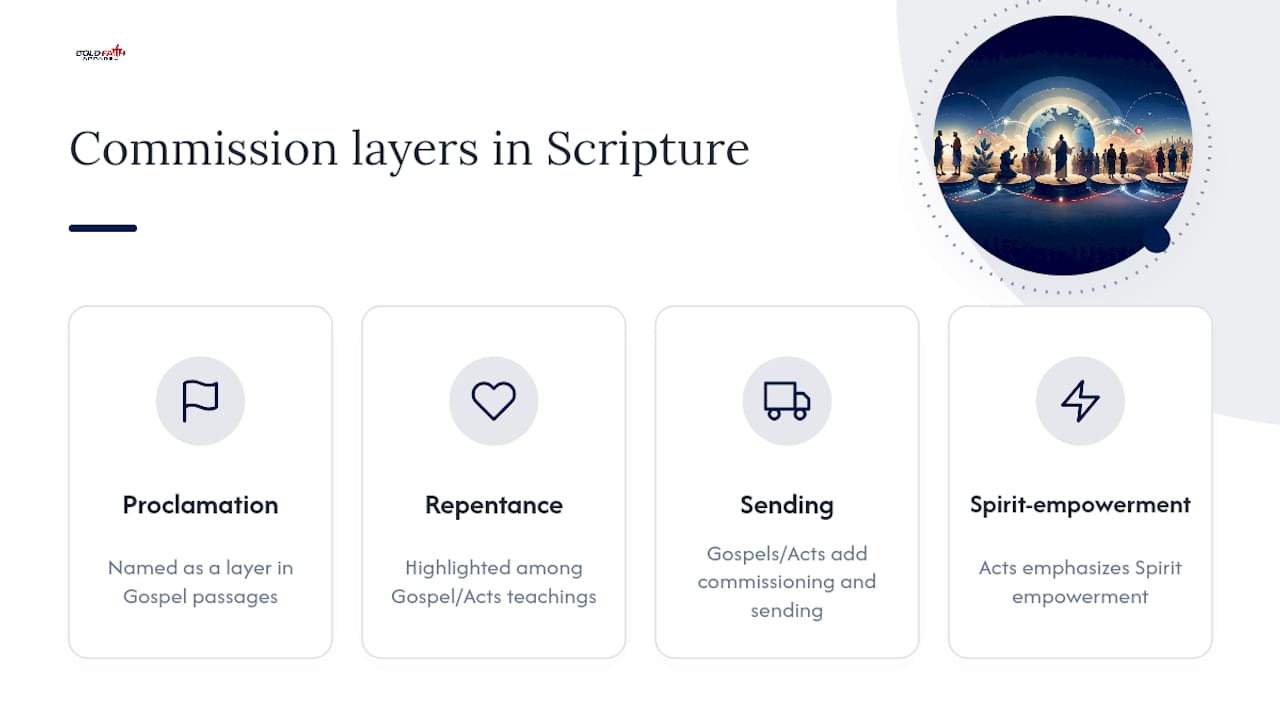
- Mark 16:15 frames it as proclamation: “Go into all the world and proclaim the gospel to the whole creation.”
- Luke 24:46 to 49 ties the mission to repentance and forgiveness of sins, preached “to all nations,” and tells the disciples to wait in Jerusalem for power.
- John 20:21 grounds the sending in Jesus’ own pattern: “As the Father has sent me, even so I am sending you.”
- Acts 1:8 names the mechanism: “You will receive power when the Holy Spirit has come upon you, and you will be my witnesses… to the end of the earth.”
The Great Commission refers to this whole cluster of instructions, not just the Matthew 28 wording, and the parallel passages reinforce each other rather than compete. Mark stresses the message, Luke stresses repentance and patience, John stresses the pattern of being sent, and Acts explains where the power actually comes from. Read together, they answer a question Matthew alone leaves open: how do ordinary people manage a task this large? Acts 1:8 answers it. The Spirit does the empowering. The disciples just show up obedient.
Why Is “Make Disciples” the Only Command in the Greek Text?
Here’s something most casual readings miss entirely. In the Greek of Matthew 28:19 to 20, there’s exactly one imperative verb: “make disciples” (matheteusate). “Go,” “baptizing,” and “teaching” are all participles, grammatically subordinate forms that describe the means by which disciple-making happens, not separate commands standing on equal footing.
That distinction changes how you read the whole passage. You’re not given four equal jobs. You’re given one job, with three built-in methods for doing it.
“Make disciples” carries the grammatical weight of the sentence. Going, baptizing, and teaching are how it gets done, not additional assignments competing for your attention.
Greek grammar scholar Daniel B. Wallace has made this point at length: prioritizing “going” or casual witness over intentional disciple-making misreads the text. You can go somewhere and never make a disciple. You can’t obey the actual command without eventually baptizing and teaching someone, because those are simply what disciple-making looks like in practice.
Pro Tip: Before you plan an outreach event or a mission trip, ask a sharper question first: who, specifically, will I disciple as a result of this? “Going” without a name attached to it usually stays theoretical.
What Does the Great Commission Require of the Church?
Jesus doesn’t send his followers on their own authority. He sends them on his, and that single fact reshapes three things the church has to take seriously if it wants to obey Matthew 28 honestly rather than selectively.
Authority precedes mission. The commission only makes sense because the one giving it already holds “all authority in heaven and on earth.” Every disciple-making effort operates under borrowed authority, not personal initiative, which is part of why the ESV’s cross-reference notes describe this passage as “the King’s Commission” rather than a personal call to adventure.
“All nations” means the scope is not optional. The Greek panta ta ethne points to every people group, not just geographic distance. A church that disciples only people who already look, vote, and talk like its members hasn’t actually engaged the nations. It’s engaged its own neighborhood and called that obedience.
Baptism and teaching form disciples; they don’t just record decisions. Baptism marks entry publicly. Teaching (didasko) is ongoing, ordering someone’s whole life around what Jesus commanded, not a single class or a single sermon. One theological reading notes that Matthew’s linking of Trinitarian baptismal language with sustained teaching makes disciple-making both relational and, in many traditions, sacramental.
The Great Commission is recorded in several passages across the four Gospels and Acts, each adding a different layer, such as proclamation, repentance, sending, and Spirit-empowerment, to the overall teaching.
How Do You Actually Live Out the Great Commission?
Discipleship rarely starts with a plane ticket. It starts with a name you already know: a neighbor, a coworker, a sibling who needs someone to walk with them consistently rather than just talk at them once.
- Notice who’s already around you. The nations Jesus meant are showing up in your break room and your cul de sac.
- Start small and consistent. A weekly conversation over coffee outpaces a one-time gospel presentation almost every time.
- Build church practices around multiplication, not just addition. Baptism, follow-up teaching, and church planting are how sustained discipleship actually happens rather than a single decision moment.
- Keep it relational. Daily rhythms of discipleship matter more than grand gestures.
Pro Tip: Pick one person this month. Not a project, not a program. One person you’ll pray for, meet with, and teach obedience to Christ alongside, on purpose.
Has the Great Commission Been Fulfilled, and Who Is It For?
Two questions come up constantly, and both deserve a straight answer instead of a dodge.
Has it been fulfilled? Some preterist readings argue the commission was substantially completed as the gospel spread through the first century Roman world. Most evangelical scholars, along with broader historical surveys of the debate, hold the futurist position instead: the mission continues until Christ returns, since entire people groups remain unreached today.
Is it for every believer, or just the original eleven apostles? Evangelical theology overwhelmingly reads it as a standing mandate for every Christian, not a job description limited to first century apostles or paid missionaries.
Two common misapplications show up often:
- Treating a single conversion moment as the finish line instead of the starting point for teaching and formation.
- Outsourcing disciple-making entirely to pastors or missionaries, as if ordinary believers were exempt.
Both miss what “teach them to observe” actually demands: ongoing, personal involvement.
What Are 6 Practical Steps to Start This Month?
You don’t need a seminary degree or a plane ticket to begin. You need obedience in the next thirty days.
- Pray specifically for Spirit-led opportunities rather than vague courage.
- Identify one or two people already in your regular orbit, work, family, gym, church.
- Start a simple rhythm: read a short passage together, pray, and follow up on whether they obeyed what they read.
- Invite them toward baptism and church commitment when they’re ready, not as a formality but as the public marker Matthew describes.
- Commit to ongoing teaching, not a single conversation, over months.
- Train that person to repeat the process with someone else. Multiplication, not addition, is the actual metric of success.
Pro Tip: Write down the name of the person you’ll invest in this month before you finish reading this article. A commission this specific deserves a name attached, not just good intentions.
A Bold Take on What This Commission Costs You
The Great Commission was never designed for comfort. Jesus led with authority, not encouragement, because he knew obedience would cost something real: reputation, convenience, and sometimes safety. What strikes me most is how often churches shrink “make disciples” down to attending an event, when the Greek text points to something far more personal and far more permanent. Bold, visible faith isn’t a personality trait some Christians have and others don’t. It’s the natural outflow of taking this command seriously. Start with one person. Let your life, and yes, even how you dress and what you’re willing to be seen wearing, say something true about who you follow.
— Larry
Wear Your Witness: Apparel That Opens the Door
Boldfaithapparel exists for the moments right after this article ends, when you’re standing in line, at the gym, or picking up your kids, and someone asks about the shirt you’re wearing. That’s a conversation starter most outreach programs can’t manufacture, and it costs you nothing but the willingness to put it on.

Bold Faith Apparel’s product lines are built around messages that do exactly that: Men’s T-Shirts and Women’s T-Shirts carrying phrases like “Faith Over Fear” and “Jesus is King,” Hoodies and Sweatshirts featuring bolder statements like “Jesus Saved My Life” or a full Bible verse hoodie referencing “Jesus Paid It All,” and Caps printed with simple, unmissable declarations like “Jesus Saves” or “I Love Jesus.” This apparel doesn’t fulfill the Great Commission for you. It’s a tool, one small, wearable prompt that can open a gospel conversation you’d otherwise never have. Browse the full collection at Boldfaithapparel, where every product ships with free delivery, and let your next shirt do some of the inviting for you.
Sources
For readers who want to go deeper than this overview:
- What is the Great Commission? — The Bible Seminary
- Great Commission — Encyclopedia of the Bible (BibleGateway)
- Matthew 28 and the Great Commission — Forge
- What is the Great Commission? — ABWE
FAQ
Has the Great Commission Been Fulfilled?
Most evangelical scholars say no. The mission continues until Christ returns, since entire people groups remain unreached, though some preterist interpreters argue it was substantially completed in the first century.
What Was the Main Message of the Great Commission?
The core command is to make disciples of all nations, carried out through baptizing and teaching, under the authority Jesus claims in Matthew 28:18 to 20.
Does the Great Commission Apply to Every Christian?
Yes. Evangelical theology generally treats it as a standing mandate for all believers, not a task limited to pastors, missionaries, or the original apostles.
What Are the Five Great Commissions in the Bible?
Scholars typically point to five commissioning passages: Matthew 28:18 to 20, Mark 16:15, Luke 24:46 to 49, John 20:21, and Acts 1:8, each emphasizing a different aspect of the same sending.
Does Bold Faith Apparel Sell Products Related to This Message?
Yes. Bold Faith Apparel offers T-shirts, hoodies, sweatshirts, and caps carrying Christian messages and Bible verses, available at Boldfaithapparel with free delivery.


